Manba Finance Ltd FY26: The Two-Wheeler Lender Pulling a High-Yield Balancing Act
Section 1 — At a Glance
Manba Finance Ltd closed its fiscal year 2026 with an Asset Under Management (AUM) scaling to ₹1,712.70 crore. Driven by a 16.0% expansion in annual disbursements to ₹976.90 crore, the lender capitalised on resurgent two-wheeler credit demand and an aggressive multi-state dealership push. Net profit for the year jumped 20.1% to ₹45.36 crore, up from ₹37.80 crore in the prior fiscal year. Net Interest Income (NII) kept pace, expanding 24.3% to ₹161.60 crore on the back of a robust Gross Yield of 22.85% across its core vehicle loan books.
While top-line trajectories remain a favorite anchor for public markets, asset quality trends continue to keep risk desks heavily occupied. Gross Non-Performing Assets (GNPA) ticked upwards to 3.33% from 3.23% year-on-year, though showing selective signs of sequential cooling from the 3.38% recorded in December 2025. Net NPA held relatively stable at 2.46%. To absorb incoming volatility from its predominantly self-employed customer segment, management stepped up balance sheet buffers, scaling its Provision Coverage Ratio (PCR) to 26.00%. Gearing levels rose significantly as the company expanded its leverage footprint, with borrowings moving to ₹1,555.60 crore. The structural challenge for retail lenders remains absolute: rapid operational scaling in unseasoned geographies routinely strains collection efficiency before local distribution reach achieves steady state. Investors are closely watching how efficiently this high-yield book preserves capital as it dilutes its historic home-state concentration.
Section 2 — Introduction
Manba Finance Ltd, established in 1996 by first-generation entrepreneur Manish Shah, has transitioned from acting as a Direct Selling Agent (DSA) for private banking giants into building an independent retail asset book. The company completed its public listing on the NSE and BSE on September 30, 2024, raising ₹151 crore to support its capital base and expand its geographical footprint.
Historically a pure-play retail vehicle financier focused on urban and semi-urban clusters, Manba exists today as a high-yield regional player chasing cross-country diversification. The company operates a network spanning 130 physical locations and over 1,500 active dealerships across six states. This article evaluates the structural realities underlying Manba’s latest full-year earnings print, the operational leverage generated by its digital loan manufacturing architecture, and the asset quality trade-offs inherent to an expanding, secured retail credit framework.
Section 3 — Business Model: WTF Do They Even Do?
Manba Finance is effectively a retail credit factory that turns high-interest dealer relationships into vehicle loans. The company functions as a non-deposit-taking, non-systemically important NBFC. It targets under-penetrated, self-employed retail borrowers who require rapid turnaround times for lifestyle and utility assets.
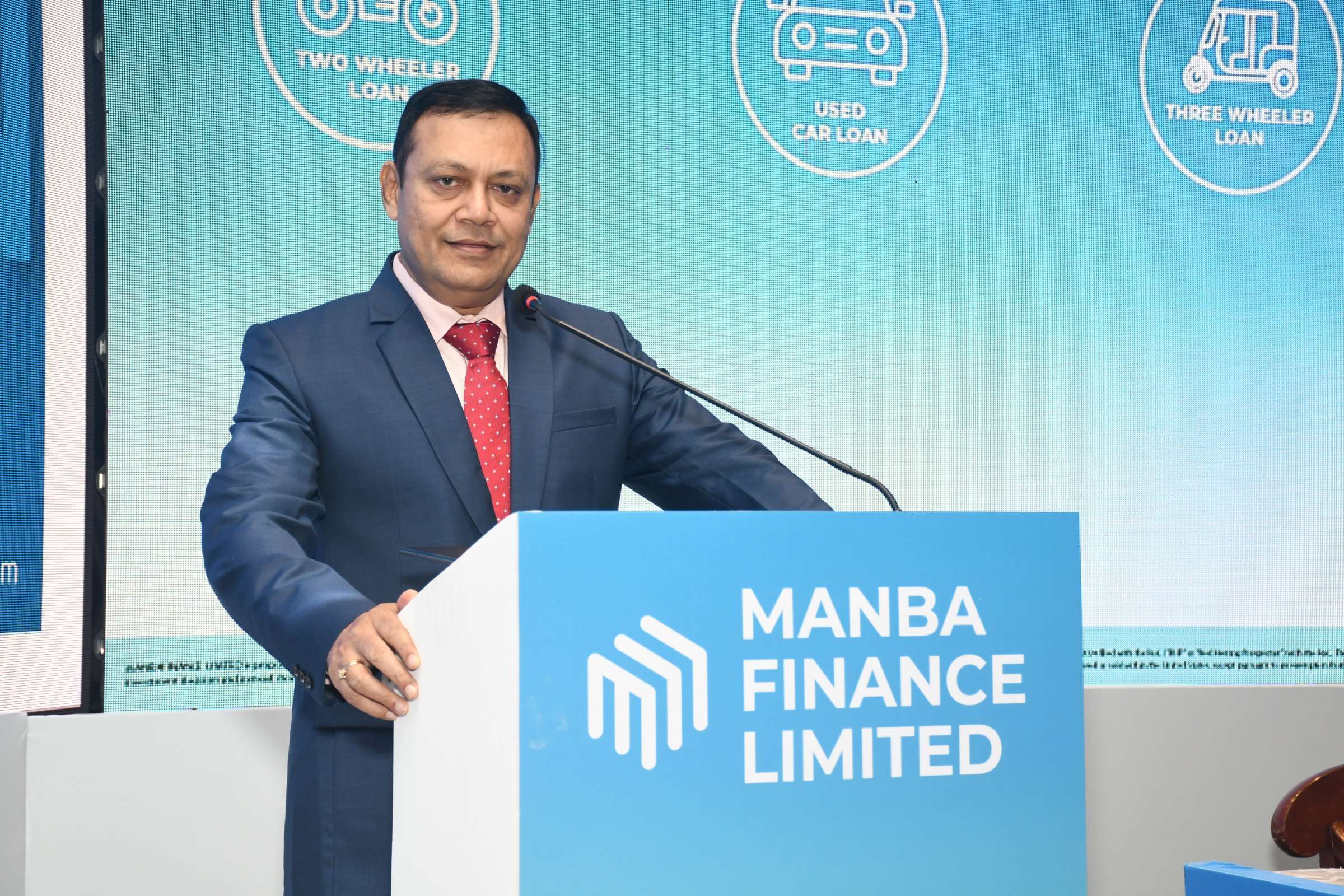
The core machine relies on an in-house digital loan origination engine. This setup bypasses traditional branch documentation bottlenecks to approve over 60% of applications within 60 seconds. While two-wheeler loans continue to dominate the credit mix at 84.5% of total AUM, the business model is deliberately introducing structural counterweights. These include three-wheeler financing (3.28%), used vehicle portfolios (1.50%), and emerging secured product verticals like the newly deployed MSME Loan Against Property (LAP) and small business variants. The underlying economic model relies on capturing hefty yields (averaging 22.85%) from secured exposures, using physical vehicle repossession infrastructure as its ultimate credit backstop.
Section 4 — Financials Overview
Figures are consolidated, in ₹ crore.
Quarterly & Annual Trend Performance
The table below illustrates the financial progression of Manba Finance Ltd over the final quarter of FY26 and the full-year performance relative to previous benchmarks.