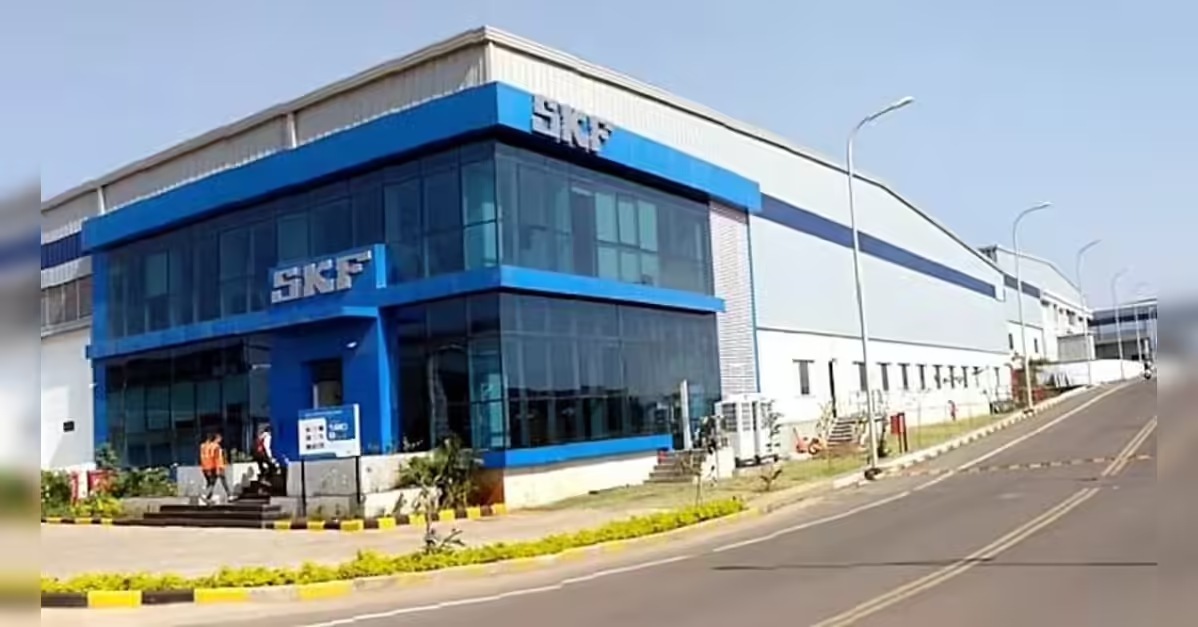
At a Glance – The Industrial Powerhouse Unleashed
SKF India (Industrial) Ltd isn’t just another bearing company; it is the newly carved-out heart of a global engineering titan, now standing on its own two feet. Following a high-stakes demerger from SKF India Limited in late 2025, this entity has taken over the high-margin, heavy-duty industrial soul of the business. While the markets often fear the “divorce” of two business segments, the numbers here suggest a focused predator is emerging.
In the latest quarter, the company clocked a massive 31.2% YoY revenue growth, reaching ₹946 crore (₹9,457 mn). This isn’t just organic growth; it is a statement of intent. The industrial segment is winning projects in railways, renewables, and heavy engineering—sectors where precision is non-negotiable. However, the headline “Net Profit” might scare the weak-hearted. Because of one-time demerger costs, IT integration, and stamp duties on land transfers, the bottom line has been a rollercoaster of exceptional items.
Investors are currently staring at a company with zero debt and a ROCE of 56.4%. Let that sink in. For every rupee of capital employed, the company is generating 56 paise in return. That is elite-tier efficiency, usually reserved for asset-light tech firms, not heavy industrial manufacturers. But there is a catch—the demerger transition is messy. Exceptional items worth ₹196 crore (₹1,961 mn) were flushed through the system this year to clean up the books.
The company is now aggressively expanding. With a planned capex of ₹800–950 crore by 2030 and a new manufacturing facility in Pune slated for 2028, the management isn’t just looking at the next quarter; they are building a fortress for the next decade. The stock currently trades at a P/E of 28.4, significantly lower than the industry average of 54.4. Is the market missing the forest for the trees, or is the demerger baggage heavier than it looks?
Introduction – The New Chapter of a Century-Old Legacy
The demerger of SKF India into two separate entities—Automotive and Industrial—was a surgical move to unlock value. SKF India (Industrial) Ltd, the subject of our audit today, is the entity that houses the “tough” stuff: rolling bearings, seals, mechatronics, and lubrication systems for the backbone of the economy.
Listed formally in December 2025, the company had a chaotic birth in the public markets. The transition involved moving thousands of employees, thousands of suppliers, and over 40 industry verticals into a new corporate structure. The “Appointed Date” was set as October 1, 2025, making the current FY26 results the first real glimpse into the independent health of this industrial beast.
The narrative here is simple: Industrial businesses usually command higher margins and better “stickiness” than automotive ones. While an automaker might squeeze a bearing supplier for every penny, a cement plant or a railway operator pays for reliability and downtime prevention. SKF Industrial is betting that by separating from the automotive side, it can move faster, invest more in localization (the “ACES” strategy), and capture the massive Indian infrastructure upcycle.
We are looking at a company that serves everything from Vande Bharat trains to giant tractors. The scale is massive: 1,700+ employees and a supply chain involving 2,000+ partners. But as any detective will tell you, the most interesting parts of a story are found in the fine print of the transition period.
Business Model – WTF Do They Even Do?
If it moves and it’s heavy, SKF Industrial probably makes sure it doesn’t grind to a halt. They are in the business of friction management.
- Bearings and Units: These are the bread and butter. From super-precision bearings for high-speed machines to “slewing” bearings that allow giant cranes to rotate.
- Sealing Solutions: Because if grease leaks out or dust gets in, the machine dies. They sell the “protection” that keeps heavy equipment alive in miserable conditions.
- Lubrication Systems: They don’t just sell the oil; they sell the automated systems that “pulse” the right amount of grease at the right time. It’s the “circulatory system” of a factory.
- Mechatronics: This is where things get nerdy. They combine mechanical engineering with electronics to create actuators and sensors that tell a factory manager when a part is about to fail.
The genius of the model is the Aftermarket. Once a bearing is installed in a steel mill, it will eventually wear out. The customer then has two choices: buy a cheap knock-off and risk a million-dollar breakdown, or buy the original SKF replacement. Most choose the latter. This creates a recurring revenue stream that is much more stable than just selling to new factories.
They call their roadmap the ACES Strategy: Accelerate localization, Commercial excellence, Execution, and Single SKF. Translation? They want to make everything in India to avoid import duties and be the “one-stop shop” for any industrial engineer who doesn’t want their machines to explode.
Financials Overview – The Real Story Behind the “Loss”
Calculating the value of a recently demerged company is like trying to weigh a moving train. We have to strip away the “one-time” noise to see the engine.
Quarterly Performance Comparison (₹ in Million)
| Metric | Q4 FY26 (Latest) | Q3 FY26 (Prev) | Q4 FY25 (YoY) | Change (YoY) |
| Revenue | 9,457.2 | 8,609.5 | 7,206.1 | +31.2% |
| EBITDA | 811.2 | 1,079.9 | 1,607.7 | -49.5% |
| Net Profit (PAT) | 1,189.7 | (500.9) | 1,213.1 | -1.9% |
| EPS (Annualised) | 96.0 | (40.4) | 98.0 | -2.0% |
Audit Note: The “Net Profit” in Q4 looks high because of a massive tax adjustment of ₹556.6 million related to the pre-demerger period. If you look at the Profit Before Tax (PBT), it was ₹899.7 million, a significant recovery from the ₹(671.4) million loss in Q3, which was buried under ₹1,800.8 million of demerger expenses.
Management “walked the talk” on growth, delivering 31% YoY revenue jump, but the demerger expenses (IT costs, stamp duty, professional fees) hit the margins harder than a sledgehammer. The OPM (Operating Profit Margin) dropped from 22% last year to 9% this quarter. Is this a permanent decay or just the cost of “corporate surgery”?
Valuation Discussion – Fair Value Range
To value SKF Industrial, we must ignore the skewed trailing P/E and look at the “normalized” earning power of the independent industrial business.
1. P/E Method
The Industry P/E is 54.4. SKF Industrial’s current P/E is 28.4. However, our annualised EPS (based on Q4 normalized for tax) sits around ₹80-90.
- Calculation: ₹85 (Est. EPS) × 35 (Conservative P/E) = ₹2,975.
2. EV/EBITDA Method
With an Enterprise Value of ₹9,980 crore and a normalized EBITDA (stripping demerger costs) of roughly ₹500 crore per annum (based on recent quarters), the stock trades at roughly 20x EV/EBITDA.
3. DCF (Discounted Cash Flow)
Assuming a 12% growth rate (in line with industrial GDP + localization) and a terminal growth of 4%, with the massive planned capex of ₹950 crore fueling future capacity.
Fair Value Range: ₹2,450 — ₹3,100
Disclaimer: This fair value range is for educational purposes only and is not investment advice.
What’s Cooking – News, Triggers, Drama
The demerger drama is mostly in the rearview mirror, but the kitchen is still hot. In February 2026, the board approved a brand new plant in Pune. This isn’t just a shed; it’s a ₹653 crore (6,535 MINR) investment that adds 8 new manufacturing “channels.”
The drama? The company just saw its Company Secretary, Ranjan Kumar, jump ship in January 2026, replaced by Ms. Poorva Bang. Leadership churn during a demerger is common, but always worth a raised eyebrow.
The biggest trigger is the Railway boom. SKF just bagged a project for local commuter trains (Vande Bharat style) developing TBU (Tapered Bearing Units) that can handle 21 tons instead of 18. This is high-tech, high-margin territory. If India keeps building trains, SKF keeps spinning.
Balance Sheet – Clean as a Whistle (Mostly)
The balance sheet is the strongest part of the SKF story. After the demerger, they walked away with the crown jewels and almost zero debt.
Consolidated Balance Sheet (₹ in Million)
| Row | Mar 2026 (Latest) | Mar 2025 |
| Total Assets | 26,745.0 | 19,147.3 |
| Net Worth | 14,768.5 | 13,110.4 |
| Borrowings | 45.7 | 0.0 |
| Other Liabilities | 11,930.8 | 6,036.9 |
| Total Liabilities | 26,745.0 | 19,147.3 |
- Borrowings? What Borrowings? The company is essentially debt-free with just ₹4.5 crore in “leash” liabilities.
- Asset Heavy or Asset Right? Total assets jumped by over ₹700 crore, mostly due to the “Other Assets” and CWIP (Capital Work In Progress) as the new Pune plant starts eating cash.
- The liability spike: Other liabilities doubled to ₹1,193 crore. A big chunk of this is “provisions” and “payables”—basically the company using its suppliers’ money to fund operations. Smart, but keep an eye on it.
Cash Flow – Sab Number Game Hai
Cash is the only truth in a world of “exceptional items” and “tax adjustments.”
Cash Flow Summary (₹ in Million)
| Year | Operating CF | Investing CF | Financing CF |
| Mar 2026 | 1,638.4 | (460.8) | (17.2) |
| Mar 2025 | (177.5) | (19.8) | (2.7) |
The company generated ₹163.8 crore from operations this year. This is impressive considering they paid out over ₹105 crore in direct taxes and moved mountains of inventory to set up the new entity. They are plowing money into “Investing Activities” (₹46 crore) to build that Pune plant. The cash conversion cycle is 56 days—not lightning fast, but healthy for a heavy industrial player.
Ratios – Sexy or Stressy?
The ratios tell a story of a high-performance machine that is currently being recalibrated.
| Ratio | Value | Verdict |
| ROE | 50.3% | Absolutely Sexy. |
| ROCE | 56.4% | God-tier efficiency. |
| Debt to Equity | 0.00 | Auditor’s dream. |
| Current Ratio | 1.75 | Safe as a vault. |
| P/B Value | 7.14 | A bit pricey, but quality costs. |
Witty Judgement: An ROCE of 56% usually means the company has a “moat” wide enough to fit a Vande Bharat train. It suggests that competitors can’t easily replicate their precision or their distribution network.
P&L Breakdown – Show Me the Money
Let’s look at the three-year trajectory (including the “Demerged Undertaking” history).
| Year | Revenue (₹ Cr) | EBITDA (₹ Cr) | PAT (₹ Cr) |
| Mar 2026 | 3,440 | 390 | 218 |
| Mar 2025 | 721 (4 months) | 161 | 121 |
| Mar 2024 | N/A | N/A | N/A |
Revenue is scaling beautifully, but the OPM (Operating Profit Margin) dropped from 22% in the partial year of 2025 to 11% in 2026. Why? Because being an independent company is expensive. You need your own IT, your own HR, and your own legal team. The “stand-up comedy” here is that they spent nearly ₹200 crore just on “Exceptional Items” to tell the world they are now independent.
Peer Comparison – The Bearing Battle
Who else is trying to spin the world?
| Company | Revenue (Qtr ₹ Cr) | PAT (Qtr ₹ Cr) | P/E | ROCE |
| SKF India Indus | 946 | 119 | 28.4 | 56.4% |
| Timken India | 764 | 50 | 61.4 | 20.9% |
| Grindwell Norton | 842 | 119 | 47.7 | 22.7% |
| SKF India (Auto) | 594 | (20) | 52.8 | 13.3% |
The Roast: Timken India is trading at double the P/E of SKF Industrial while having less than half the ROCE. Meanwhile, the “Parent” (SKF India Auto) is struggling with negative profits while the “Child” (Industrial) is printing money. It looks like the Industrial business got the Ferrari in the divorce settlement, and the market hasn’t realized it yet.
Miscellaneous – Shareholding and Promoters
- Promoters (AB SKF): Hold 52.58%. They are Swedish, they are disciplined, and they don’t like debt.
- DIIs: A massive 29.72%. HDFC Mid-Cap and Mirae Asset are sitting heavy here. Smart money likes stability.
- Public: Only 12.83%. This is a “tight” stock. When it moves, it moves fast because there isn’t much float.
Promoter Roast: The Swedish masters at AB SKF decided to split the baby to make it grow faster. It’s a classic “Value Unlock” play. They’ve successfully transferred the industrial “burden” (and the massive profits) to this new entity, leaving the automotive side to deal with the EV transition headache.
Corporate Governance – Angels or Devils?
SKF is generally considered the “Gold Standard” in governance. Their auditors are Deloitte Haskins & Sells LLP, a Big 4 firm that doesn’t play around.
The only “yellow flag” is the delayed disclosure of the Company Secretary’s resignation, which they noted in their own secretarial compliance report. It’s a minor administrative slip, but in the world of high-finance, “we forgot to tell you the CS left” is a bit sloppy. However, having an unmodified opinion from Deloitte on their first full-year independent audit is a massive badge of credibility.
Industry Roast and Macro Context
The industrial bearing industry is basically a proxy for “How much is India building?” If the GDP grows at 7-8%, the industrial bearing sector usually grows at 1.5x that.
The industry is undergoing a “Localization Roast.” For decades, high-end bearings were imported from Germany or Japan. Now, with the “China Plus One” strategy and “Atmanirbhar Bharat,” companies like SKF are forced to build plants in Pune to stay relevant.
The macro context? Steel production is up 9.7%, Electricity production is up 6.4%, and Construction is up 6.6%. If you aren’t making money in bearings right now, you should probably be in a different business. SKF is riding the wave, but they are spending heavily to do so.
EduInvesting Verdict – The Industrial Alpha?
SKF India (Industrial) is a high-quality beast emerging from a messy chrysalis. The financials are currently “distorted” by the demerger cleanup, which makes the stock look cheaper on a P/E basis than its peers, but also riskier to the untrained eye.
SWOT Analysis:
- Strengths: Zero debt, 56% ROCE, dominant position in Railways and Heavy Industry.
- Weaknesses: Margin contraction due to independent corporate overheads; high dependence on industrial capex.
- Opportunities: The new Pune plant (2028) and the Vande Bharat railway expansion.
- Threats: Leadership churn; potential slowdown in global industrial demand affecting exports (which are currently only 5% of sales).
The company is betting ₹950 crore that India’s industrial story is just getting started. If they can bring their margins back to the 20% range as demerger costs fade, the current valuation will look like a steal. But for now, it’s a game of watching the transition costs and the speed of the Pune plant construction.
Final Thought: Are you watching the “Exceptional Items” or the 31% Revenue growth? In the long run, the revenue always wins.