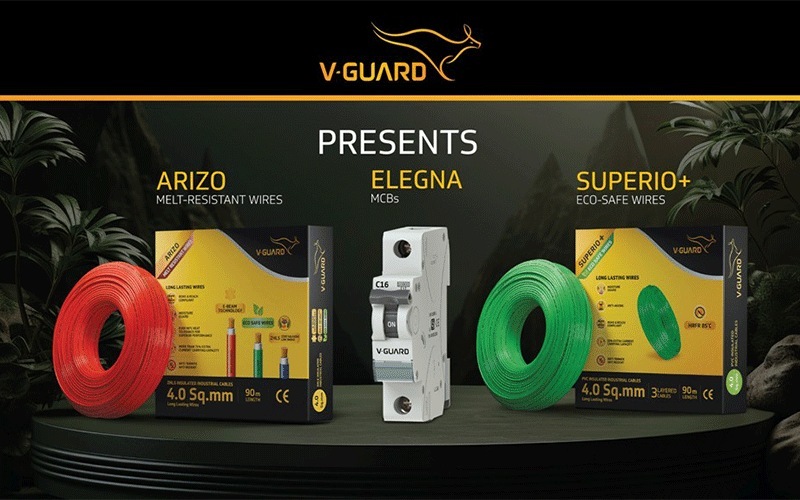
V-Guard Industries:
₹1,404 Cr Revenue. 17% ROCE.
Copper’s Up 40%, Margins Are Down. Fun Times Ahead.
Eighth consecutive quarter of revenue growth. But wait—there’s a catch. Sunflame is bleeding, copper inflation is carnage, and that ₹25 crore Gegadyne bet just became a 30% stake. Is this the story of a diversified powerhouse or a conglomerate drowning in multiple simultaneous problems?
The Electricals & Durables Chaos: One Company, Five Crises
- 52-Week High / Low₹413 / ₹290
- Q3 FY26 Revenue₹1,404 Cr
- Q3 FY26 PAT (Reported)₹57 Cr
- Q3 FY26 EPS₹1.30
- Annualised EPS (Q3×4)₹5.20
- Book Value₹47.5
- Price to Book6.67x
- Dividend Yield0.47%
- Debt / Equity0.03x
- ROCE (TTM)17.2%
Welcome to V-Guard: The Conglomerate That Forgot to Say “No”
Founded in 1977 by Kochouseph Chittilappilly, V-Guard started with one boring, profitable thing: voltage stabilizers. You know, the devices that sit between your wall socket and your electronics to stop power fluctuations from nuking your TV. Unsexy. Essential. Margins that make sense.
Then the company discovered diversification. Not the good kind. The kind where you wake up in 2026 and suddenly you’re manufacturing wires, pumps, fans, water heaters, air coolers, modular switches, switchgears, solar inverters, inverter batteries, kitchen appliances (via Sunflame acquisition), AND investing in immersion cooling tech startups (Gegadyne). It’s like someone handed the CFO a dictionary and said, “Make it a business.”
The results? Q3 FY26 delivered ₹1,404 crore in consolidated revenue—yes, eight consecutive quarters of growth—but a PAT of just ₹57 crore when you strip away the noise. The stock is trading at 54.2x P/E (sector median is ~45.8x). Copper is up 40% YoY. Sunflame is melting. Fans—a category once expected to be a cash cow—are drowning in new energy efficiency regulations that require hefty price hikes. Management says “very bullish.” Investors say “very confused.”
This is the story of a company that went from being one thing and doing it brilliantly (40–45% market share in stabilizers), to being seven things and struggling to do any of them profitably. Let’s untangle the mess.
One Company. Seven Product Categories. Zero Focused Execution.
V-Guard operates through three core segments: Electronics (30.5% of H1 FY26 revenue)—stabilizers, UPS, inverter batteries, solar inverters; Electricals (38.7% of H1 FY26 revenue)—wires, pumps, switchgears, modular switches; and Consumer Durables (26.6% of H1 FY26 revenue)—fans, water heaters, air coolers. Then there’s Sunflame (4.2% of revenue)—the kitchen appliances acquisition from 2023 that management hoped would be a growth catalyst. Spoiler: it isn’t.
Distribution spans 100,000+ channel partners, 35 branches, and geographic split is now 51.6% South, 48.4% non-South (management’s geographic levering bet). The company manufactures ~65% in-house, outsources 35%, and has ambitions to push in-house to 70–75% within 3–4 years. They own manufacturing facilities in Tamil Nadu, Uttarakhand, Himachal Pradesh, Telangana, Haryana, and Gujarat.
Capital allocation is a mixed bag: ₹100–130 crore annual capex, funded by internal accruals. Recent announcements include a ₹50 crore battery plant (Phase 1) in Hyderabad to reach 40–50% of inverter battery demand, and a ₹100 crore TPW/ceiling fan factory near Hyderabad (expected operations ~18 months). Oh, and ₹25 crore into Gegadyne (battery/energy storage tech startup), now bumped to 30.35% ownership. The diversification playbook says: if you’re struggling in your core, add more bets.
Q3 FY26: The Numbers (And The Lies We Tell Ourselves)
Result type: Quarterly Results | Q3 FY26 EPS: ₹1.30 | Annualised EPS (Q3×4): ₹5.20 | Full-year FY25 EPS: ₹5.97
Source table
| Metric (₹ Cr) | Q3 FY26 Dec 2025 |
Q3 FY25 Dec 2024 |
Q2 FY26 Sep 2025 |
YoY % | QoQ % |
|---|---|---|---|---|---|
| Revenue | 1,404 | 1,269 | 1,272 | +10.6% | +10.4% |
| EBITDA | 123 | 104 | 119 | +18.3% | +3.4% |
| EBITDA Margin % | 8.8% | 8.2% | 9.4% | +60 bps | -60 bps |
| PAT (Reported) | 57 | 60 | 66 | -5.2% | -13.6% |
| EPS (₹) | 1.30 | 1.37 | 1.51 | -5.1% | -13.9% |
Is ₹317 Fair or is it “Faith-Based Investing”?
Method 1: P/E Based
FY25 full-year EPS = ₹5.97. CMP P/E = 54.2x. Industry median P/E = 45.8x. A discount to current trading (i.e., a more realistic valuation) would price at sector median 45x on normalized earnings.
Range: ₹240 – ₹300 (at 40x–50x P/E)
Method 2: EV/EBITDA Based
TTM EBITDA (estimated) = ₹430–450 crore. Current EV = ₹13,881 Cr. EV/EBITDA = 30.8x–32.3x. Quality consumer durables/electrical players trade at 15x–22x. Near-zero net debt. Fair EV/EBITDA band: 18x–25x.
EV range (18x–25x EBITDA): ₹7,740 Cr – ₹10,750 Cr → Per share (at ₹44.4 Cr equity):
Range: ₹175 – ₹245
Method 3: DCF Based
Operating CF (FY25): ₹444 crore. Growth assumption: 6–8% for 5 years (below historical 15% due to execution risk). Terminal growth: 3%. WACC: 10.5%.
→ Terminal Value (3% growth / 7.5% cap rate): ~₹7,500 Cr
→ Total EV: ~₹9,700 Cr (near-zero net debt)
Range: ₹195 – ₹275
The Copper Crisis, The Sunflame Fiasco, and The Gegadyne Gamble
🔴 The Existential One: Copper Up 40%, Everything Up In Smoke
Copper prices have risen 40% in a single year. This is the highest inflation in a single commodity that V-Guard has ever seen. The problem? V-Guard is a wires and pumps company now. Wires are copper-heavy. The gross margin compression (100 bps YoY) is directly attributable to this. Worse: the Wires segment achieved +20% price growth in Q3 but only +10% volume growth, meaning price hikes are beginning to destroy demand. Management flagged “softening of demand from Projects’ customers… not too confident to buy in large quantities at elevated copper prices.” Translation: Your margin is inflating your revenue away. They expect to take “calibrated pricing actions across the product portfolio in the coming quarter.” Calibrated = tiny. Too big, volumes collapse. Too small, margins disappear. The copper tightrope act is what’s keeping V-Guard from jumping off the cliff.
⚠️ Sunflame Continues the Spiral
- • Q3 revenue declined 9.9% YoY in kitchen appliances
- • CSD (Canteen Stores Department) channel “continued to be weak”
- • Operational integration “completed” (done in Q2, done again in Q3?)
- • Sales integration underway (~2 months in, started in Nov)
- • Product refresh cycle takes 18 months; actions started late
- • Management says “challenges more or less behind us” (read: wishing)
✅ Gegadyne: The ₹25 Crore Hope Chest
- • ₹25 crore investment approved, stake rises to 30.35%
- • Tech moving from “development” to “commercialization phase”
- • Small supplies ongoing to “local players” for proof-of-concept
- • V-Guard expected to start using it in “next 3–4 months, small quantities”
- • Strategic bet on energy storage opportunity (immersion cooling, batteries)
- • Could work. Probably won’t. But they’re trying.
⚠️ Fans: The BLDC Repricing Nightmare
- • New energy rating norms kick in Jan 1—already happened
- • Requires “significant price hikes” for non-BLDC models
- • Management expects 2–3% more price hikes before March FY26
- • ~25–30% of fan motor base is copper-heavy (hit worst by inflation)
- • BLDC adoption “shrinking price delta” but not 100% adoption soon
- • Demand for non-BLDC fans likely to shift downward (price resistance)
✅ Stabilizers: The Boring Cash Cow That Still Works
- • 40–45% market share; only “serious competitor” is Microtech
- • Long debate about AC inbuilt stabilizers reducing need; ongoing 15 years
- • Volume growth stabilizers: 7–8% CAGR (7–8 years), 10% (last 5 years)
- • Benefits from “newly electrified villages” upcountry markets
- • No margin issues; pricing power intact; execution solid
- • But now only 15% of sales (down from 20%+ historically)
Is the Fort Still Standing? (Barely)
Source table
| Item (₹ Cr) | Mar 2024 | Mar 2025 | Sep 2025 | Dec 2025 (Latest) |
|---|---|---|---|---|
| Total Assets | 2,886 | 3,039 | 3,001 | 2,960 |
| Net Worth (Eq + Reserves) | 1,768 | 1,999 | 2,074 | 2,068 |
| Borrowings | 356 | 77 | 70 | 68 |
| Other Liabilities | 762 | 964 | 858 | 824 |
| Total Liabilities | 2,886 | 3,039 | 3,001 | 2,960 |
Borrowings fell from ₹356 Cr (Mar 2024) to ₹68 Cr (Dec 2025). The Sunflame acquisition debt has been paid off aggressively. Debt/Equity now 0.03x—essentially debt-free. Management clearly learned not to lever up for non-core bets.
Other Liabilities remain elevated at ₹824 Cr (mostly trade payables, employee benefits). Working capital days at 37 (down from 88 in Mar 2022)—management has tightened cash conversion significantly. Not bad execution here.
Net worth growth has slowed to ₹2,068 Cr. With FY25 PAT of ₹260 crore and ₹150 crore dividend paid out, retained earnings are modest. The balance sheet is strong but not expanding—typical of a cash cow company that’s also struggling to grow.
Sab Number Game Hai (But The Cash Flow Is Real)
Source table
| Cash Flow (₹ Cr) | FY24 | FY25 | TTM (Latest) |
|---|---|---|---|
| Operating CF | +350 | +444 | +450 |
| Investing CF | -107 | -77 | -85 |
| Financing CF | -232 | -372 | -340 |
| Net Cash Flow | +11 | -5 | +25 |
Some Are Good. Most Are Scary.
3-Year Profit & Loss: Watch the OPM Collapse
Source table
| Metric (₹ Cr) | FY24 | FY25 | TTM (Latest) |
|---|---|---|---|
| Revenue | 4,559 | 5,309 | 5,485 |
| EBITDA | 354 | 422 | 396 |
| OPM % | 7.8% | 7.9% | 7.2% |
| PAT | 231 | 260 | 242 |
| EPS (₹) | 5.32 | 5.97 | 5.55 |
Revenue growing 9.3% CAGR, but profit growing only 1.8% CAGR. That’s not leverage. That’s the opposite. Diversification into lower-margin categories (wires, fans, pumps) is diluting the overall profit pool. Management is buying growth with profitability. Most investors are not pricing this trade-off.
Multiproduct Durables: V-Guard vs. The Competition
Source table
| Company | CMP | P/E | MCap (₹ Cr) | ROCE % | ROE % | Div Yield % |
|---|---|---|---|---|---|---|
| V-Guard | 317 | 54.2x | 13,845 | 17.2% | 13.6% | 0.47% |
| Voltas | 1,449 | 92.4x | 47,960 | 17.6% | 13.5% | 0.48% |
| Blue Star | 1,945 | 74.8x | 39,950 | 26.2% | 20.6% | 0.46% |
| Crompton | 247 | 32.5x | 15,911 | 19.0% | 17.4% | 1.25% |
| LG Electronics | 1,577 | 52.0x | 107,042 | 56.8% | 45.2% | 0.00% |
V-Guard’s P/E of 54.2x is at the sector median (45.8x) but masking a 17% ROCE. Compare to Blue Star’s 26.2% ROCE at 74.8x P/E—Blue Star deserves the premium. Compare to Crompton’s 32.5x P/E with 1.25% dividend yield vs V-Guard’s 54.2x P/E with 0.47% yield. The market is pricing V-Guard for perfection. The company is delivering mediocrity.
Who Owns the Chaos? The Chittilappilly Family.
(Kochouseph Chittilappilly family—founder + descendants)
The Chittilappilly family (Mithun Kochouseph @ 19.8%, Thomas Kochouseph @ 8.4%, Arun Chittilappilly @ 8.7%, and various trusts) commands 53.3% of V-Guard. Management is family-controlled, which means strategic pivots (like diversification into Sunflame, Gegadyne, fans) are not shareholder votes—they’re founder whims. Promoter holding has slightly declined (down from 54.3% in Mar 2025), likely dilution from the Gegadyne investment. FII holding dropped (13.4% to 12.1%), suggesting foreign money is rotating out. DII holding is rising (20.6% to 23.3%), meaning domestic mutual funds (with mandate to hold Indian smallcaps) are holding the bag. Retail (<1%) suggests retail investors have already exited this party.
Boards, Audits, and Why Management Takes Forever to Pivot
✅ The Basics Are Fine
- ✓ Crisil A1+ rating on commercial paper (reaffirmed Nov 2025)
- ✓ Clean audit history—no material qualifications
- ✓ 36-member board (now: Chairman Kochouseph Chittilappilly + Prof. Biju Varkkey independent director reappointed May 2026)
- ✓ Shareholding pattern disclosed quarterly
- ✓ ESG rating assigned by NSE (69 for FY25, up from 68 FY24)
- ✓ No promoter pledge—clean balance sheet
⚠️ The Weaknesses
- ⚠ Strategic decisions (Sunflame, Gegadyne, diversification) made by founder, not board consensus
- ⚠ Sunflame integration delayed 18 months post-acquisition (typical of family-run acquisitions)
- ⚠ CGST audit objection filed Jan 2026 for ₹17.76 crore (FY20–FY24)
- ⚠ GST demand history: ₹20.7 crore (FY17–FY25) dropped by appeal (Oct 2025)
- ⚠ Simon India CEO (Amit Garg) resigned June 2025 post-acquisition integration stress
Electricals & Durables: The 6% Growth Ghetto
India’s electrical and consumer durables market is growing at 6–8% annually—slower than GDP growth, slower than discretionary consumption, slower than literally any sexy sector. Wires, pumps, fans, water heaters—these are defensive, steady-state markets dominated by fragmented competition and Chinese imports. Margins are razor-thin because organized players (like V-Guard) compete with organized players (Gulf, Veedol) and unorganized players (your local supplier) all at the same time.
🔌 Commodity Inflation: The Permanent Problem
Copper, aluminum, steel—these commodities are traded globally and volatile. A 40% YoY spike is rare, but a 5–10% YoY move is normal. V-Guard manufactures products with ~2–4 month inventory cycles, so inflation hits them hard and fast. They can’t absorb it. They can’t pass it on fully (market resistance). They sit in the middle, grinding margins. This is not a V-Guard problem—it’s an industry problem. But it’s made V-Guard’s strategic pivots (diversification) more urgent and less wise at the same time.
🎯 Market Share Consolidation Is Already Done
V-Guard has 40–45% in stabilizers, 14–16% in water heaters, 8–9% in wires, 9–12% in pumps. These are leadership positions. But the addressable market for each is shrinking (stabilizers down, fans under pressure from energy norms, wires fragmented). The company can’t grow by taking share (already has most of it). It has to grow by expanding the market OR by moving into new categories (which it’s doing badly).
⚡ Energy Norms Reshaping Everything
New BEE (Bureau of Energy Efficiency) energy rating norms for fans (effective Jan 2026) require non-BLDC models to jump efficiency ratings. The cheapest move? Price them up (which kills volume) or switch to BLDC (which has different margins, different supply chains, different OEM approvals). V-Guard’s fan factory is not yet operational (construction ongoing, opens ~18 months). Timing could not be worse. They’re trying to launch a factory right as the entire category is being repriced and remixed.
🌍 Unorganized Players Eating Lunch
In wires, pumps, and fans, unorganized players (no brand, no after-sales, bulk manufacturing in UP/Tamil Nadu) charge 20–30% less. They don’t have margin pressures because they don’t invest in R&D, distribution, or compliance. V-Guard is trying to compete on brand and reliability. Against commodity suppliers, this works. Against commodity supply chains at commodity prices, it doesn’t.
Macro Tailwinds (Small): Infrastructure capex and rural electrification benefit pump and wiring demand. Summer heat drives stabilizer and fan demand. But these are not enough to overcome structural margin compression and category maturity.
The Chaos Conglomerate
V-Guard is a company that was good at one thing (stabilizers) and decided to become mediocre at seven things. Revenue up 9.3% CAGR. Profit up 1.8% CAGR. ROCE down from 27% to 17%. Margins compressed from 10% to 7%. And the stock is priced at 54x P/E. The math doesn’t work. It’s never worked. It’s still not working.
Q3 FY26 Execution: ₹1,404 crore revenue (+10.6% YoY), ₹123 crore EBITDA (+18.3% YoY, sounds great until you see margins at 8.8%), ₹57 crore PAT reported (adjusted for ₹22 crore one-time charge, ~₹79 crore underlying). Electricals segment booming (+26%) on copper-driven price growth masking volume weakness. Sunflame melting (-9.9%). Fans under pressure from energy norms. Management spinning the narrative (“underlying PAT +22%”) and avoiding accountability.
The Sunflame & Gegadyne Lesson: Both are bets on new categories / technologies. Both have consumed capital (₹50+ crore from acquisition, ₹25+ crore in Gegadyne stake). Neither has contributed meaningful profits yet. Sunflame is 18 months into integration, still declining YoY. Gegadyne is “4–5 months away” from internal supplies and “3–4 years away” from real commercialization. This is not strategic diversification. This is founder desperation disguised as vision.
Valuation Absurdity: At 54.2x P/E and ₹317 CMP, you are paying for: (a) 17.2% ROCE (below cost of capital for most investors), (b) 0.47% dividend yield (below FD rates), (c) 7.2% OPM (declining), and (d) the hope that Sunflame and Gegadyne will suddenly become cash machines. Hope is not a valuation argument.
Historical Context: Over 10 years, V-Guard stock returned ~18% CAGR, but most of that was between 2015–2020 (market cap expansion from a small base). Since 2020, returns have been flat to negative. Profit growth has decelerated. ROCE has compressed. But the P/E has NOT. The market is still pricing it like 2015.
✓ Strengths
- 40–45% market share in stabilizers (dominant franchise)
- 100,000+ distribution network (organized retail + channel partners)
- Strong brand recall (45+ years, high consideration set)
- Debt-free balance sheet (₹68 crore net debt, essentially zero)
- ₹450 crore annual operating CF (steady cash generation)
- Dividend yield + capital appreciation possible from ₹175 base
✗ Weaknesses
- ROCE compression (27% → 17% in 10 years)
- OPM compression (10% → 7.2% TTM)
- Profit growth (1.8% CAGR) far below revenue growth (9.3% CAGR)
- Low dividend yield (0.47% vs 1%+ sector median)
- P/E at 54x with slowing fundamentals (growth + margin concern)
- Management credibility damaged by repeated Sunflame miss-communications
→ Opportunities
- Stabilizer volume CAGR 10% (rural electrification, upcountry markets)
- Gegadyne immersion cooling tech (hyperscaler data centres 2–3 years out)
- Non-South geography now 48% of revenue (headroom to equalize)
- New product launches (BLDC fans, solar inverters, kitchen appliances post-refresh)
- Energy efficiency ramps driving inverter battery demand
⚡ Threats
- Copper / aluminum commodity inflation (40% YoY is real, damages gross margins)
- Energy norms forcing fan category repricing and mix shift (demand destruction risk)
- Unorganized competition in wires, pumps (margin pressure ongoing)
- Sunflame integration delays (18+ months, still not profitable)
- PE funding dried up, growth capital scarce (capex plan ₹100–130 Cr constrained by OCF)
- EV adoption in long-term (stabilizers, fans may face structural decline 10+ years out)
V-Guard is a business where the founder made brilliant decisions in 1977–2010, mediocre decisions in 2010–2020, and confused decisions in 2020–2026.
The stabilizer franchise is rock-solid. The expansion into electricals and durables made sense strategically—adjacent markets, same distribution channels, same customer base. But execution has been poor. Margins are compressed. Returns are declining. And the company is now trying to use Sunflame and Gegadyne to create new moats. Neither will succeed at the current capital allocation pace and execution quality.
At ₹317 (CMP), V-Guard is a “show-me” story. The stock needs: (a) Sunflame to turn profitable (2+ years minimum), (b) Copper prices to normalize (unlikely), (c) Gegadyne to actually commercialize (3+ years, speculative), and (d) Overall margins to stabilize (structural headwind from diversification). That’s a lot of “ifs” for a company trading at 54x P/E with 17% ROCE.