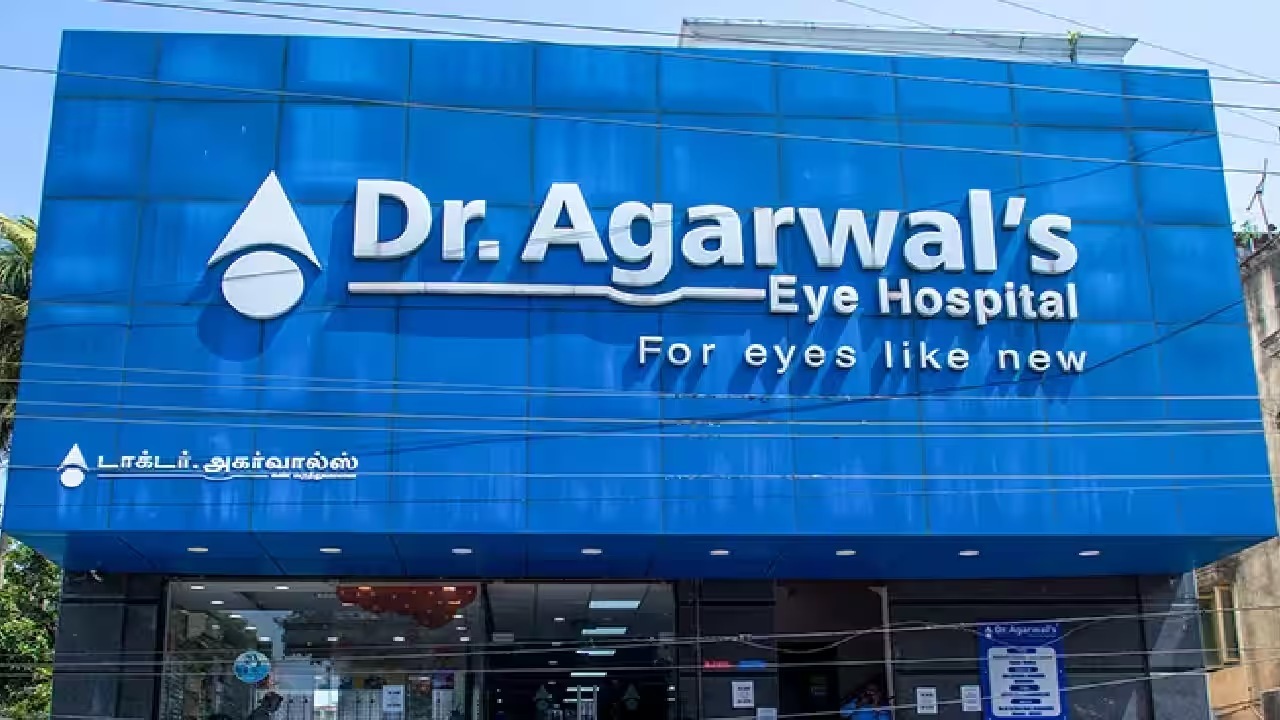
Dr Agarwal’s Health Care:
₹1,976 Cr Revenue. 74% PAT
Growth. IPO Money Still Hot.
IPO’d less than a year ago, expanding 38+ new centers in the first 9 months, and somehow still delivering earnings growth that’d make any startup founder weep with joy. Eye care is the new startup. Except it’s been around for 15 years.
The Hospital That IPO’d, Expanded Like Crazy, And Somehow Still Made Money
- 52-Week High / Low₹568 / ₹327
- FY25 Revenue (Full Year)₹1,711 Cr
- FY25 PAT (Full Year)₹110 Cr
- 9M FY26 Revenue₹1,516 Cr
- 9M FY26 PAT₹118 Cr
- Book Value₹61.0
- Price to Book7.14x
- Dividend Yield0.00%
- Debt / Equity0.51x
- Q3 FY26 EPS (₹)1.07
The Eye Care Gold Rush: How To Make Money From Human Vision Problems
Dr. Agarwal’s Health Care is India’s largest organized eye care chain. Twenty-five percent market share. Two hundred fifty-three facilities across India. Nineteen in Africa. And until February 2025, it was a private company run by the Agarwal family because apparently some successful businesses don’t need Wall Street’s permission to exist.
But IPO’d they did. ₹300 crore fresh issue, ₹195 crore went into debt payoff, and the remaining ₹105 crore disappeared into “general corporate purposes” — which in healthcare-speak means “we’re going to open 60+ new centers because why not.” The first 9 months post-IPO saw 38 new facilities commissioned. In human terms, that’s like launching a new hospital every week. In financial terms, that’s very expensive optimism.
Cataract surgeries are 72.7% of their surgical volume. Refractive surgeries are tiny but growing. They just installed robotic cataract machines (Femto) at five locations and are printing 4,400+ robotic cataracts annually, up 83% YoY. Revenue grew 21.2% in the first 9 months of FY26. Profits grew 74.3%. And yet the stock is expensive, unprofitable by traditional metrics, and burning cash on expansion. The auditor is simultaneously impressed and deeply concerned.
Let’s dive into the numbers with the kind of surgical precision a cataract surgeon would appreciate — and the kind of sarcasm a cost accountant would deploy when reviewing capex budgets.
It’s Three Facilities Masquerading As One Business.
Dr. Agarwal’s runs a hub-and-spoke model. Primary centers are clinics — they do eye tests, sell glasses, dispense drops. Secondary centers are surgical hubs — they do cataract ops, simple retinal stuff. Tertiary centers (called Centers of Excellence) are the Michelin-starred restaurants of eye surgery — robotic cataracts, complex corneal transplants, advanced refractive stuff. All leased space. Minimal fixed assets. High patient throughput.
The revenue mix is 67% surgeries (money printer goes brrr), 21.5% optical/contact lens/accessories (margin buffer), and 11.6% consultations/diagnostics (the free samples that drive traffic). The cataract surgery is the gateway drug — one ₹50,000 surgery with a premium lens and you’re making ₹25,000+ per patient. Do 200+ per month across your network and suddenly your ₹5–6 crore secondary center is worth the investment.
Payer mix: 62.4% cash patients, 28.5% insurance, 9.1% government schemes. If you’re paying out-of-pocket, you’re not shopping for price — you’re shopping for quality. This is why their margins stay fat even as they expand into tier-2 markets. Patients will travel to a reputable center rather than squint at the local nobody’s discounted ₹10,000 cataract.
Q3 FY26 Numbers: When Growth Comes With Margin Expansion
Result type: Quarterly Results (Q3 = Oct-Dec quarter) | Q3 FY26 EPS: ₹1.07 | Annualised EPS (Q3×4): ₹4.28 | FY25 Full Year EPS: ₹3.47
Source table
| Metric (₹ Cr) | Q3 FY26 Dec 2025 |
Q3 FY25 Dec 2024 |
Q2 FY26 Sep 2025 |
YoY % | QoQ % |
|---|---|---|---|---|---|
| Revenue | 530 | 431 | 499 | +23.0% | +6.2% |
| Ind AS EBITDA | 155 | 128 | 136 | +21.3% | +13.9% |
| EBITDA Margin % | 28.4% | 29.7% | 27.3% | -130 bps | +110 bps |
| PAT | 44 | 28 | 36 | +55% | +22.2% |
| EPS (₹) | 1.07 | 0.72 | 0.94 | +48.6% | +13.8% |
When A 108x P/E Starts To Make Sense (Barely)
Method 1: P/E Multiple Based
FY26 annualized EPS (using Q3 trend + Q4 seasonality guide) estimated at ~₹4.00–₹4.40. Healthcare services peers trade at 35x–50x P/E (Apollo 59.94x, Max 68.06x, Fortis 64.87x). Dr. Agarwal’s premium justification: 25% market share, 20%+ organic growth, expansion momentum. Fair P/E band: 40x–55x (discount to mature peers due to execution risk).
Range: ₹160 – ₹242
Method 2: EV/EBITDA Based
9M FY26 EBITDA = ₹440 cr (annualized ~₹585 cr). Current EV = ₹14,575 cr → EV/EBITDA = 24.9x. Healthcare services peers trade 18x–35x EV/EBITDA (Apollo 17x, Narayana 19x, Max 25x). Dr. Agarwal’s justified at 22x–28x (expansion-stage discount). Debt = ₹983 cr; Cash = ~₹397 cr; Net Debt = ₹586 cr.
EV range (22x–28x): ₹12,870 Cr – ₹16,380 Cr → Per share:
Range: ₹225 – ₹288
Method 3: DCF (Expansion Scenario)
Base FCF: ₹ 360 cr (FY25 operating CF). Growth: 18% for 5 years (market expansion + new center ramp). Terminal growth: 5%. WACC: 10% (low debt, high growth).
→ Terminal Value (5% growth / 5% cap rate): ~₹12,800 Cr
→ Total EV: ~₹15,900 Cr (net debt adjusted)
Range: ₹235 – ₹290
When Your IPO Flush Meets Your Acquisition Hunger
🔴 The Merger Nobody Asked For (But NCLT Might Approve)
Aug 2025: Dr. Agarwal’s (AHCL) board approved a merger with its own subsidiary, Dr. Agarwal’s Eye Hospital (AEHL), at a 23:2 share swap ratio. Yes, you read that right — they’re merging the parent with the subsidiary after the parent IPO’d six months prior. AEHL shareholders get 23 AHCL shares for every 2 AEHL shares. AEHL also got a ₹70 crore preferential issue at ₹5,270/share. Stock exchange NOCs received (Feb 2026). NCLT approval expected mid-2026. Completion timeline: Q3/Q4 2027. The auditor’s question: why complicate cap structure with a 15+ month merger process when you could’ve just stayed separate?
✅ Expansion Execution
- • 38 new facilities added in 9M FY26 (23 surgical)
- • 14 greenfield additions in Q3 alone (9 secondary + 5 primary)
- • Next quarter plan: 16 more centers (11 expected surgical)
- • Core market breakeven: 6–7 months; newer regions: 15–18 months
- • FY26 CAPEX guidance: ₹310 cr (₹275 cr YTD spend)
⚠️ The Put Option Ticking Bomb
- • Dr. Thind Eye Care (DTEPL): ₹330 crore put option liability
- • 49% stake still to be acquired (currently 51% owned)
- • Payable after FY2029 — future cash outflow flag
- • Test case: How PE-backed expansion interacts with earnout obligations
What Happens When You IPO With Debt, Then Double Your Facilities
Source table
| Item (₹ Cr) | Mar 2023 | Mar 2024 | Mar 2025 | Sep 2025 (Latest) |
|---|---|---|---|---|
| Total Assets | 1,823 | 2,751 | 3,665 | 3,786 |
| Net Worth (Equity + Reserves) | 622 | 1,330 | 1,835 | 1,899 |
| Borrowings | 857 | 966 | 961 | 983 |
| Other Liabilities (Trade Payables) | 336 | 445 | 837 | 873 |
| Total Liabilities | 1,823 | 2,751 | 3,665 | 3,786 |
Sab Number Game Hai. Especially When You’ve Got 300 New Centers To Build.
Source table
| Cash Flow (₹ Cr) | Mar 2023 | Mar 2024 | Mar 2025 | Trend |
|---|---|---|---|---|
| Operating CF | +233 | +346 | +360 | Stable ➜ |
| Investing CF | -509 | -914 | -750 | Capex Heavy |
| Financing CF | +303 | +553 | +382 | Debt + Equity |
| Net Cash Flow | +27 | -15 | -8 | Burning Slowly |
The Report Card Nobody Expected Post-IPO
Annual Trends — FY22 to FY25 & 9M FY26 Projection
Source table
| Metric (₹ Cr) | FY22 | FY23 | FY24 | FY25 | 9M FY26 |
|---|---|---|---|---|---|
| Revenue | 696 | 1,018 | 1,332 | 1,711 | 1,516 |
| Operating Profit | 186 | 275 | 367 | 463 | 440 |
| OPM % | 27% | 27% | 28% | 27% | 29% |
| PAT | 43 | 103 | 95 | 110 | 118 |
| EPS (₹) | Not Applicable (Pre-IPO) | Not Applicable | Not Applicable | 3.47 | 3.68 (9M annualized) |
Here’s the awkward truth: Revenue is growing 30% but profit growth is 3.5%. Why? Expansion. Every new center costs ₹5.5–12 cr and loses money for 12–18 months. The 38 centers added YTD represent ₹210+ cr in future revenue capacity but ₹30+ cr in current losses. This is “growth at any cost” — except the cost is visible in today’s P&L, not tomorrow’s earnings surprise.
Dr. Agarwal’s Versus The Big Hospitals. Spoiler: They’re All Overvalued. Differently.
Source table
| Company | Revenue (₹ Cr) | PAT (₹ Cr) | P/E | ROCE % | Div Yield |
|---|---|---|---|---|---|
| Dr Agarwal’s | 1,976 | 127 | 108x | 10.0% | 0.0% |
| Apollo Hospitals | 24,215 | 1,816 | 59.9x | 16.6% | 0.25% |
| Max Healthcare | 8,140 | 1,459 | 68.1x | 14.9% | 0.15% |
| Narayana Hrudayalaya | 6,778 | 826 | 42.4x | 20.8% | 0.26% |
| Fortis Healthcare | 8,770 | 1,008 | 64.9x | 12.0% | 0.12% |
Dr. Agarwal’s P/E is 45–155% higher than every peer. Narayana Hrudayalaya — the closest competitor — trades at 42.4x with 20.8% ROCE. Dr. Agarwal’s trades at 108x with 10% ROCE. That’s not a premium for growth. That’s a fever dream. Sector median P/E is 42.38x. Dr. Agarwal’s is 2.55x sector median. For a company that’s burning cash on expansion and delivering below-industry ROCE, that’s optimism bordering on irresponsibility. The only justification: they’re priced for flawless execution across 300+ facilities. One missed quarter, one botched M&A, one refractive demand slowdown, and this valuation vaporizes.
When IPO Dilutes Founder Control But FIIs Take The Other 60%
- Promoters (Agarwal Family)32.39%
- FIIs (Global PE + Hedge Funds)60.62%
- DIIs5.21%
- Public1.78%
Pledge: 0.00%. Shareholding split (Dec 2025): Anosh Agarwal (5.83%), Amar (4.46%), Ashvin (4.46%), Adil (4.44%), Athiya (2.86%), Ashar (4.46%). The Agarwals own ₹4,460 crore of market cap. FIIs own ₹8,360 crore. It’s effectively a foreignfounder IPO.
Promoter Base: The Agarwal Ophthalmology Dynasty
Seven family members. One mission: dominate Indian eye care. Started with a single clinic in the 1980s. Now 253 facilities across 14 states + Africa. The family is aligned on expansion (no pledges, no wealth disputes visible). But post-IPO, they’ve taken the back seat. Institutional investors now call the strategy shots. Merger with AEHL = consolidation of family empire under one listed entity.
FII Dominance: Hyperion, Claymore, Arvon, Singapore Government
Hyperion (Singapore sovereign wealth management) owns 23.13%. Claymore (Mauritius-based asset manager) owns 10.21%. Arvon (Singapore-based) owns 9.88%. Singapore government monetary authority owns 6.47%. It’s essentially a Singapore-managed PE play on Indian healthcare. These guys own your IPO. They’ll exit at ₹600+ or ₹300 depending on execution. Retail India owns 1.78%. Your insurance company owns it via ICRA-rated bonds.
The ICRA Report Card Says AA- Stable. The Balance Sheet Says “We’re Betting Everything.”
✅ The Prudent Side
- ✓ IPO April 2025; NOCs for AEHL merger received Feb 2026 — regulatory agility
- ✓ ICRA rating: AA-(Stable) with “strong brand equity, proven track record”
- ✓ Interest coverage: 5.6x (H1 FY26) — debt-servicing capacity adequate
- ✓ Zero pledges on promoter holdings — alignment of interest visible
- ✓ BRSR & ESG reporting on time — governance theatre impressive
⚠️ The Concerning Side
- ⚠ 55–60 facility/year expansion = ₹300+ cr capex annually
- ⚠ ₹330 cr put option liability (Thind Eye Care) — timing unknown
- ⚠ Greenfield losses: ₹28.57 cr in 9M alone — compounding
- ⚠ Lease liabilities: ~₹800 cr and growing with each new facility
- ⚠ Management churn: Post-IPO executives still settling in; execution risk visible
Why Everyone’s Suddenly Obsessed With Cataracts (And Why That’s Good News)
🏥 The Organized Eye Care Consolidation Thesis
India’s organized eye care segment is still only 40–50% of total market. The rest is unorganized clinics, quacks, and people just living with vision impairment. As incomes rise, patients migrate to organized chains. Dr. Agarwal’s 25% market share means room to grow even with zero new markets. Management targets 40% organized penetration by 2030 = ₹8,000+ crore market TAM expansion. The Agarwal strategy: acquire unorganized players and consolidate under hub-and-spoke model. Less risky than greenfield.
🔬 The Premiumization Opportunity: Robotic Cataracts & Specialty Procedures
India’s cataract procedure volume is 40 lakh/year; only 15% are premium (intraocular lenses, advanced platforms). Dr. Agarwal’s high-end cataract penetration: 43.5% (vs industry 15%). Robotic FEMTO cataracts: 4,400 in 9 months, up 83% YoY. At ₹40,000+ per robotic cataract vs ₹15,000 for traditional, the yield per surgery is exploding. This is real premiumization, not just volume inflation. Management guidance: robotic systems at Gurgaon, Vashi, other metros. This is 5–10 year structural upside.
💰 The Insurance Reimbursement Tailwind
Ayushman Bharat covers cataract at ₹10,000–15,000 per procedure. Implant cost adds ₹5,000–10,000. Corporate group mediclaim covers better. 28.5% of Dr. Agarwal’s revenue is now insurance-payor (vs 10–15% industry average). This is scale. As Ayushman penetration grows + corporate wellness programs expand, the insurance payor mix will continue climbing. Margins get tighter per procedure but volume capacity expands massively. The trade-off is favorable.
🚩 The Refractive Surgery Slowdown & TBD Market
Refractive surgeries (LASIK, PRK for myopia correction) grew only 6.6% in 9M FY26 (vs 12% in cataracts). Management: “industry being slightly slow on the refractive side this year; expect to bounce back next year.” The reality: SMILE/lenticular options are niche; laser prices have commoditized; cost-conscious Indians still prefer corrective lenses. This segment is not the growth engine. It’s a margin contributor on mature centers but not a scaling revenue driver. Anyone betting on refractive growth is mistaken.
Competitive dynamics: Apollo Hospitals (24,000 cr revenue, 7 eye hospitals) is presence but not focused. Max Healthcare has eye ops but they’re ancillary to cardiac/orthopedic. Fortis, Aster, others are generalists. Dr. Agarwal’s is the only pure-play organized eye care chain. This creates moat. But it also means new competition can enter with better capital efficiency. Unorganized players will fight back with pricing. The margin floor is real.
Macro tailwinds: Rising healthcare spend per capita in India. Aging population = cataract incidence grows 2–3% annually. Urban migration = better awareness of eye care (vs rural reliance on unqualified practitioners). Penetration of organized insurance = formalization of demand. All winds at their back. The question is whether they can scale without destroying unit economics.
The Eye Test
Dr. Agarwal’s Health Care is executing brilliantly on a fundamentally sound strategy. 25% market share. 21% revenue growth. 74% profit growth. They’ve raised ₹300 crore, absorbed it into expansion capex, and are still growing profits YoY. But the valuation is broken. At ₹435, the stock is pricing in 20+ years of flawless execution, zero execution risk, and terminal growth rates that make even tech companies blush.
The IPO Story: February 2025, they raised ₹300 crore at ₹383/share. Today, it’s ₹435. That’s a 13.6% return in 11 months — not bad, but for a high-growth healthcare stock, that’s mediocre. More importantly: the IPO was fully priced. Institutions took the bulk. Retail India got 5%. The present investors are FIIs who are down from peak (52-week high ₹568). They’re not going to pump this beyond fair value. They’ll exit on any bad quarter.
The Expansion Question: 38 new facilities in 9 months = ₹210 cr capex deployed. Each facility is losing ₹28 lakh–₹50 lakh in year 1. Cumulatively, ₹28.57 cr in greenfield losses. Management says 12-month blended breakeven. Let’s assume they’re right. That still means: every new center is a temporary profit drag until month 12. At 55–60 centers/year, you’re perpetually running with loss-making units on the books. This isn’t unsustainable — it’s just not as profitable as it looks.
Historical context: Pre-IPO (FY23-FY25), they delivered 35% CAGR revenue growth and 3.5% CAGR profit growth. The gap was expansion. Post-IPO, they’re accelerating expansion (55–60 centers/year vs prior 30/year), so profit growth will decelerate further until all new units reach critical mass. That’s 3–4 years out. Investors pricing at ₹435 are betting on year 4–5 profitability delivery. That’s a long wait and a high bar.
✓ Strengths
- 25% market share in organized eye care — largest chain in India
- ₹1,976 cr revenue at 5.9% net margin (improving)
- Premiumization working: 43.5% high-end cataract, 4,400 robotic surgeries YoY
- Hub-and-spoke asset-light model = 6–7 month breakeven in core markets
- Operating CF stable at ₹360 cr despite expansion capex spending
- ICRA AA-(Stable) rating = debt capacity exists
✗ Weaknesses
- ROCE at 10% below WACC = destroying shareholder value on new centers
- ROE at 4.76% = abysmal capital efficiency post-IPO
- Greenfield losses: ₹28.57 cr in 9M alone; compounding with 55+ centers/year
- Refractive surgery growth stalling at 6.6% YoY (management: “slowdown”)
- Lease liabilities ~₹800 cr + growing; debt + lease = ₹1.7 billion exposure
- No dividend; all cash reinvested into expansion capex
→ Opportunities
- Organized eye care penetration still 40–50%; addressable market 2x–3x
- Premiumization (robotic, advanced lenses) = ₹1 lakh+ per cataract possible
- Insurance reimbursement growth (Ayushman, corporates) = formalization tailwind
- South India concentration (63% revenue) = North/West geographic arbitrage
- M&A of unorganized chains = faster consolidation than greenfield
- Ethiopia + Africa expansion = new geographic TAM with 19 facilities seeded
⚡ Threats
- Valuation at ₹435 (P/E 108x) requires zero execution misses for 3+ years
- ₹330 cr put option (Thind Eye Care) payable post-FY29 = future liquidity test
- AEHL merger (completion Q3/Q4 2027) = integration risk, delay risk
- Refractive slowdown extends → segment growth disappoints
- New centers ramp slower than 12 months = margin compression acceleration
- Retail competition from unorganized players on pricing; cannot match cost base
Dr. Agarwal’s is executing a textbook healthcare expansion story.
They’re growing fast, building scale, acquiring market share, and institutionalizing what was once a family practice. The business model is sound. The TAM is real. The management is competent. But at ₹435, you’re not buying the business — you’re buying the mythology of perfect execution. And mythology has a shelf life. The fair value range of ₹160–₹290 reflects what the business is actually earning (not what it might earn in 10 years). The current price reflects what it might earn if everything goes perfectly. That gap is a risk, not opportunity.