01 — At a Glance
The Hospital Network That Found Itself in a Fever Dream
- 52-Week High / Low₹844 / ₹366
- Q3 FY26 Revenue₹320 Cr
- Q3 FY26 PAT₹43 Cr
- Q3 EPS₹4.71
- Annualised EPS (Q3×4)₹18.84
- Book Value₹175
- Price to Book3.76x
- Dividend Yield0.00%
- Debt / Equity0.02x
- Promoter Holding55.8%
The Auditor’s Intake Room Note: Yatharth turned in Q3 FY26 with ₹320 crore revenue (+46% YoY), ₹431 crore operating profit adjusted for new hospital startup losses, and the kind of growth that makes older hospital networks reach for their inhalers. The company raised ₹604 crore via QIP in December 2024, spent it on acquiring two new hospitals (Delhi + Faridabad), and is now planning a three-year sprint to 5,000 beds from 2,300 today. Valuation is stratospheric (P/E 37.9x). But the business velocity is also stratospheric. Whether you’re buying growth or tulip futures is your call.
02 — Introduction
Welcome to The Hospital Network That Treats Itself Like a Software Startup
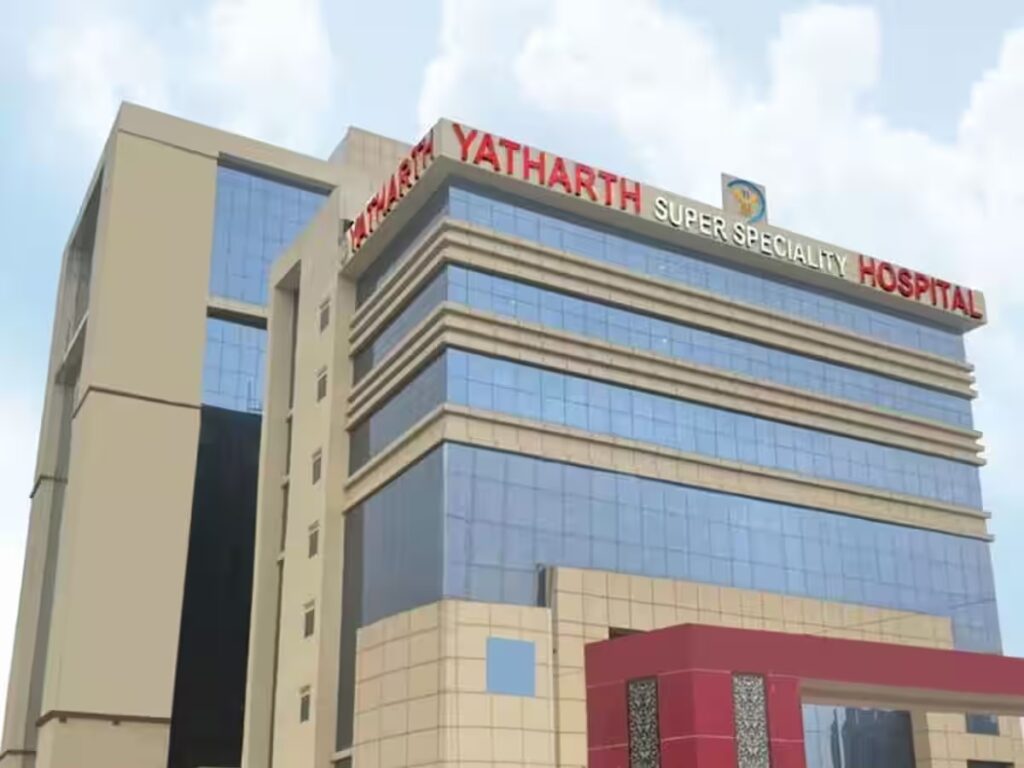
Yatharth Hospital is not your grandfather’s hospital network. Your grandfather’s hospital network was called the government hospital, had three broken beds, and fixed appointments via phone call that nobody answered. Yatharth is seven hospitals, 2,300+ beds, NABH accreditation, robots doing surgery, and a promoter group (Ajay Tyagi, Kapil Tyagi, and crew) that’s been operating in healthcare for two decades but decided in 2024 that the real move was to aggressively acquire competing hospitals and consolidate the North India market.
Founded in 2008 by the Tyagi brothers, the company started with one 250-bed hospital in Noida. By Q3 FY26, they operate seven hospitals across Delhi-NCR, Jhansi, Faridabad, and Agra. They’re adding oncology, neurosurgery, and “Medical Value Travel” — a term that means rich Muslims from the Middle East paying in cash for advanced treatment. And they’re CRISIL A-rated now (upgraded in November 2025), which means even the credit agencies believe this thing will work.
But here’s the plot twist: they’ve raised ₹604 crore in equity, added ₹26 crore in debt, and are planning another ₹1,500 crore capex over five years. They’re adding 3,000 beds over the next three years. That’s not a stable business — that’s a leveraged acquisition binge with medical karma riding along. And the Q3 results show it’s actually working. Occupancy climbed. Margins held. New hospitals are ramping faster than greenfield typically does because they’re acquiring established facilities, not building from scratch.
Let’s break it all down — with data, sarcasm, and the uncomfortable truth that North India is about to have way too many hospital beds because everyone is bullish on Indian healthcare except, you know, Indian healthcare funding.
Concall Clarity (Feb 2026): “Record quarter with industry-leading performance.” They said it exactly like that. Translation: the spreadsheet went up and to the right, and the new hospitals didn’t catch fire. Wins, basically.
03 — Business Model: WTF Do They Even Do?
Beds, Doctors, ARPOB, and a Government Mix That’s Slowly Being Strangulated
Yatharth runs hospitals. People get sick. They come to hospitals. Hospitals charge money. Standard. But here’s where it gets interesting: the company operates a payer mix that’s deliberately shifting away from government towards private and insurance, because government patients take three months to pay and occupy beds cheaper than they should.
The unit economics are crude but revealing: Average Revenue Per Occupied Bed (ARPOB) is ₹33,744 in Q3 FY26, up 10% YoY. Across all hospitals. Noida Extension (their crown jewel) is at ₹44,000 ARPOB with 70% super-specialty mix. Jhansi is at ₹14,000 because, well, Jhansi. Occupancy across the board: 67% (blended). Some hospitals (Noida flagship): 91% occupied. New hospitals (Delhi, Faridabad): 38–43% occupied because they’re brand new and ramping.
What’s their strategic obsession? Shifting government patient mix from ~35% today to ₹28% in 2–2.5 years and eventually <25% (2–3 years out). Why? Because government pays late. ESI payments alone account for 30–35% of government receivables, and ESI pays like a government entity (which it is). Every percentage point of mix shift towards private = every day of receivables shortened by one day. Do the math: move from 35% government to 25% government, and you save roughly 10 days of working capital. On ₹320 crore quarterly revenue, that's material cash unlocking.
Occupancy (Blended)67%Q3 FY26
ARPOB₹33,744+10% YoY
Govt Mix Target25–28%From 35% today
Receivables Days115Target: 80–82
The ARPOB Roast: Noida Extension is at ₹44,000 per bed per day. Jhansi-Orchha is at ₹14,000. That’s a 3.1x spread across the same company. Turns out oncology patients spend more than trauma patients. Who knew? (Everyone. Everyone knew.)
💬 If a hospital shifts 10% of its patient mix from government to private, does it still deserve the same valuation multiple? Or are we just pricing in the debt they took on to acquire capacity? Drop your view.
04 — Financials Overview
Q3 FY26: The Numbers Are Bonkers. Yes, Literally.