General information and entertainment, not investment advice. The author is not a SEBI-registered adviser or research analyst. No recommendation, no promised returns. Markets carry risk including loss of capital. Figures may not be current. Consult a registered adviser before acting.
1 — At a Glance
Yaashvi Jewellers closed FY26 with sales of ₹448 crore, up from ₹297 crore a year earlier, and net profit of ₹18.3 crore against ₹11.3 crore. On the top and bottom lines, a machine-made gold-chain maker in Jaipur put together the kind of year most SME issuers advertise in bold on the prospectus cover.
Then there is the cash flow statement, which tells a quieter, opposite story. Operating activities consumed ₹15.3 crore of cash in FY26, and ₹29 crore the year before that. A company earning ₹18 crore of accounting profit that hands ₹15 crore back to its own working capital every year is running two ledgers that disagree with each other — and both are audited.
The bridge between them is inventory and borrowings. The business grew by stocking gold and funding it with debt, which is a legitimate way to grow and also an expensive one. The company listed on the SME board in May 2026 after raising ₹42 crore, part of which the prospectus earmarks for repaying exactly those borrowings.
The market currently pays about 8x earnings here, the lowest multiple in its listed peer group. The number worth carrying into the rest of this entry: profit up 62%, operating cash negative for the fourth straight year.
2 — Introduction
Incorporated in December 2016 and converted to a public company in December 2024, Yaashvi Jewellers manufactures and trades gold jewellery out of a leased facility in Jaipur, Rajasthan. For most of its life it has been a B2B wholesale operation, selling to distributors rather than walk-in buyers.
The recent history is compressed into two years. Total operating income grew roughly 47% in FY25 and again sharply in FY26 to ₹448 crore. CARE Ratings, which reaffirmed and then withdrew a CARE BB; Stable / CARE A4 rating on 31 March 2026 at the company’s request, attributed the FY25 profitability improvement to the company’s entry into retail, a license to import 80 kg of gold, better absorption of fixed overheads, and rising gold prices through the year.
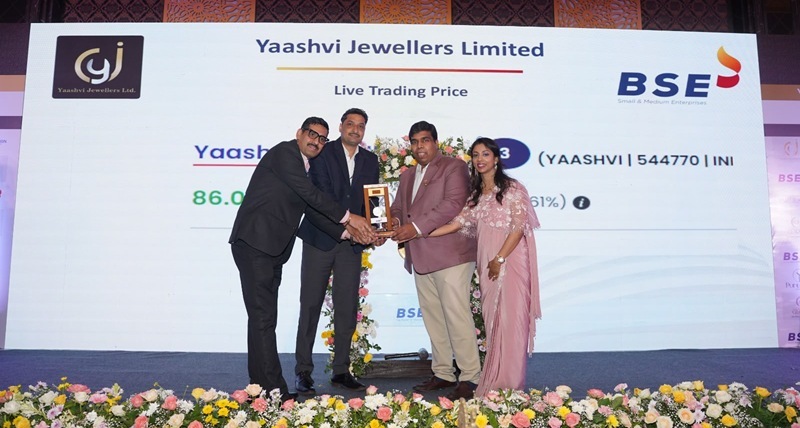
The withdrawal itself came after the company repaid its Kotak Mahindra Bank facility in full and secured a No Dues Certificate, per the rating release. In May 2026 the fresh capital arrived: a ₹42 crore IPO, listed on the BSE SME platform on 27 May 2026, with proceeds tagged for working capital, repayment of borrowings, and general corporate purposes.
So the FY26 numbers describe a company mid-transition — from wholesale to a mix that now includes retail, from bank-funded to partly equity-funded, from closely held to listed.
3 — Business Model: WTF Do They Even Do?
They make gold chains by machine, and they make a lot of them. Per the prospectus revenue mix, plain gold chains alone were 65.5% of FY26 revenue, with designer gold jewellery at 28% and everything else — silver, bullion, other manufacturing — sharing the crumbs. By karat, 22K gold jewellery and bullion accounted for 93% of revenue. This is not a diversified jewellery house; it is a chain factory with a trading desk attached.
The split between the two halves is manufacturing 71.5%, trading 28.5%. The manufacturing runs out of a 1,092 sq. mt. Jaipur unit that used 53.09% of its ~1,100 kg installed capacity in FY26, producing 583.99 kg of jewellery. Half the machine sat idle, which is either room to grow or capacity bought ahead of demand, depending on which year you check next.
The customer base is wholesale-heavy and, per the prospectus, reasonably sticky: repeat customers were 71.5% of FY26 buyers. Concentration is the flip side — the top 5 customers were 46% of sales, the top 10 nearly 60%. When ten relationships carry six of every ten rupees, the business is only as calm as those ten phone calls.
The newest limb is B2C retail, which grew from a rounding error to 25.9% of revenue in three years, anchored by a ~9,800 sq. mt. showroom in Jagatpura, Jaipur. Retail carries showroom rent, staff, and inventory that B2B never did — the margin math changes when you start selling one chain at a