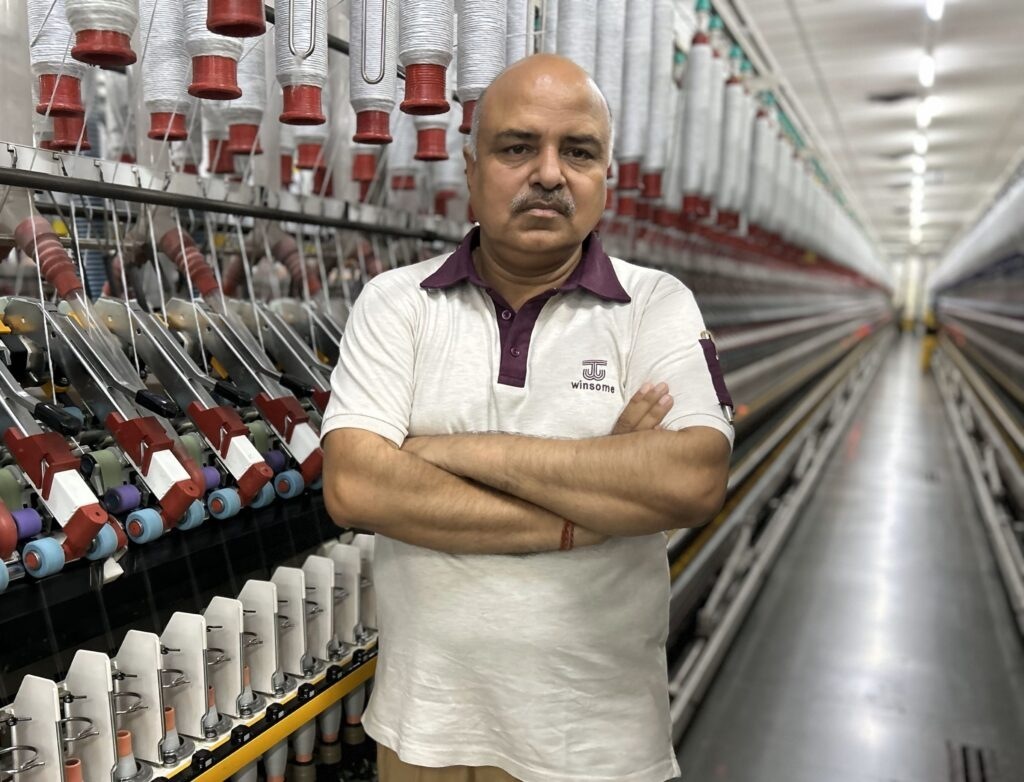
Winsome Textile Industries Limited Q4 FY26: Profit Before Tax Crosses ₹36 Crore Despite Fire Incidents and Margin Pressures
1. At a Glance
Winsome Textile Industries Limited (WTIL) presents an intriguing puzzle in the micro-cap textile ecosystem. Operating with a market capitalization of ₹170 crore, the corporate machinery commands an annual asset base exceeding ₹920 crore. This structural disproportionality immediately triggers closer analytical inspection. For a business that moves hundreds of crores of physical yarn across 50 countries, its equity value is priced like a forgotten warehouse.
On paper, the headline growth figures look comfortable enough to draw interest. Annual revenue climbed to ₹898 crore in FY26, and the bottom line generated a net profit of ₹26.6 crore. This places the trailing Price-to-Earnings (P/E) ratio at an incredibly compressed 6.38 times, starkly contrasting with the broader textile industry median P/E of 18.2 times. To an uninitiated observer, this looks like an obvious valuation dislocation.
Market Capitalization: ₹170 crore
Total Annual Revenue: ₹898 crore
Total Assets Managed: ₹922 crore
However, a serious look below the surface reveals deep operational vulnerabilities. The core financial architecture relies heavily on debt capital, with total borrowings standing at ₹283 crore against an equity base of ₹331 crore. Interest obligations consumed ₹48.26 crore of cash in FY26 alone. This high debt burden creates an intense drag on net profitability, leaving the company with a low interest coverage ratio of 1.75 times.
Adding to these structural concerns, a significant disruption hit operations on February 14, 2026. A fire broke out at Unit-1 in Baddi, Himachal Pradesh, resulting in an estimated raw material loss of ₹4.55 crore. While insurance claims have been filed, the physical impairment of processing capacity during the final quarter of the fiscal year highlights the acute operational vulnerabilities associated with highly concentrated manufacturing facilities.
Can a business burdened by massive debt obligations, low interest coverage, and sudden asset disruptions continue to hold the interest of value investors? The tension between its low valuation multiples and high underlying operational risks forms the core narrative of this financial assessment.
2. Introduction
Winsome Textile Industries Limited is a long-standing player in the Indian textile manufacturing landscape. Established in 1980 by S.C. Bagrodia, the enterprise has spent over four decades building an integrated infrastructure dedicated to the production of high-value spinning products. Today, the operational oversight rests with Chairman and Managing Director Ashish Bagrodia, who brings over twenty years of industrial experience to the table.
The operational core of the company is based in Baddi, District Solan, Himachal Pradesh. From this single geographic base, WTIL manages an industrial apparatus consisting of 110,000 spindles, a yarn dyeing house capacity of 35 metric tonnes per day (MTPD), and a specialized knitting setup producing 8 metric tonnes per day (MTPD). To offset volatile state grid electricity costs, the firm runs a 3.5 MW captive hydro power plant alongside a recently commissioned 2.89 MW solar installation.
The commercial reach of the company spans both domestic and international markets. Its export operations contribute approximately 54% of total revenue, with a dedicated branch office located in Poland to maintain a direct logistical foothold in Central Europe. The remaining 46% of production is absorbed by domestic manufacturers within India.
The client ecosystem includes relationships with over 250 international customers and 600 domestic entities. WTIL operates primarily as a Tier-2 supplier, manufacturing specialized yarns that flow into the supply chains of global clothing labels. Its products are ultimately used by international retail brands like GAP, H&M, Tommy Hilfiger, and Walmart.
3. Business Model – WTF Do They Even Do?
At its heart, Winsome Textile Industries Limited operates as a specialized processor that transforms raw fiber into customized yarn and knitted fabrics. Instead of competing in the low-margin, commoditized grey yarn market where scale and low cost determine survival, WTIL focuses almost entirely on value-added products.
The core business is centered on Melange yarn and dyed yarn. Melange production requires blending different colored fibers before the spinning process, creating a distinct, multi-colored textured effect. The product portfolio includes variants like Neppy Melange, Jaspe Melange, Injection Slub, and Wool-Touch mixtures. This requires high manufacturing precision, precise color matching, and small-batch processing.
A standard look at the financial architecture of this business model reveals its core challenge: it is highly capital intensive and demands substantial working capital. In FY23, the product split showed that the sale of yarn brought in 84% of revenue, while finished knitted fabrics contributed 8%, and the rest came from waste and incentive sales.
By integrating forward into fabric knitting (producing 8 MTPD), the company attempts to capture extra margins from its own yarn. However, maintaining this complex portfolio requires keeping a massive inventory of raw cotton, dyed fibers, and multiple yarn variations. This ties up substantial cash in warehouses for long processing periods, turning what looks like a high-value niche into a challenging working capital cycle.
4. Financials Overview
A detailed review of the financial performance for the period ending March 31, 2026, reveals a significant gap between top-line expansion and actual net cash generation. The financial numbers from the latest quarter, compared against historical periods, show how inflation and rising operational costs affect performance.
Quarterly Performance Comparison
All figures are presented in ₹ Crore (1 Crore = 10 Million).
Financial Metric
Latest Quarter (Mar 2026)
Previous Quarter (Dec 2025)
Same Quarter Last Year (Mar 2025)
YoY Change (%)
QoQ Change (%)
Net Revenue
243.97
207.67
224.62
+8.61%
+17.48%
EBITDA
29.65
21.26
22.97
+29.08%
+39.46%
PAT
7.83
5.31
6.94
+12.82%
+47.46%
Reported EPS (₹)
3.95
2.68
3.50
+12.86%
+47.39%
Annualized EPS (₹)
15.80
10.72
14.00
—
—
The company has a historical P/E ratio of 6.38 based on its full-year performance. For our annualized calculation, multiplying the latest quarter’s EPS of ₹3.95 by 4 yields an annualized EPS of ₹15.80.
The fourth quarter shows a clear seasonal volume expansion, with revenue climbing to ₹243.97 crore. This growth was supported by stronger export demand, partly driven by industrial disruptions in Bangladesh that shifted global apparel orders toward reliable Indian spinning mills.
However, looking at the full-year performance paints a different picture. While total revenue for FY26 reached ₹898 crore compared to ₹865.23 crore in FY25, net profit actually declined to ₹26.59 crore from ₹28.07 crore in the prior fiscal year.
This brings up a key question about management’s historical guidance: If the operational capacity was upgraded during the ₹51.78 crore Baddi modernization project (completed at the end of FY24), why hasn’t it translated into sustained margin expansion over the full year?
The benefits of that modern equipment appear to have been offset by rising power and fuel costs, which jumped from ₹66.65 crore in FY25 to ₹77.74 crore in FY26. This reveals that the company remains highly exposed to external utility cost pressures.
5. Valuation Discussion – Fair Value Range Only
To evaluate the financial positioning of Winsome Textile Industries Limited, we perform a multi-perspective valuation using three distinct