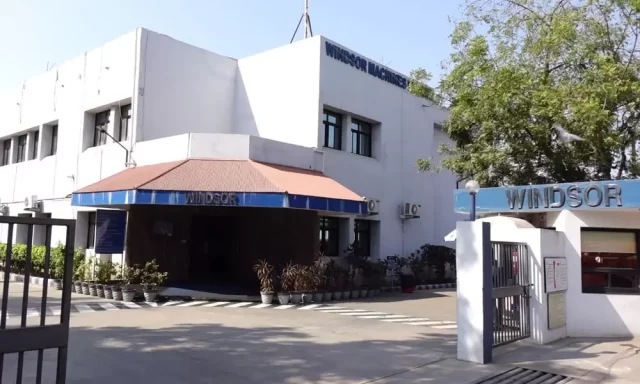
Windsor Machines is currently in the middle of a violent structural transformation. The numbers coming out of Q4 FY26 are a paradox of massive top-line expansion and razor-thin bottom-line survival. With a Market Cap of ₹2,678 Cr and a trailing P/E that has practically left the orbit at 2,214, the market is pricing in a future that looks nothing like the company’s past.
1. At a Glance
Windsor Machines is no longer the sleepy plastic machinery player of the last decade. It is being forcibly evolved into a multi-divisional precision engineering powerhouse. The core of this transformation is the September 2024 change in control, where Plutus Investments and Holding Pvt. Ltd. took a 53.9% stake, effectively clearing out the old guard and initiating a “clean-up” of the balance sheet.
The Aggressive Expansion Numbers:
- Revenue Growth: A staggering 54.7% YoY increase, reaching ₹570 Cr for FY26.
- Order Book: Standing firm at ₹231 Cr as of March 31, 2026.
- Capacity: Operations have moved to a massive 36-acre integrated facility in Rajkot, boosting capacity from a legacy level to 3,600 machines p.a., with a roadmap to hit 8,400.
The Red Flags You Cannot Ignore:
While the growth narrative is loud, the financial health indicators are whispering a different story. The ROE is a near-invisible 0.20%, and the ROCE sits at a measly 2.11%. More concerning is the Working Capital Cycle, which has ballooned from 63.6 days to a massive 189 days. The company is essentially tying up its cash in inventory and receivables to fuel this growth.
Furthermore, 36.8% of the promoter holding is pledged. In the world of serious finance, high growth backed by high pledges and stagnant return ratios is a cocktail that demands extreme scrutiny. Is the massive capital infusion of ₹725 Cr enough to outrun these operational inefficiencies?
2. Introduction
Windsor Machines Ltd, incorporated in 1963, has spent over six decades in the plastic processing machinery business. For years, it was known for its Injection Moulding and Extrusion lines. However, the FY25-26 period will be remembered as the “Great Reset.”
The company has successfully executed a “triple-play” strategy:
- Acquisition: Swallowed Global CNC and Unitech Workholding to pivot into high-precision metal cutting.
- Consolidation: Shut down legacy plants in Vatva and Chhatral to move everything under one roof in Rajkot.
- Monetization: Signed MOUs to sell off old industrial plots in Thane and Ahmedabad for over ₹300 Cr to fund this new identity.
The market is currently valuing Windsor not on its current earnings—which are negligible—but on its potential as an Import Substitution play. With the government imposing anti-dumping duties on Chinese machinery, Windsor is positioning itself as the “Made in India” alternative for high-tonnage machines.
3. Business Model – WTF Do They Even Do?
Windsor creates the “Mother Machines”—the heavy-duty equipment that other factories use to make products. They have broken their business into three distinct buckets:
- Injection Moulding (44% of Revenue): They build massive machines (up to 3200T) that squeeze plastic into shapes for cars and consumer goods. They are the only ones in India making machines this big, targeting a market previously dominated by European and Chinese imports.
- CNC Division (33% of Revenue): Through the Global CNC acquisition, they now make the machines that cut metal with micron-level precision. Think aerospace parts, defense components, and medical devices.
- Extrusion (23% of Revenue): These are