General information and education, not investment advice. The author is not a SEBI-registered adviser or research analyst. No recommendation, no promised returns. Markets carry risk including loss of capital. Figures may not be current. Always consult a SEBI-registered adviser.
1. At a Glance
Websol Energy System Ltd makes solar cells and the modules that hold them, at Falta in West Bengal. Cell output over the three months to June 2026 reached 259 MW, with modules at 103 MW. The same quarter a year earlier produced 126 MW of cells and 50 MW of modules.
Revenue from operations came to ₹372.60 crore, up 70.3% on the same quarter a year earlier. Profit after tax was ₹77.79 crore, a rise of 15.8%. EBITDA is earnings before interest, tax, depreciation and amortisation, and the company reports it excluding other income. On that measure it was ₹126 crore, up 21.4% over the year. The margin came in at 33.7%, against 47.3% in the three months to June 2025.
Two entries followed the close of the quarter, both in August. On 4 August the company repaid its entire outstanding IREDA term loan of ₹110 crore. The repayment came from internal accruals, meaning cash the business had generated itself. On 10 August the board approved the results and appointed two directors. It also accepted one director’s unwillingness to stand for reappointment and hired a new Company Secretary. That meeting ran from 1:45 p.m. to 4:30 p.m. and appears to have used every minute.
The confirmed order book stood at ₹1,278 crore on 30 June 2026, from ₹1,161 crore at March-end. A 600 MW Mono PERC cell line is being upgraded to a 750 MW TOPCon line. The company puts the cost at about ₹270 crore and the target at March 2027. The planned 4 GW greenfield expansion moved from Andhra Pradesh to West Bengal, some 1,700 kilometres. There was no financial outflow on the Andhra land, which resembles cancelling a hotel booking inside the free-cancellation window. Management’s explanation for the margin move is a mix explanation.
2. Introduction
The Websol group was incorporated in 1990 by Mr Sohan Lal Agarwal. It has made solar photovoltaic equipment since 1994, one of India’s earliest entrants into the business. Most of India ignored that business for the two decades that followed. The company’s presentation traces peak output per cell from 1.1 watt-peak in 1994 to an expected 9.5 watt-peak in 2027. Watt-peak is the measure used for a cell’s output at full sunlight. That is a tenfold improvement, achieved by a company that spent much of the journey financially quiet.
Quiet is putting it kindly. Sales were ₹17.22 crore in the year to March 2023 and ₹25.86 crore the year after. Those are figures more often associated with a mid-sized restaurant chain than a solar cell plant. Crisil, a credit-rating agency, attributes that trough in production and margin to a change of technology. Its rationale points to the transition out of multicrystalline cells into monoperc, which commenced operations in February 2024.
Sales then reached ₹575.46 crore in the year to March 2025 and ₹1,049.44 crore the year after. In September 2025 a second 600 MW Mono PERC line commenced production, doubling cell capacity to 1.2 GW. Module capacity at the plant stands at 550 MW. In December 2025 Crisil assigned ‘Crisil BBB+/Stable’ to ₹150 crore of bank facilities. The agency described an established market presence, with a share of around 10% in solar cell manufacturing.
Four entries have followed on the corporate calendar. A 1:10 stock split took effect in November 2025. In December 2025 the company signed an MoU with Linton Crystal to explore PV ingot and wafer manufacturing. Also in December 2025, an order from CIT(Appeals), the tax appeals authority, annulled a demand of ₹73.04 crore for 2016-17. Warrant conversion in March 2026 allotted 1.21 crore shares for ₹48.10 crore. The 4 GW project, approved by Andhra Pradesh in January 2026, has since been redirected to West Bengal.
US
Now live
US Stocks terminal is live
13,000+ US tickers · EDGAR fundamentals · screener and filings feed — the same terminal, for American markets.
Explore →
3. Business Model: WTF Do They Even Do?
Websol manufactures crystalline photovoltaic solar cells and the modules that hold them. Ind AS 108, the accounting standard on segment reporting, confirms a single operating segment. There is none of the diversified conglomerate energy that afflicts so much of listed India.
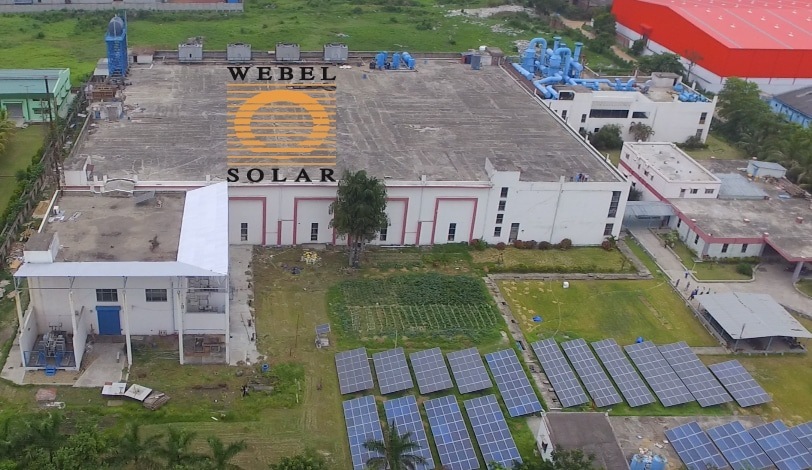
The physical arrangement runs like this: silicon wafers arrive and are processed into Mono PERC cells. The facility spans about 7 acres in the Falta Special Economic Zone. Cells then either leave as cells or are soldered into modules on the same campus. Of the 259 MW of cells produced in the three months to June 2026, about 153 MW were sold externally. The balance was consumed captively or held, so the company is partly its own customer. A cell can reach the module division without leaving the property, a supply chain measured in metres.
Cell efficiency currently averages around 23.3%, with the Mono PERC lines running above 90% utilisation. Efficiency is the entire sport here: the same square of silicon either converts that share of sunlight or it does not. A fraction of a percentage point separates a competitive line from a museum exhibit. The upgraded TOPCon line targets around 25%.
Where the output goes is a policy question as much as a commercial one. Management stated on the August call that Websol supplies “mostly DCR projects”, naming PM-Surya Ghar and PM-KUSUM. Domestic Content Requirement tenders can