1. At a Glance
The financial architecture of VST Tillers Tractors Ltd currently presents a striking, dual-faceted narrative. For the full financial year ending March 2026, the company recorded its highest-ever annual turnover, reaching ₹ 1,240 crore. This achievement marks an impressive 24.7% year-on-year expansion from the previous year’s base of ₹ 995 crore. Volume growth across the small farm mechanization business provides strong operational validation. Annual power tiller volumes crossed the key milestone of 50,000 units, expanding by 34.9%, while power weeders posted an explosive 52.1% volume surge to 11,346 units. Structurally, the company continues to establish deep roots across India’s core rural landscape, where small and marginal landowners represent approximately 80% of the farming demographic. This market penetration is further supported by an expanding retail financing ecosystem, which now finances 12% to 13% of its power tiller volume compared to historic near-zero levels.
However, looking past these full-year volume numbers reveals a massive quarterly breakdown in profitability. For the fourth quarter ending March 2026, the company reported revenue of ₹ 328.46 crore, indicating a stable top-line growth of 8.97% against the ₹ 301.43 crore recorded in the same period last year. Yet, its Net Profit (PAT) for the exact same quarter plummeted by an astonishing 78.82%, collapsing to a minor ₹ 5.29 crore from ₹ 24.98 crore in the corresponding prior-year period.
This severe bottom-line contraction stems from intense volatility across non-operating line items. Other income for the final quarter turned deeply negative, recording a net loss of ₹ 31.20 crore due to mark-to-market adjustments on corporate treasury investments. This non-operating drag was further exacerbated by a sharp spike in the quarterly effective tax rate, which jumped to 40.63%.
Furthermore, while the small farm equipment segment has shown strong momentum, the core domestic tractor segment continues to lag behind broader industry indices. Total tractor sales remain constrained, and export tractor volumes fell by 6.7% over the full fiscal year, reflecting ongoing macroeconomic headwinds in key European markets.
Alarmingly, the structural efficiency of the balance sheet appears to be undergoing asset intensification. The company’s working capital cycle has expanded dramatically, with working capital days surging from 131 days to 245 days. This significant slow-down in inventory velocity and cash conversion raises serious operational questions. Investors are left to parse whether the historic full-year revenue milestone points to sustainable structural scaling, or if the severe quarterly earnings breakdown exposes structural vulnerabilities in non-operating risk management.
2. Introduction
VST Tillers Tractors Ltd occupies a highly specialized, historically fortified position within India’s agricultural capital goods sector. Established in 1967 by the century-old VST Group of companies under the leadership of Sri V.S. Thiruvengadaswamy Mudaliar, the enterprise established its initial technical and manufacturing foundation via a strategic joint venture with Japan’s Mitsubishi Heavy Industries Ltd. Over the subsequent decades, these legacy international manufacturing collaborations naturally expired. Today, the founding VST family retains clear managerial control, backed by a stable 55.61% equity stake in the listed entity.
The operational environment of the enterprise is fundamentally intertwined with the cyclical nature of India’s rural economy. Demand for its product pipeline is driven by monsoon distribution patterns, localized crop yield economics, and the allocation schedules of state-level capital subsidies. Operating from four state-of-the-art manufacturing hubs across Bangalore, Malur, Mysore, and Hosur, the company has positioned itself as India’s largest manufacturer of power tillers, holding a dominant market position.
By focusing heavily on small farm mechanization, the company has historically insulated its operations from the high-horsepower tractor categories dominated by large domestic industrial conglomerates. However, this focused positioning exposes its financial performance to sudden changes in state-level budgetary allocations.
Currently, the organization is navigating a multi-layered transition. Management is shifting its commercial strategy away from traditional, centralized tractor dealerships toward a highly localized distributor-retailer network designed to reach taluka-level rural markets. Simultaneously, significant internal capital is being deployed to upgrade its powertrain architectures, including the roll-out of the Fuel Efficient and Torque Max engine platform, alongside newer corporate joint ventures targeting higher-horsepower market segments. The performance of the past fiscal year tests whether this infrastructure can support consistent returns when non-operating adjustments introduce massive earnings volatility.
3. Business Model – WTF Do They Even Do?
To understand how this business operates without getting lost in marketing jargon, you have to look at the realities of small-scale Indian farming. The business model is built entirely around serving the marginal farmer who cannot afford, and does not require, a multi-ton, full-sized commercial tractor.
+-----------------------------------------------------------------+
| VST TILLERS TRACTORS LTD |
| BUSINESS MODEL |
+-------------------------------+---------------------------------+
| 1. Small Farm Machinery (SFM) | 2. Compact Tractors (FIELDTRAC) |
| - Power Tillers (Walking) | - 4WD Compact Form Factors |
| - Power Weeders & Reapers | - Domestic Niche & EU Exports |
+-------------------------------+---------------------------------+
| 3. Precision Components | 4. Digitized Distribution |
| - Crankshafts & Blocks | - Spares, Parts & Lubricants |
| - Supplies Internal Assembly | - 3,000+ Taluka Retail Counters |
+-------------------------------+---------------------------------+
Small Farm Machinery (SFM)
This is the primary financial driver of the enterprise. The core product is the power tiller—essentially a two-wheeled, walking tractor where the operator guides the machine from behind. These units are lightweight, highly maneuverable, and specifically optimized for small, fragmented land parcels and wet paddy cultivation. The company commands a dominant 70% market share in this domestic niche. This division also includes power weeders and power reapers, offering low-cost mechanization alternatives.
Tractors
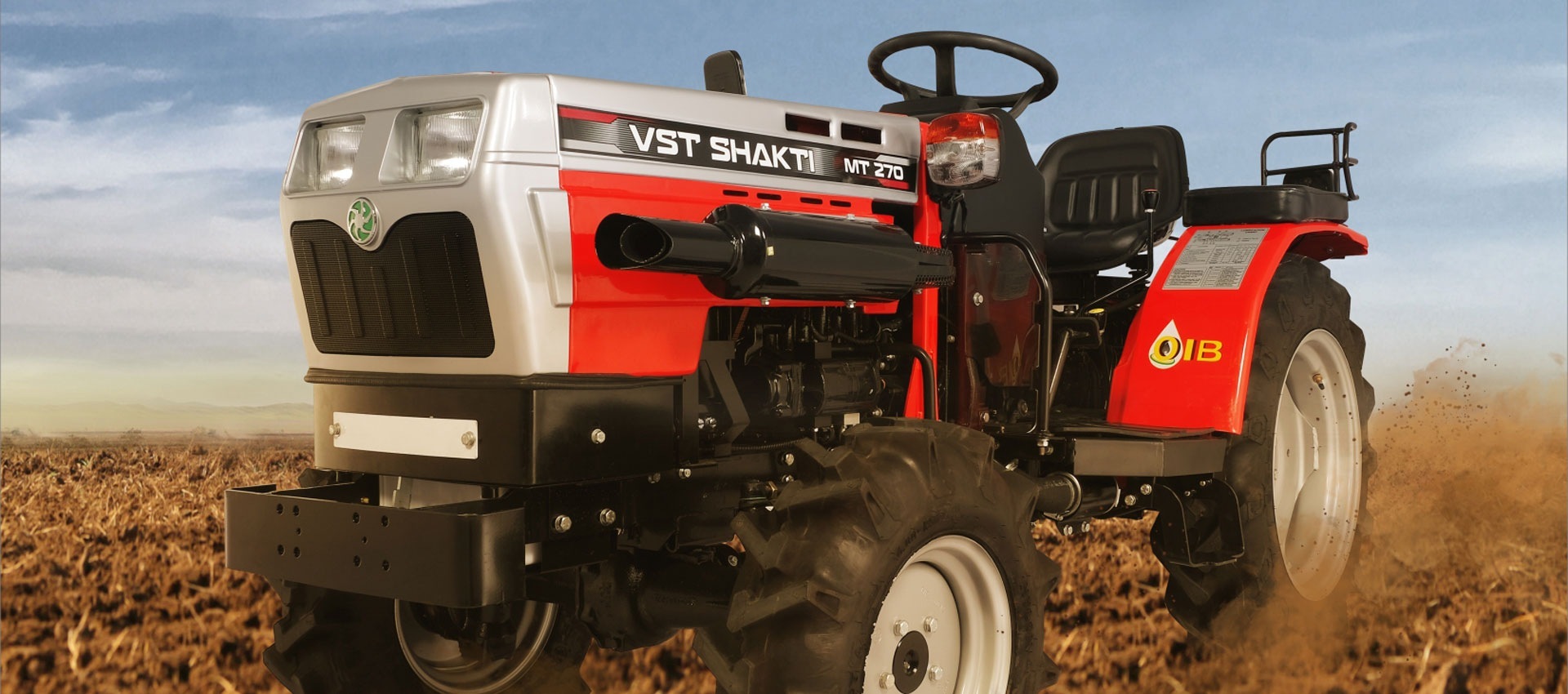
The company deliberately avoids direct competition with massive commercial tractor players. Instead, it focuses on compact, four-wheel-drive agricultural tractors. These units are distributed domestically and exported to various European Union markets under the FIELDTRAC brand, maintaining a 7% market share in the domestic compact tractor niche.
Precision Components & Auxiliary Distribution
The company runs an internal precision machining