Vraj Iron & Steel Ltd — FY2026: A ₹588 Crore Company Running a Very Busy Construction Site
Spotted a factual error — a wrong number, date, or fact? Tell us and we will check the source.
General information and entertainment, not investment advice. The author is not a SEBI-registered adviser or research analyst. No recommendation, no promised returns. Markets carry risk including loss of capital. Figures may not be current. Consult a registered adviser before acting.
1. At a Glance
Vraj Iron and Steel Limited closed FY2026 with consolidated revenue of ₹588 crore — up 24% from ₹475 crore in FY2025. The topline grew. Almost everything else compressed.
PAT fell to ₹32 crore from ₹44 crore, a 27% decline. Operating profit margin contracted to 10% from 13%. Depreciation nearly tripled — from ₹8 crore to ₹23 crore — as new capacity arrived on the books. The balance sheet has grown from ₹417 crore to ₹480 crore in total assets, with fixed assets alone jumping from ₹195 crore to ₹273 crore.
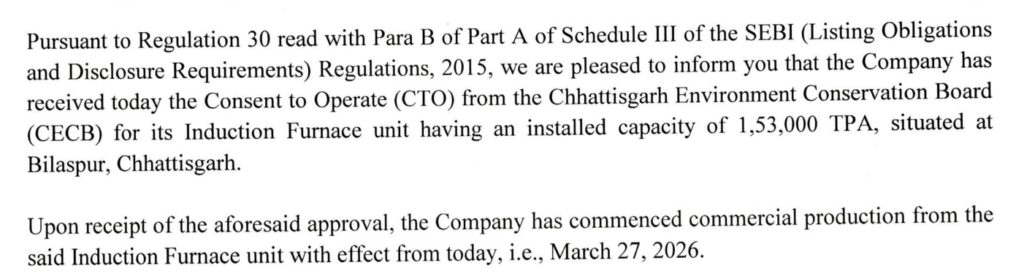
Three plants commissioned over 15 months: additional sponge iron (December 2024), a 15-MW waste heat recovery boiler (March 2025), and the long-delayed 153,000 TPA Bilaspur billet plant (March 27, 2026 — 11 months behind schedule). A 15-MWp solar plant commissioned December 18, 2025, added another ₹49 crore to the cost base, funded through ₹38 crore of new debt.
The market currently prices this at 12x earnings and 0.94x book — both figures sitting well below the sponge iron peer median. The central tension of FY2026: a company with a revenue line that grew 24% and a profit line that fell 27%, simultaneously running one of the more ambitious capacity build-outs in its sector segment. What the expanded asset base delivers in FY2027 is a question the numbers haven’t yet answered.
2. Introduction
Vraj Iron and Steel Limited was born in 2004 as Phil Ispat Private Limited, a quiet Chhattisgarh steelmaker with no particular fame. In FY2012, Gopal Sponge and Power Private Limited (GSPPL) acquired a controlling stake and the company eventually got its present name in November 2023. It listed on BSE and NSE in July 2024, raising ₹171 crore through an IPO — proceeds earmarked for debt repayment (₹70 crore) and the Bilaspur expansion (₹59.5 crore).
The post-IPO chapter has been defined almost entirely by construction. The company set out to expand aggregate production capacity from 231,600 TPA to over 500,000 TPA, while simultaneously scaling captive power from 5 MW to 35 MW-plus (20 MW WHRB and 15 MW solar). Each element arrived, but not always on schedule: the sponge iron plant made it in December 2024, the WHRB power plant in March 2025, and the billet plant — originally targeted for April 2025 — finally received its Consent to Operate on March 27, 2026. Management attributed the billet delay to early monsoon onset and supplier delays, per filings.
Through FY2026, the company also signed a Long-Term Agreement with NMDC for iron ore (October 2024), won a coal linkage auction for 78,000 MT per annum (February 2025), and acquired a 49.90% stake in Vraj Metaliks Private Limited (September 2024). The promoter structure is itself in motion: a December 2025 announcement flagged a merger of promoter entities that will consolidate Gopal Sponge and Power’s direct stake from 54.52% to 71.37%.
CARE Ratings reaffirmed the CARE A-; Stable rating on bank facilities in February 2026 and confirmed in May 2026 that IPO proceeds were fully and correctly deployed.
3. Business Model: WTF Do They Even Do?
Vraj Iron makes steel — specifically the kind of steel that gets made in Chhattisgarh, from raw materials sourced in Chhattisgarh, and sold largely within Chhattisgarh. The geographic concentration is not incidental; it is the business model.
The production chain is semi-integrated. Iron ore and coal go in one end. Sponge iron comes out. Most of the sponge iron gets captively consumed to make MS billets. Most of the billets get further processed into TMT bars sold under the “Vraj” brand. The remainder at each stage gets sold externally. By-products — dolochar, pellets, pig iron — get sold too.
The revenue mix, based on 9MFY24 data in the prospectus, was roughly 53% sponge iron, 30% TMT bars, and 14% MS billets. The strategic direction, per CARE Ratings, is a gradual shift toward downstream TMT, where margins tend to be less commoditised.
Captive power has become increasingly central. The 20-MW WHRB plant (waste heat from sponge iron kilns converted to electricity) is textbook cost engineering in this sector — running on exhaust rather than the grid. The new 15-MWp solar plant, commissioned December 2025, adds another layer of self-sufficiency. Between the two, the company has materially reduced its reliance on purchased power, which CARE identifies as a positive contributor to the cost structure.
The strategic location near raw material sources (iron ore and coal belt of Chhattisgarh) and good road-rail connectivity to Raipur railway station are flagged by CARE as meaningful cost advantages, particularly because freight costs constitute a significant portion of landed cost in this business.
What the model doesn’t do: it doesn’t export, doesn’t operate nationally, and doesn’t sell retail. Top five customers accounted for roughly 32% of FY25 revenue — moderate concentration for a B2B industrial operation. The customer base is industrial rather than retail, which reduces demand volatility but tightens the geographic exposure.
The newly commissioned 153,000 TPA billet plant at Bilaspur arrived just before the financial year closed. Its contribution to FY2026 results is essentially nil — commercial production began March 27, 2026. The full-year effect of this capacity, plus the 115,500 TPA additional sponge iron commissioned in December 2024, rolls into FY2027. The business currently has significantly more production infrastructure than its FY2026 numbers reflect.
4. Financials Overview
Figures are consolidated, in ₹ crore.
Quarterly Results — March 2026
Metric
Mar 2026
YoY (vs Mar 2025)
QoQ (vs Dec 2025)
Revenue
170
+14%
+17%
Operating Profit
25
+56%
+400%
PAT
16
+23%
+1,457%
EPS (₹, not annualised)
4.72
+46%
+1,330%
The March 2026 quarter recovered sharply from the unusually compressed December 2025 quarter (PAT of ₹1 crore, OPM of 4%). Revenue grew, operating profit recovered to ₹25 crore, and PAT reached ₹16 crore — the strongest quarter of FY2026. The December 2025 quarter’s compression is visible in the data; no cause is attributed in the filings beyond what CARE describes as muted realisation across products in Q3FY26.