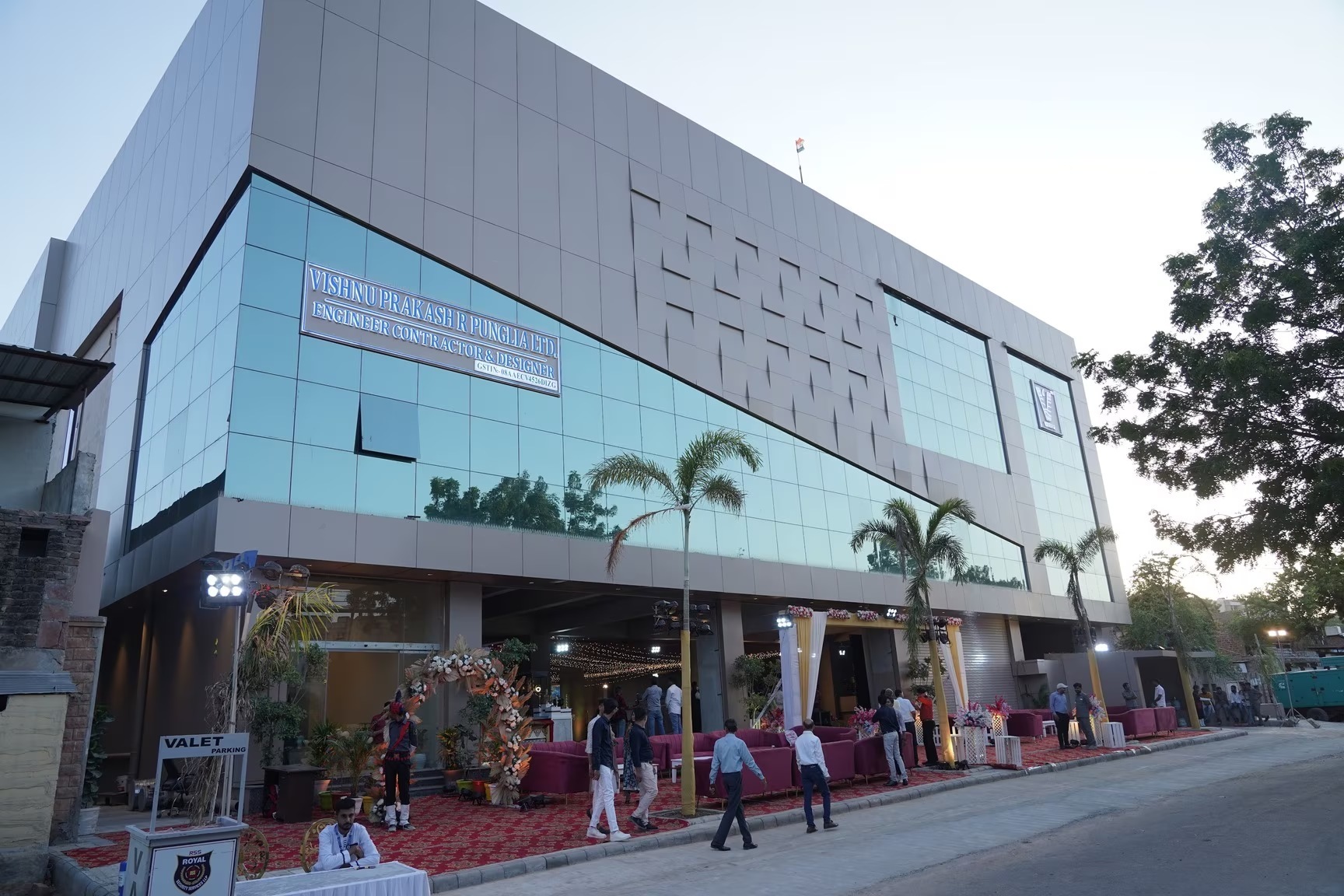
Vishnu Prakash R Punglia FY26: A ₹150 Crore Loss, a 93% Pledge, and an Auditor Who Said the Words “Going Concern”
Spotted a factual error — a wrong number, date, or fact? Tell us and we will check the source.
General information and entertainment, not investment advice. The author is not a SEBI-registered adviser or research analyst. No recommendation, no promised returns. Markets carry risk including loss of capital. Figures may not be current. Consult a registered adviser before acting.
1 — At a Glance
For five straight years, this Jodhpur-based infrastructure contractor printed profits that climbed like a well-managed staircase: ₹45 crore in FY22, ₹91 crore in FY23, ₹122 crore in FY24. Then FY26 arrived and the staircase ended at a cliff. Revenue fell to ₹851 crore from ₹1,237 crore the year before — a 31% drop. Profit after tax came in at minus ₹150 crore, against a positive ₹59 crore in FY25. The full-year EPS reads minus ₹12.04.
Most of the damage landed in a single quarter. The March 2026 quarter alone carried a pre-tax loss of ₹152 crore and an operating loss of ₹125 crore, against quarterly revenue of just ₹102 crore. A company that did ₹657 crore of sales in the March 2024 quarter did ₹102 crore in the March 2026 one.
The balance sheet tells a parallel story: borrowings of ₹650 crore against a net worth of ₹630 crore, and promoters who now hold 44.6% of a company they held 67.8% of a year ago. The auditors attached a going-concern note. A construction firm with a ₹5,000 crore order book reported the worst annual loss in its listed life in the same year its credit rating was cut to BB- and marked “Issuer Not Cooperating.”
How does a profitable contractor with a full order book post a ₹150 crore loss? The answer, by management’s own telling, lives in receivables that stopped arriving on time. Whether that is a timing problem or a deeper one is the question the rest of this entry sits with.
2 — Introduction
Vishnu Prakash R Punglia Limited began in 1984 as a partnership concern run by Vishnu Prakash Punglia and his family, became a public limited company in 2013, and listed on the BSE and NSE in September 2023. It builds infrastructure — chiefly water supply systems — for central and state governments, urban local bodies, and autonomous authorities. It is registered as an ‘AA’ class contractor with Rajasthan’s Public Health Engineering Department, a credential it has leaned on for four decades.
The listing in 2023 caught the company mid-sprint. Revenue had nearly quadrupled from ₹372 crore in FY20 to ₹1,474 crore in FY24, and the order book swelled past ₹5,000 crore. The growth was real, and so was the working capital it consumed.
The recent record reads as a sequence of escalating distress signals. CARE downgraded the company from BBB+ to BBB- to BB+ and finally, on June 9, 2026, to BB- with an Issuer-Not-Cooperating tag. Two railway contracts were terminated by the awarding authorities, with bank guarantees ordered encashed; the Rajasthan High Court has stayed the encashments pending hearings. SEBI fined the company ₹200,000 in February 2026 for delayed disclosures. And promoters, across late FY26, diluted roughly 19% of their stake and pledged most of what remained to keep the business liquid.
3 — Business Model: WTF Do They Even Do?
They dig, lay pipe, and wait for the government to pay. That is the model, dressed in the language of “EPC infrastructure.”
Concretely: water supply projects — pipelines, reservoirs, treatment plants, overhead tanks, the unglamorous plumbing of public water — made up about 76% of activity in H1 FY25, down from 89% in FY22. Railway work (tracks, stations, foot-over bridges) has grown to roughly a third of the order book. Roads and irrigation canals fill out the rest. The company runs an integrated model with an in-house team and a fleet of 500-plus pieces of construction equipment, which is its way of saying it would rather own the excavator than rent it.
The customer base is the elegant part and the trap. Nearly all the orders come from government entities — low risk of the customer vanishing, high risk of the customer paying eleven months late. The order book is overwhelmingly tied to schemes like Jal Jeevan Mission, and management has been explicit that Jal Jeevan is precisely where payments jammed.
Here is the structural joke of the construction business, told in this company’s numbers: you spend cash today to build something the government certifies and pays for much later. In good years, that lag is financed cheaply and the order book looks like destiny. In a year where certifications slow and receivables balloon, the same model that printed ₹122 crore of profit can manufacture a ₹150 crore loss — and the order book just sits there, full and unhelpful, a promise the balance sheet can’t yet eat.
Reader question: when the entire customer base is one slow-paying counterparty wearing different government letterheads, is a ₹5,000 crore order book an asset or a financing obligation?
4 — Financials Overview
Figures are consolidated, in ₹ crore. This is the FY26 annual result, with the year ended March 31, 2026 as the latest period.
Metric
FY26
FY25
YoY
Revenue
851
1,237
-31%
EBITDA
-82
164
swung to loss
PAT
-150
59
swung to loss
EPS (₹)
-12.04
4.70
swung to loss
EBITDA here is PBT plus interest plus depreciation (-177 + 74 + 22 = -82). Every line that was positive a year ago is negative now, and the swing is not subtle.