01 — At a Glance
The Discount Retailer That’s Trading at a Premium Investor’s Dream
- 52-Week High / Low₹158 / ₹96.3
- TTM Revenue (FY25)₹12,340 Cr
- TTM PAT (FY25)₹786 Cr
- Full-Year EPS (FY25)₹1.69
- Q3 FY26 EPS (Dec 2025)₹0.67
- Book Value₹14.8
- Price to Book7.58x
- Dividend Yield0.00%
- Debt / Equity0.27x
- Return 3 months-14.0%
Auditor’s Opening Note: Vishal Mega Mart closed Q3 FY26 with ₹3,670 crore revenue (+17% YoY), ₹313 crore PAT (+19.1% YoY), and a 66.5x P/E ratio. The stock is down 14% in three months even though earnings grew 36% (TTM). Management insists the adjusted same-store sales growth is a clean 10% after removing “festival timing” distortions. That adjustment is doing more heavy lifting than a Vishal trolley on checkout day. We dug in.
02 — Introduction
The Store That Was Too Cheap to IPO, Now Too Expensive to Ignore
Vishal Mega Mart is what happens when a private equity backer (Kedaara Capital) decides discount retail needs a ₹50,000 crore makeover. Incorporated in 2001, it spent 23 years perfecting the art of selling apparel, groceries, and home essentials to India’s middle and lower-middle-income groups without the stock market knowing it existed. Then, in December 2024, it IPO’d at ₹75 per share, raised ₹8,000 crore, and watched its stock trade at ₹158 within weeks before settling at ₹112 today.
The narrative is seductive: 771 stores across 517 cities, 13.2 million square feet of retail space, and 36% profit growth over 12 months. Add in the fact that it’s opening 80–100 stores annually, experimenting with quick commerce (723 stores, 12 million users), and has management that walks concalls with precision-engineering exactitude about “adjusted SSSG” and “premiumization,” and you get the vibe. This is retail for engineers. Very un-Indian retail energy.
But here’s the uncomfortable bit: a 66.5x P/E valuation in an organized retail sector trading at 36.6x median P/E means Vishal is baked with expectations the size of a Durga Puja pandal. The stock has delivered 6.96% return in one year and -27% in six months. That’s volatility that’ll make your SIP nervous. Management’s Q3 concall spent more time explaining “festival adjustments” to SSSG than actually celebrating a record quarter. Let’s figure out if this is a generational bargain or just a well-marketed Dunning-Kruger case study in polyester retail.
Concall Clarity (Jan 2026): “That is what we expect… ~10% SSSG… and that would be our endeavor.” — Management. Translation: they hope, they work hard, and they’ll adjust metrics in both directions if the market changes. Very Delhi-school planning.
03 — Business Model: WTF Do They Even Do?
Buy Cheap, Dress It Up, Sell to Tier II India, Repeat.
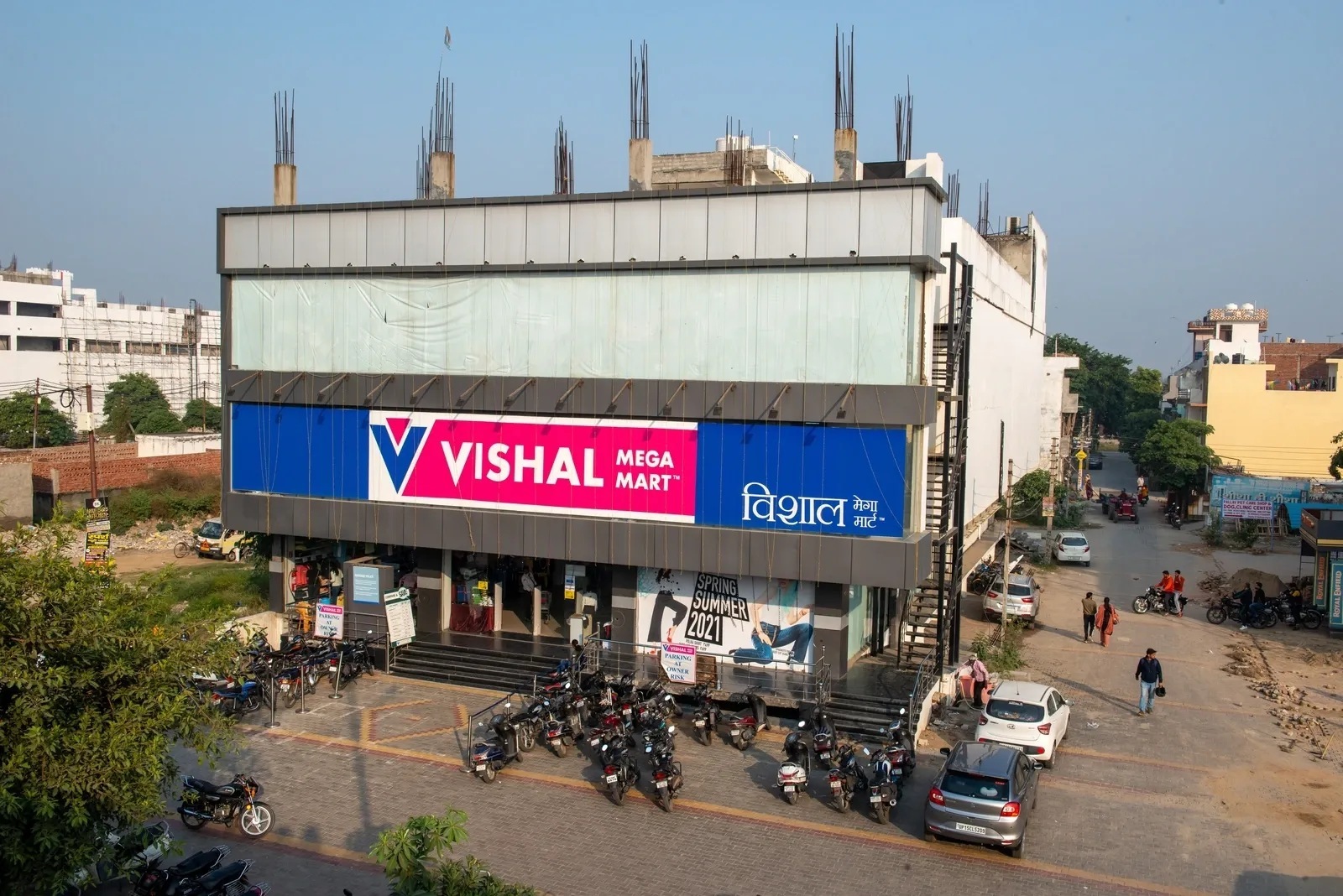
Vishal Mega Mart runs what might be the simplest retail playbook in India: buy apparel, general merchandise, and FMCG from 850+ third-party contract manufacturers, put your own label on 74.7% of it, slap them in 771 stores across small towns and rural areas where a ₹2,000 pair of jeans is aspirational, and pocket the 14–16% operating margin. The business is almost stupid in its straightforwardness—except it works, and it scales, and it doesn’t require venture capital to explain why it’s “disrupting” anything.
The revenue split is dead simple: Apparel 43%, FMCG 45%, General Merchandise 12%. Geography? North dominates with 40% of revenue. East, South, and West tag along. The core customer is aged 25–55, monthly income ₹30,000–₹80,000, lives in Tier II/III cities, and shops at Vishal Mega Mart because it’s within walking distance and the prices make her feel like a member of the middle class rather than a bargain hunter. That customer is real. Her repeat visits are real. Her transaction growth is real (management quantified it: ~70% of SSSG comes from more transactions, not higher bill values).
Distribution is a hub-and-spoke model: one central DC near Delhi, one additional regional DC, and 17 regional centers that feed 771 stores. It’s linear, boring, and profitable. The company is now building a 600,000 sq ft automated warehouse in Haryana (near Gurgaon) to handle future capacity without scaling headcount. That’s not a growth story. That’s infrastructure maturity. It’s the opposite of exciting, which is exactly why it works.
Own Brands %74.7%Revenue Mix
Stores Operational771As of Dec 2025
Quick Commerce723Stores Enabled
Cities Covered517Pan-India
Own Brand Strategy: 19 of Vishal’s own brands have crossed ₹100 crore in annual revenue. Six have exceeded ₹500 crore. This isn’t just relabeling generic merchandise—it’s a supply chain moat. When your customers trust your brands more than the original manufacturer’s, pricing power follows. Management quantified it: 73.1% own brand contribution in FY25 (up 100 bps). For context, most discount retailers manage 40–50%.
💬 Would you rather shop at Vishal Mega Mart for a ₹999 shirt or wait for Amazon to deliver a Myntra alternative? The choice your grandmother makes answers this question.
04 — Financials Overview
Q3 FY26: The Numbers Nobody Expected to Be This Clean
Result type: Quarterly Results | Q3 FY26 EPS: ₹0.67 | Annualised EPS (Q3×4): ₹2.68 | Full-year FY25 EPS: ₹1.69 | TTM EPS: ₹1.88
| Metric (₹ Cr) |
Q3 FY26
Dec 2025 |
Q3 FY25
Dec 2024 |
Q2 FY26
Sep 2025 |
YoY % |
QoQ % |
| Revenue | 3,670 | 3,136 | 2,981 | +17.0% | +23.1% |
| Operating Profit | 605 | 505 | 395 | +19.8% | +53.2% |
| OPM % | 16.5% | 16.1% | 13.3% | +40 bps | +320 bps |
| PAT | 313 | 263 | 152 | +19.1% | +105.9% |
| EPS (₹) | 0.67 | 0.58 | 0.33 | +15.5% | +103.0% |
The Adjusted Reality: Management’s 9M FY26 SSSG narrative (adjusted 10.3%, reported 9.1%) is a masterclass in “true underlying growth” speak. They removed Durga Puja timing shifts (a 2.1% adjustment factor between Q2 and Q3), refurbishment store closures, and infrastructure disruptions. The reported 9M profit growth of +30% (PAT ₹671 cr vs ₹516 cr) is real. Whether the “adjusted” figures provide cleaner analysis or just better-looking ppt slides is your call. We split the difference: underlying momentum is sound, but expect volatility around seasonal festivals and store refurbishments.
05 — Valuation: Fair Value Range
Is This a Retail Steal or Retail Theatre?
Join 10,000+ investors who read this every week.