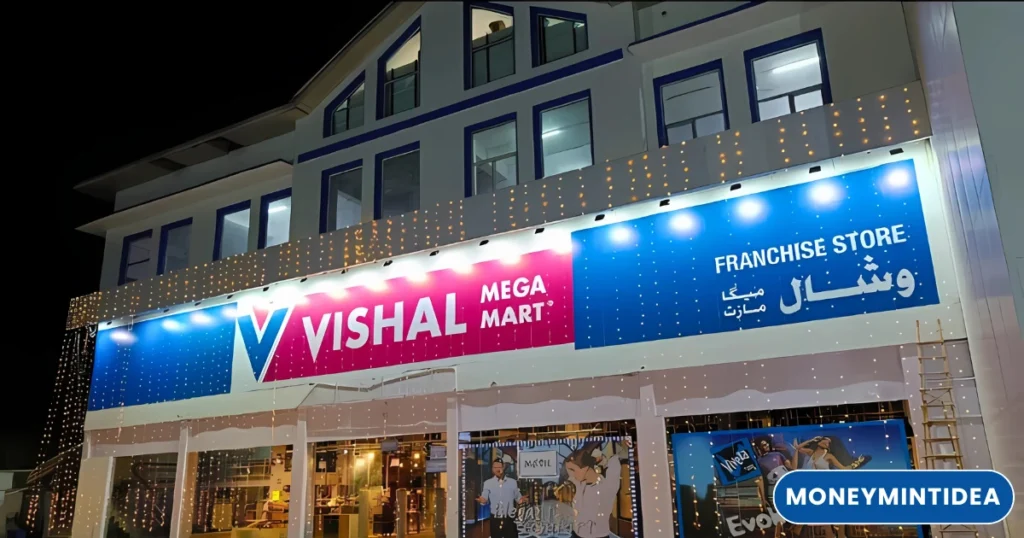
Vishal Mega Mart Ltd: India’s Budget Walmart with ₹11,260 Cr Sales, 645 Stores, and a P/E Taller Than Its Shelves
1. At a Glance
Vishal Mega Mart is India’s desi hypermarket chain for the middle-class shopper who wants everything under one roof — from cheap jeans to atta, LED bulbs, and plastic buckets. With ₹11,260 Cr sales, ₹688 Cr PAT, and a stock P/E of 104x, this company is priced like a luxury Louis Vuitton, while selling daily wear worth “Buy 1 Get 2 Free.” The promoters recently cut their holding from 74.5% to 54.2% (thanks IPO + dilution), but investors are still piling in. Because who doesn’t like a monopoly in small-town India’s wallet?
2. Introduction
Incorporated in 2001, Vishal Mega Mart started as the middle-class cousin of Big Bazaar, and unlike its more glamorous peers, it actually survived the retail apocalypse. Today it operates 645 stores across 414 cities, with a massive presence in Tier-2 and Tier-3 towns. It’s not just a supermarket; it’s the weekly mela for families where the father bargains for trousers, mother hoards steel utensils, and kids cry for Kurkure.
Their secret? Private labels. 26 in-house brands now account for 73% of revenues. That’s like running your own versions of Lux, Colgate, and Levi’s but cheaper, so nobody complains when the stitching comes loose.
Investors are drooling over the fact that Vishal has become one of India’s top three offline retailers by space (11.5 million sq ft). Add to it a lean hub-and-spoke supply chain and partnerships with 839 vendors for third-party manufacturing — and suddenly, Vishal looks less like a “kirana upgrade” and more like a systemized retail machine.
But here’s the paradox: while sales growth is 20%+, margins are wafer-thin. Net margin is only 5.9%. That means for every ₹100 shirt they sell, they keep less than ₹6. The rest goes into rent, salaries, electricity, and discounts. Investors, however, are valuing it like Avenue Supermarts (DMart) 2.0.
3. Business Model – WTF Do They Even Do?
Vishal Mega Mart makes money by selling three things:
Apparel (44% of revenue): In-house shirts, jeans, kurtas, innerwear. This is the big driver. Their ₹299 jeans are so popular that shoppers often wear them out of the store itself.
General Merchandise (29%): From mixer grinders to plastic chairs, they sell everything you didn’t plan to buy but end up buying anyway.
The strategy is simple: lure customers with FMCG, make them buy apparel, and tempt them with home goods on the way out. 73% sales come from own brands, making them the Reliance Trends for small towns but at Walmart scale.
Their hub-and-spoke distribution is key. One central DC, 17 regional centers, and one backup DC ensure that inventory moves efficiently. Unlike kiranas who rely on distributors, Vishal manages its own supply chain — which explains why you always find stock but rarely find branded products at competitive prices.
4. Financials Overview
Metric
Latest Qtr (Jun’25)
YoY Qtr (Jun’24)
Prev Qtr (Mar’25)
YoY %
QoQ %
Revenue (₹ Cr)
3,140
2,596
2,548
20.9%
23.2%
EBITDA (₹ Cr)
459
366
357
25.4%
28.5%
PAT (₹ Cr)
206
150
115
37.3%
79.1%
EPS (₹)
0.44
0.33
0.25
33.3%
76.0%
Commentary: Revenues growing faster than onion prices, PAT growth even juicier. Annualised EPS = ₹1.76. At CMP ₹153, the P/E is 87x forward. Market clearly thinks Vishal is DMart’s long-lost twin.
5. Valuation – Fair Value Range Only
P/E Method Annualised EPS = ₹1.76. Retail peers trade 40–110x. Fair Value Range (60x–80x) = ₹105 – ₹140.
EV/EBITDA Method FY25 EBITDA = ₹1,624 Cr. EV = ₹72,645 Cr. EV/EBITDA = 44.7x. Peers trade 25–35x. Fair Value Range = ₹8000 – ₹60,000 Cr EV → per share ₹110 – ₹130.
DCF Method Assume 18% CAGR sales, 6% net margin, 12% WACC. Fair Value Range = ₹115 – ₹145.
👉 Consolidated Fair Value Range: ₹105 – ₹145.
Disclaimer: Educational purposes only, not investment advice.
6. What’s Cooking – News, Triggers, Drama
IPO Buzz: ₹8,000 Cr IPO (all OFS). Translation: promoters cashing out, no fresh funds for expansion.
Store Expansion: Added 72 stores in FY25, now at 717 by Q1 FY26. Focus remains on Tier-2+ cities.
Quick Commerce Entry: 670 stores now servicing Q-commerce orders (competing with Zepto, Blinkit). Vishal’s play: hyperlocal delivery of cheap FMCG + apparel.