Vikas Lifecare FY26: A ₹116 Crore Operating Loss That Still Filed as a Profit
Spotted a factual error — a wrong number, date, or fact? Tell us and we will check the source.
General information and entertainment, not investment advice. The author is not a SEBI-registered adviser or research analyst. No recommendation, no promised returns. Markets carry risk including loss of capital. Figures may not be current. Consult a registered adviser before acting.
1 — At a Glance
The headline number for Vikas Lifecare’s FY26 is a net profit of ₹18.41 crore. The operating profit for the same year is minus ₹116 crore. Both figures are real, both sit on the same statement, and the gap between them is filled almost entirely by an “Other Income” line of ₹135.74 crore. A company whose core trading and manufacturing segments lost money for the year reported its best bottom line in three years, and the engine of that turnaround was not the engine that sells anything.
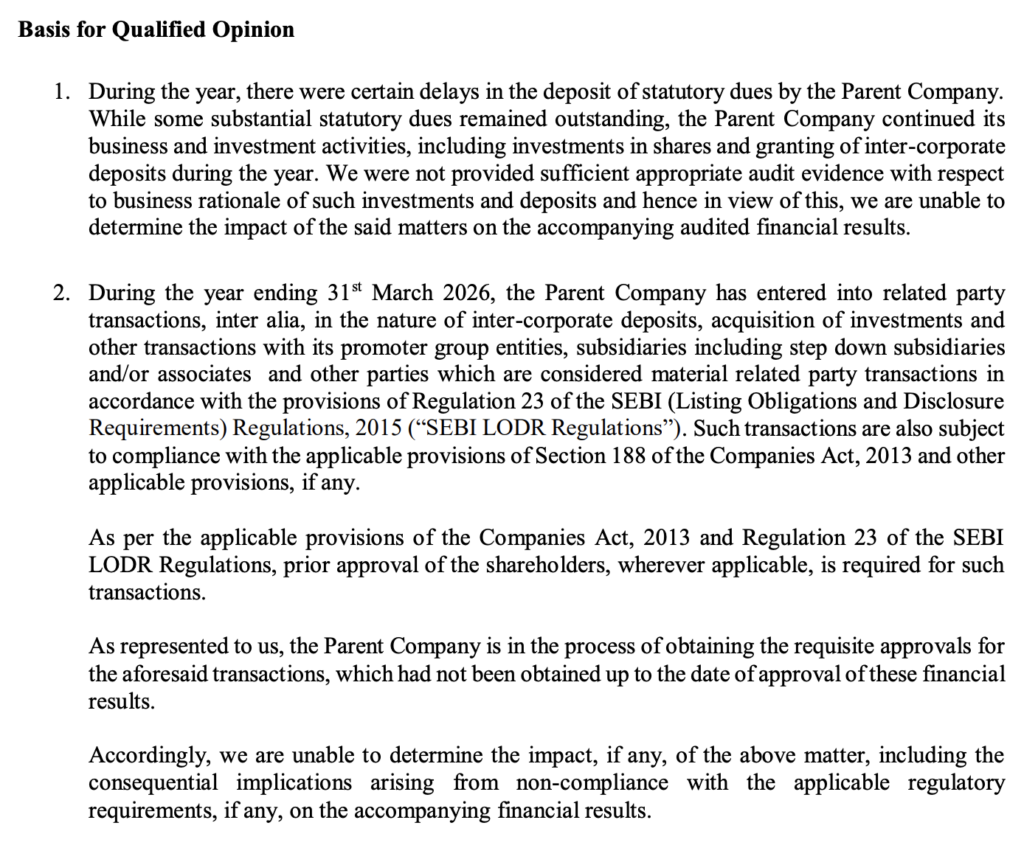
Revenue did grow — ₹480 crore to ₹499 crore, a 4% rise. But the operating margin moved from -2% in FY25 to -23% in FY26, the worst in the visible record. Against this, the audited results carry a qualified opinion, a provisional Enforcement Directorate attachment of properties valued at ₹1,333.84 lakh tied to the Mahadev Online Book matter, and an ongoing SEBI investigation under Section 11C.
The market currently pays 14.7x earnings and 0.49x book value here. A balance sheet that carries ₹394 crore of investments against a ₹271 crore market cap, and a profit line that depends on a foreign associate it does not yet control — that is the tension this entry records.
What does a 4% revenue rise mean when the operating line went ₹2,700 basis points the wrong way?
2 — Introduction
Vikas Lifecare Limited, formerly Vikas Multicorp Limited, was incorporated in 1995. The company describes itself across four broad activities: trading in base polymers and chemicals, manufacturing up-cycled polymer compounds, plastic-waste recycling to meet EPR obligations, and an FMCG-and-healthcare cluster that includes smart gas meters, agro products, and infrastructure fittings.
That is the description. The FY26 financials tell a more crowded story. During the year the company contributed ₹297.7 crore (US$34.83 million) towards the acquisition of Ebix Inc. as part of a consortium led by Eraaya Lifespaces. When repayment did not arrive by January 2025, the company invoked arbitration; a settlement deed during the June 2025 quarter transferred it 51% of Ebix International Holdings Limited. Per the filing, the company does not yet exercise control over that entity, so the stake is carried as an associate under the equity method.
The same year brought a ₹52 crore debenture settlement with Hallow Securities, a ₹26.44 crore set of income-tax demands, the disposal of a beverage subsidiary at a ₹7.06 crore loss, and a Delhi property sold at a ₹2.56 crore loss. The board approved the audited FY26 results on 24 June 2026. The auditors signed with a qualified opinion.
3 — Business Model: WTF Do They Even Do?
On paper, the spread is impressive. Polymers, agro, infrastructure fittings, smart gas meters through Genesis Gas Solutions, packaged beverages, an NBFC interest, and — per the dump’s own list — the entertainment industry. The segment data narrows it considerably: for FY26, the Agro division did ₹407 crore of the ₹499 crore, polymers ₹27 crore, and infrastructure ₹58 crore. The conglomerate sprawl resolves, on the revenue line, into mostly agro trading.
And agro trading is a thin business. The Agro segment’s pre-tax-and-interest result was ₹12.06 crore on that ₹407 crore — a low-single-digit segment margin doing the heaviest lifting. The polymers segment, the company’s namesake activity, contributed ₹1.37 crore of segment result for the full year.
Meanwhile the genuinely interesting asset — Genesis, which the dump credits with roughly 20% of India’s domestic gas-metering business — sits in a gas-meter segment that booked ₹2.48 crore of revenue for the year. A pioneer’s market share and a rounding-error revenue line, in the same company, is the kind of contrast a reference entry simply records and lets sit.
The business model, then, is a polymer-and-recycling name that earns most of its revenue selling agro commodities and most of its FY26 profit from a UK associate acquired through a U.S. bankruptcy settlement. The “Lifecare” does a lot of work.