01 — At a Glance
The Refractory Rebels Nobody’s Watching
- Q4 Revenue₹551 Cr
- Q4 PAT₹80.2 Cr
- Q4 EPS (₹)3.95
- Annualised EPS (Q4×4)₹15.80
- FY2025 Full-Year Revenue₹2,104 Cr
- Book Value₹82
- Price to Book5.80x
- Debt / Equity0.01x
- Dividend Yield0.32%
- 52-Week Return+12.5%
The Pitch: Vesuvius India sells refractory products — stuff that doesn’t melt when you pour 1,600°C molten steel through it. Steel mills, foundries, cement plants, and aluminum smelters are their clients. Q4 turned in the second-highest revenue in the company’s history, profit jumped 34% YoY, and they’re mid-capex supercycle with factories lighting up in Visakhapatnam. The stock is up 12% in one year, 44% in three, and trades at 36.6x P/E. That’s not a red flag. That’s just the market’s way of saying “yes, we notice the consistent growth.”
02 — Introduction: What Even Is Refractory?
Imagine A Job Where Your Clients Are Literally On Fire
Here’s the deal: when a steel mill heats iron ore to 1,600°C, the furnace itself doesn’t spontaneously combust — because refractory bricks line the inside. Those bricks are purpose-built, temperature-engineered ceramics that laugh at conditions that would vaporize normal materials.
Vesuvius India manufactures those bricks. They also make stoppers, shrouds, flow control systems, nozzles, crucibles, and a universe of refractory solutions that help molten metal stay molten without turning the equipment into a puddle.
The parent company is Vesuvius plc, a 150-year-old UK-listed firm that operates in 40+ countries. Vesuvius India is a 55.6% owned subsidiary, incorporated in 1991, with four original manufacturing plants and a shiny new capex project underway at Visakhapatnam (Anakapalli) — the second-largest greenfield investment in the company’s history at ₹87.7 crore, targeting 1.2 lakh tonnes of Al-Si monolithic annual capacity.
The business is unglamorous, non-cyclical by normal standards (because steel gets made in all seasons), and delivers what analysts call “boring growth.” The market has decided boring growth combined with 22.9% ROCE is worth 36.6x P/E. Whether that’s fair is the conversation this entire article is for.
Concall Insight (Q4 2025): Management emphasized the record-high revenue in FY2025 (₹2,104 Cr), the strong profitability recovery post-pandemic, and the newly operational manufacturing plants at Visakhapatnam (Al-Si monolithic, Basic monolithic, Flux plant). Translation: they’re confident in execution and capital deployment. New CFO Neeraj Jumrani takes over March 16, 2026, after interim period.
03 — Business Model: Stuff That Lives In Hell
Refractory Products For Steel, Foundries, And Things That Melt On Purpose
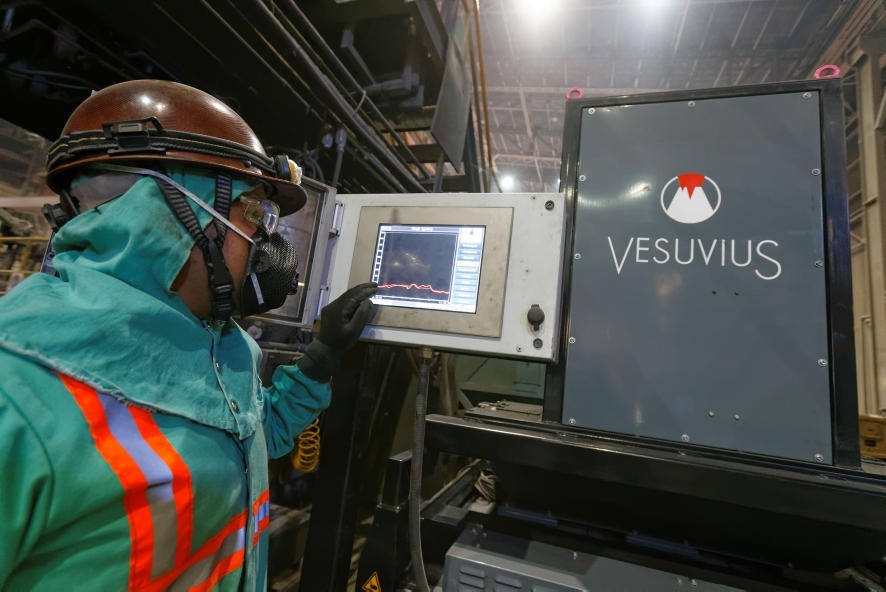
Vesuvius has two divisions. The first is Steel & Flow Control — they sell custom refractory solutions, measurement systems, and process control tech to steel mills. Stoppers, shrouds, nozzles, flow control systems. Everything designed so molten steel flows where humans want it, not where physics takes it.
The second is Foundry Division — temperature sensors, oxygen probes, hydrogen probes, sublance probes, metal sampling solutions. Think of it as the nervous system that tells a foundry “this metal is currently 1,580°C, cool it down 20 degrees or your crucible fractures.”
The mix is roughly 57% manufacturing (refractory products), 43% services (installation, maintenance, technical support, measurement). In FY2025, the company exported to 30+ countries but derived just 3.4% of revenue from exports. Domestic India consumption of refractories is 2.5–3 million tonnes annually, growing at 3.5–4% per year. Vesuvius targets 1.5x–2x market growth through capacity additions, better distribution, and product innovation.
Client concentration: 59% of FY2023 revenue came from just 3 external customers. That’s concentration risk. But those three are blue-chip names (Tata Steel, JSW Steel, etc.), so default risk is exactly zero. They’re more likely to go bankrupt than pay Vesuvius late.
Primary Segment57%Manufacturing
Secondary Segment43%Refractory Services
Market Share10–12%India’s refractory market
Plant Economics: At Visakhapatnam, Vesuvius invested ₹87.7 crore for Al-Si monolithic capacity (1.2 lakh tonnes annually) plus Basic monolithic and Flux plants. All three are now commercially operational (May and June 2025 launches). The company owns the land, the buildings, and all the production equipment. Depreciation will hit P&L for 15–20 years, but capacity utilization in a seller’s market (and refractory capacity is tight globally) should push RoI north of 20% very quickly.
💬 Ever wondered why steel mills don’t just line furnaces with regular concrete? Spoiler: 1,600°C melts concrete in seconds. Your favorite steel car exists because companies like Vesuvius figured out how to not melt. Thoughts?
04 — Financials Overview
Q4 FY2025: The Numbers That Prove Growth Is Real
Continue reading with a premium membership.