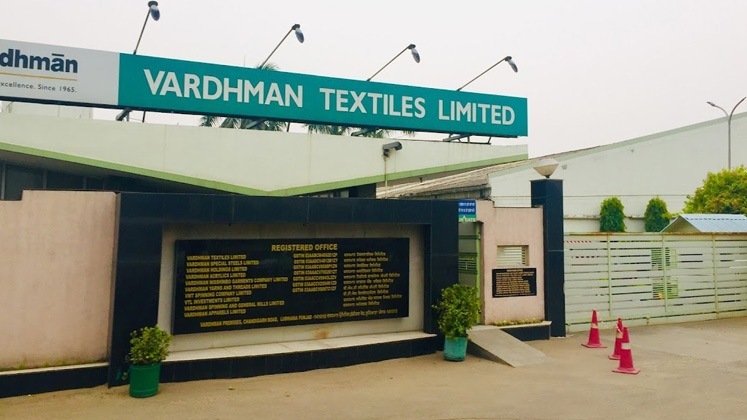
Vardhman Textiles — the grand old titan of India’s textile loom — reported Q2FY26 revenue of ₹2,480 crore and net profit of ₹187 crore, a marginal drop of 0.9% QoQ in sales and ~5% QoQ in profit. But despite the soft quarter, the stock still threads a decent narrative with a market cap of ₹12,656 crore, P/E of 15x, and a dividend yield of 1.14%, proving old-school manufacturing can still look classy in an overvalued market full of SaaS dreams and fintech heartbreaks.
Trading at ₹438 per share, it’s not the multibagger type that’ll make your broker call you “sir” again, but it’s steady, like that one kurta that’s survived 12 Diwalis. The company boasts ROE of 8.95%, ROCE of 10.8%, and negligible debt (Debt-to-Equity = 0.15). Basically, Vardhman runs its mills like your thrifty dadi runs her kitchen — everything accounted for, nothing wasted.
From spinning yarn to dressing up Zara and Calvin Klein, this Ludhiana-based juggernaut doesn’t chase hype; it weaves compounding. But has it reached peak fabric saturation, or is a global expansion spree still rolling? Time to unroll the yarn.
2. Introduction
The textile industry in India is like a 90s Bollywood hero — massive potential, a solid legacy, but constantly outshined by flashier newcomers. And yet, Vardhman Textiles Ltd remains one of the OGs that quietly stitched together a ₹12,000+ crore empire, while others kept fighting over polyester vs. cotton memes.
Founded by the Oswal family in Ludhiana, Vardhman started with spindles when colour TVs were still a luxury. Fast-forward to FY26, it operates 15 factories across 5 states, producing everything from yarn and fabric to garments for global icons like Zara, H&M, GAP, Walmart, and Tommy Hilfiger.
If Indian textiles were cricket, Vardhman would be Dravid — steady, disciplined, occasionally underappreciated. And in a world of cheap Bangladeshi exports and Vietnamese tax perks, this 60-year-old textile ninja keeps competing with efficiency, scale, and a surprisingly global distribution network spanning 75 countries.
But Q2FY26 came with some wrinkles. Demand in the US remained slow (40–45% of Vardhman’s exports go there), cotton prices softened, and margins faced a reality check. Still, the company is in expansion mode — adding spindles, looms, and green capex projects worth ₹3,500+ crore through FY27. While the short-term numbers may look dull, the long-term weave is getting tighter.
3. Business Model – WTF Do They Even Do?
Vardhman isn’t just “a textile company”; it’s an entire supply chain wrapped in one logo. Here’s the elevator pitch — they spin yarn, weave fabric, and stitch garments, all under one roof, selling to both domestic and international buyers. It’s the textile equivalent of running a farm, factory, and fashion label — minus the influencer drama.
The product bouquet looks like a textile buffet:
Yarn (62% of revenue): Melange, slub, recycled, corespun, superfine, acrylic — basically, if it can be spun, Vardhman’s spun it.
Fabric (36%): Grey, dyed, printed, blended — you name the weave, they’ve got the loom.
Garments (1–2%): 7,500 shirts a day. It’s small, but hey, even H&M started somewhere.
Domestic sales make up 54%, exports 46%. The company is heavily tilted toward B2B — meaning they sell fabric to apparel giants rather than running their own brand. So while Raymond fights for shelf space at Shoppers Stop, Vardhman quietly earns by supplying everyone else.
The upcoming expansion adds 31 million metres in fabric and 15,600 spindles in yarn — a move aimed at scaling efficiencies, not chasing volume hype.
So yes, Vardhman doesn’t “trend.” It compounds — slowly, silently, stubbornly.
4. Financials Overview
Metric (₹ Cr)
Latest Qtr (Sep’25)
YoY Qtr (Sep’24)
Prev Qtr (Jun’25)
YoY %
QoQ %
Revenue
2,480
2,502
2,386
-0.9%
+3.9%
EBITDA
334
315
326
+6.0%
+2.5%
PAT
187
197
208
-5.1%
-10.1%
EPS (₹)
6.47
6.81
7.16
-5.0%
-9.6%
Margins remain healthy, with EBITDA margin at ~13%. The small dip in PAT stems from export sluggishness and cotton price normalization. For a cyclical sector, these are pretty “boring good” numbers — and boring is often beautiful in textiles.
5. Valuation Discussion – Fair Value Range Only
Let’s get nerdy for a minute.
P/E Method: EPS (FY25) = ₹29.1 Industry P/E = ~22x Current P/E = 15x If we apply 16–20x (reasonable range for midcap textile compounders): Fair Value Range: ₹465 – ₹580 per share.
EV/EBITDA Method: EV = ₹14,030 Cr EBITDA (FY25) = ₹1,260 Cr EV/EBITDA = 11x Industry average = 9–12x → Vardhman sits mid-range.
DCF (Discounted Cash Flow): Assuming EBITDA growth of 8%, WACC 10%, terminal value at 6%, and consistent dividend payout, intrinsic range works out to roughly ₹470 – ₹510.
Final Educational Range: ₹460 – ₹520 per share.
⚠️ Disclaimer: This fair value range is for educational purposes only and not investment advice. Please don’t mortgage your cotton fields based on it.
6. What’s Cooking – News, Triggers, Drama
Q2FY26 earnings dropped this week — and like a good Punjabi mill, it brought both good and “chalo-theek-hai” news.
Capex Tsunami: The company is midway through its ₹3,535 crore expansion — adding looms, spindles, and green tech. This is the textile world’s version of an arms race.
Management Shuffle: Veteran director Tara Chand Gupta retired in Sep’25, a symbolic changing of the guard.
Green Push: Vardhman’s not spinning just yarns anymore — it’s spinning sustainability stories. Investments in renewable power (via stake in ReNew Green) and