01 — At a Glance
The Aggarwal Family’s Tier-II Apparel Carnival
- 52-Week High / Low₹2,572 / ₹1,565
- Q3 FY26 Revenue₹929 Cr
- Q3 FY26 PAT₹102.1 Cr
- Q3 FY26 EPS (₹)27.99
- Annualised EPS (Q3×4)₹111.96
- Book Value₹106
- Price to Book18.2x
- Debt / Equity3.39x
- ROCE16.9%
- 9M FY26 Revenue₹2,270 Cr
The Ground Reality: V2 Retail closed Q3 FY26 with ₹929 crore revenue (+57% YoY), ₹102 crore PAT (+99% YoY), 294 stores, and a QIP of ₹400 crore just completed. On paper: textbook growth. On the price chart: -13.8% in 3 months. The market is baking in either eternal perfection or preparing for disappointment. Probably both.
02 — Introduction
Apparel for the Masses Who Actually Have Cash Now
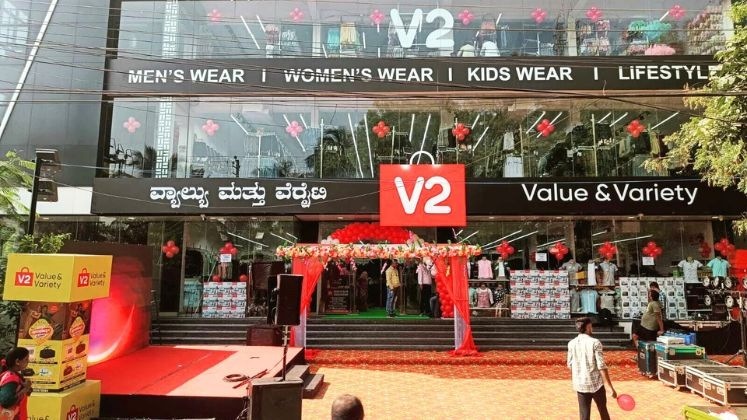
Welcome to V2 Retail — where your cousin goes to buy a birthday shirt that looks expensive but costs ₹299. The company is basically India’s Tier-II and Tier-III middle-class clothing store. It sells family apparel (men, women, kids) at affordable prices in cities where Amazon still spells “logistic cost” as “death cost.”
The numbers are wild. In 9 months of FY26, they’ve grown revenue 64% YoY, PAT 119%, opened 105 net new stores (35 in Q3 alone), and maintained same-store sales growth of 8.6% on the base. But here’s the twist: three months back, the stock was at ₹2,250. Today it’s ₹1,928. Everything is growing. The stock price is not. Classic India retail karma.
The CEO (Manshu Tandon) left in April 2025 “due to personal reasons” — which in corporate speak means “I saw the debt mountain and decided hiking was healthier.” A new CFO is absent. The board just approved a stock split. Meanwhile, management is opening stores like they’ve learned how to print cash but forgot to check the interest rate on their ₹1,312 crore debt mountain.
Let’s break down what V2 Retail actually is, what it’s built, where the money is actually coming from, and why the stock deserves better scrutiny than a clearance rack at a mall.
Concall Insight (Feb 2026): Management claimed new stores are “EBITDA-positive from month one.” If true, that’s operational excellence. If not, that’s financial engineering masquerading as strategy. We’ll let the numbers decide.
03 — Business Model: Desi Walmart For People With Bikes
The Economics of Selling ₹250 Shirts to Bihar
V2 Retail operates like this: find a 10,000–11,000 sq ft space in a Tier-II or Tier-III city (ideally near parking, NOT in the middle of the market anymore — management changed this), spend ₹1.1 crore capex, stock ₹1.3–₹1.4 crore inventory, and start selling family apparel at full price (which in Q3 was 92% of sales, up from 85% last year).
The product portfolio: Men’s wear (39% of revenue), Ladies wear (27%), Kids wear (25%), Lifestyle products (9%). They make ~35% of the product in-house via their subsidiary “V2 Smart Manufacturing” (capacity: 15–20% of needs). The rest is sourced. Private label penetration is targeted to rise to 80% eventually. Average bill value in Q3 was ₹964 (high because of winter garments — kurti season is cash season). Average selling price: ₹297.
Store maturity metrics revealed in Q3 concall: Stores opened before Mar 2024 earn ~₹1,200 per sq ft per month. Stores opened in FY25–FY26 earn ~₹730–₹740 per sq ft. The company admits new stores take 2–3 years to mature and claims blended PSF should stabilize around ₹1,000 even while adding 50% area annually. Ambitious, honest, or both? Let’s see.
Stores (Q3)294+35 in Q3
Retail Area31.9LSq Ft
Full-Price Sales92%Q3 FY26
Repeat Customers68%Stores 2+ yrs
Geographic Strategy Shift: Management explicitly said they moved away from “opening a store in the middle of the market.” New priority: parking, frontage, floor plate — even 1–2 km away. This is a critical tactical change. Convenience beats foot traffic in the new store model. Higher rents. But better long-term retention.
💬 Quick question: If a new store is EBITDA-positive from day one, why hasn’t every retailer figured this out? What’s the catch?
04 — Financials Overview
Q3 FY26: The Numbers That Make You Uncomfortable