General information and entertainment, not investment advice. The author is not a SEBI-registered adviser or research analyst. No recommendation, no promised returns. Markets carry risk including loss of capital. Figures may not be current. Consult a registered adviser before acting.
1. At a Glance
Revenue climbed 31% to ₹288 Cr in FY26, but operating margin compressed—not the cheerful story it sounds at first glance.
Profit after tax rose 19% to ₹41 Cr. The spread between the two growth rates (31% vs 19%) raises a familiar tension: the company is shipping more, but each rupee of revenue is thinner.
Other income hit a new high of ₹13.8 Cr, a wall of cash support that flatters the bottom line. Strip it out and the core earnings picture gets tighter.
Cash from operations collapsed to ₹2 Cr in FY26, down from ₹49 Cr the year before—a drop the balance sheet barely whispers about.
The real story lies in June 2026: two fresh AMC orders worth ₹4.24 Cr and ₹5.60 Cr in quick succession, signaling that client relationships are thawing.
ROCE sits at 45%, ROE at 34%—both fortress-grade. But here’s the rub: most of that return comes from the cash pile, not operations.
Teaser: A zero-debt IT services firm with premium returns and fresh order momentum—but the business itself is paying for growth with cash flow.
2. Introduction
Unified Data-Tech Solutions emerged from its IPO listing in May 2025, raising ₹144.5 Cr in an offer for sale. The company spent the year after flotation doing what young public companies do: learning to live with scrutiny, filing disclosures, and chasing revenue at pace.
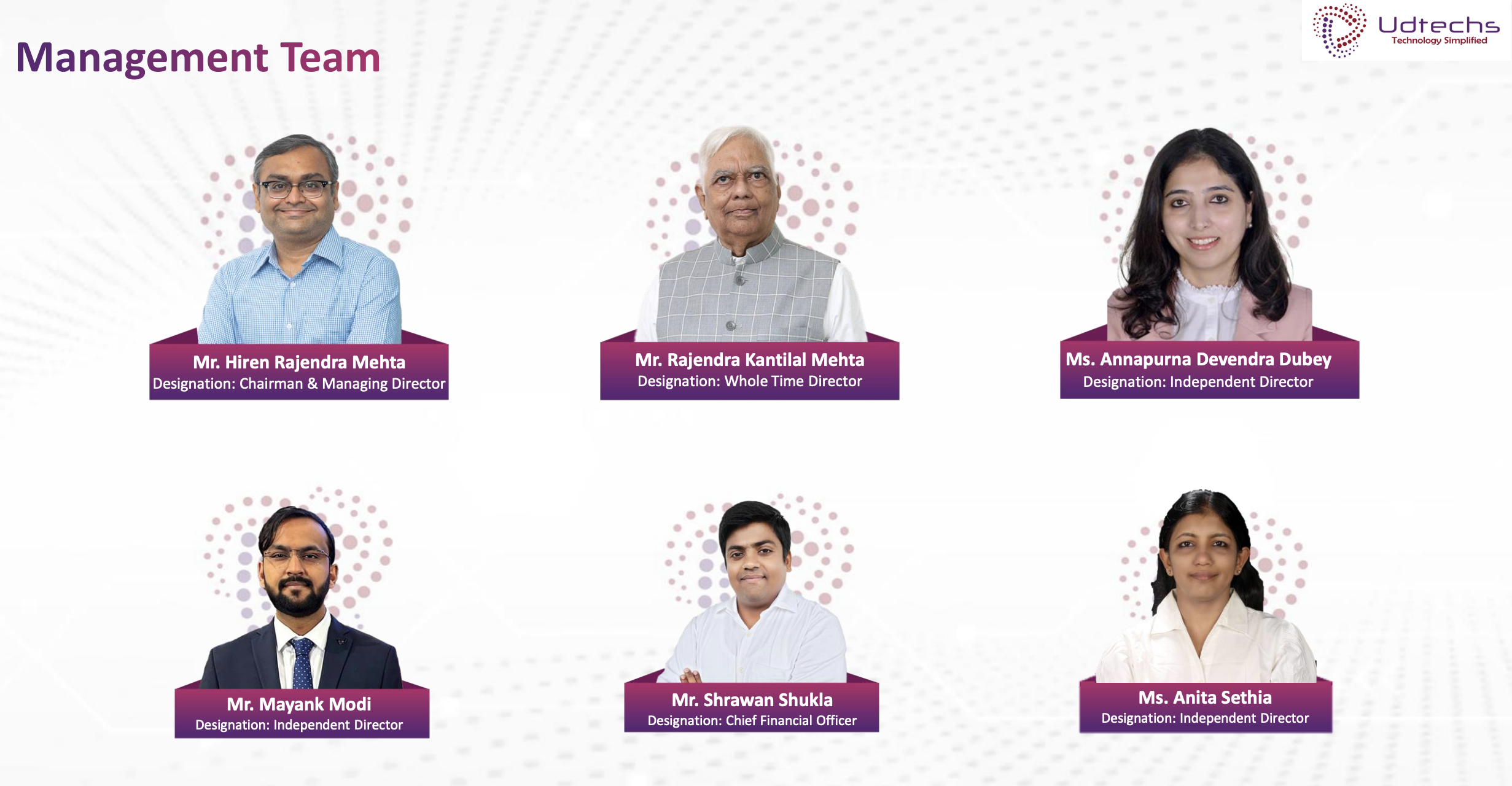
Founder Hiren Rajendra Mehta holds 60%, the bedrock shareholder stake that has run the firm since 2010. The management team sits four independent directors deep, including a CFO who arrived from elsewhere.
In June 2026—just now—the company landed two fresh AMC (Annual Maintenance Contract) orders worth ₹9.84 Cr combined from large private-sector banks. This is the kind of velocity the market wants to see from an IT services firm two years into scale-up.
The data center and system integration landscape in India is moving fast. Cloud, cybersecurity, disaster recovery—the adjacencies are clear. Unified Data has spent FY26 assembling them, product by product, service by service.
The question is whether revenue growth is the beginning of margin expansion or the symptom of a business in cost squeeze.
3. Business Model: WTF Do They Even Do?
Unified Data-Tech Solutions is a system integrator: they buy enterprise infrastructure (servers, storage, networking gear) from Tier 1 OEMs—IBM, Dell, Veritas, Fortinet—repackage it with custom integration, deployment, and managed services, and sell it to large enterprises as a complete solution.
The product business contributes 55% of FY26 revenue (₹159 Cr). This is hardware: data center infrastructure, virtualization stacks, backup systems, firewalls, load balancers.
Services are the other 45% (₹129 Cr): technical advisory, system integration, expert technical support, operational management. A bank doesn’t just want a new private cloud. It wants the design, the migration, the training, the 24/7 baby-sitting.
The customer base is concentrated: top five clients accounted for 62% of FY26 revenue. BFSI (banking, financial services, insurance) is the heavyweight vertical at 71% of FY26 revenue. Manufacturing, IT/ITeS, and others round out the remainder.
Geography: Western India (mainly Mumbai) is the anchor, followed by Southern India. The company opened a new office in Ahmedabad in FY25 and is signaling a push into geographic adjacency.
Distribution model: Direct relationships with CIOs, IT heads, procurement committees in large enterprises. Zero mass market, zero SME product-fit. This is a “win the deal” business, not a “scale the funnel” business.
Why it matters: The model is asset-light (they don’t own data centers). But it is order-heavy (they need to keep winning from the same shrinking pool of large enterprise buyers). Concentration risk is baked in.
OEM partnerships are the moat: 310+ OEM badges and certifications, Platinum partnerships with IBM, Gold with Veritas, Titanium with Dell. This isn’t marketing fluff. It means OEMs route their largest, most complex deals through Unified Data when they need a trusted integrator in India.
The worrisome bit: the company hasn’t opened new products or verticals, just leaned deeper into the existing ones.
4. Financials Overview
Figures are consolidated, in ₹ crore.
Result Type: Annual (Full Year). Period: FY26 (Year ended 31 March 2026) vs. FY25 (Year ended 31 March 2025).
Metric
FY26
FY25
Change (%)
Revenue
288.0
220.3
+30.8%
Operating Profit (EBIT)
40.3
38.1
+5.8%
Operating Margin
14.0%
17.3%
(327 bps)
Net Profit
40.8
34.2
+19.3%
Net Margin
14.2%
15.5%
(136 bps)
EPS (full year)
20.3
17.0
+19.4%
What happened:
Revenue grew 31%. Operating profit grew 6%. The gap tells you the business absorbed a ₹13.7 Cr increase in cost of goods sold (raw materials / hardware procurement) against a ₹67.7 Cr increase in revenue.
Net profit was saved by other income (₹13.8 Cr), a pool of investment returns and sundry gains. Without it, FY26 net profit would have been ₹27 Cr—down in absolute terms from FY25.
Operating margin fell 327 bps from 17.3% to 14.0%. This is the business trading margin for volume—a deliberate choice, perhaps, or a forced one if competitive pricing tightened. Either way, the spreadsheet doesn’t lie: every rupee of incremental revenue is thinner than the last.
Concall context (from management): Management attributed margin compression to a change in revenue mix (higher product sales, lower service margins) and higher raw material costs in FY26. They flagged a return to margin recovery in