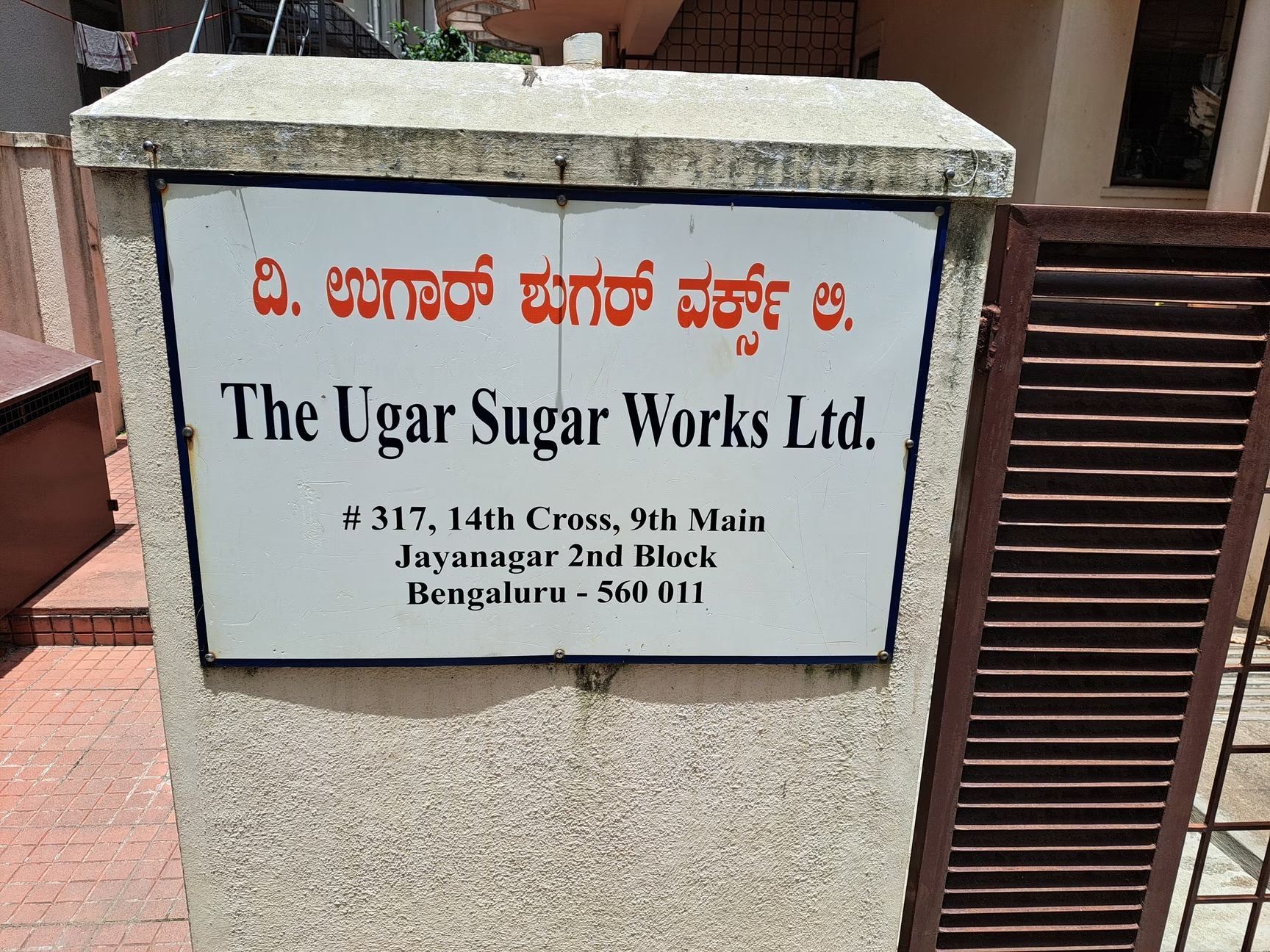
Ugar Sugar Works Ltd Q2 FY26 – Losses, Liquor, and Liquid Assets: How a 1939 Sugar Daddy Is Now Drowning in Its Own Molasses
1. At a Glance
Ugar Sugar Works Ltd, the 1939-born granddaddy of Karnataka’s sweet (and spirit-filled) economy, just dropped another quarter that can best be described as sugar crash with a hangover. The company reported Q2 FY26 revenue of ₹417 crore but a net loss of ₹32 crore, proving that ethanol fumes can’t hide bitter finances. Market cap sits around ₹458 crore, the stock trades at ₹40.7, and the P/E ratio is a laughable 47.1, because apparently, losses still command a premium in India’s sugar rush.
With a debt-to-equity ratio of 2.56, a ROE of -7.9%, and ROCE crawling at 3.1%, Ugar looks more like a liquidity-deprived distillery than a sweet play. Over the past year, the stock melted like jaggery in the monsoon — down 46% YoY. Yet, somehow, it’s still sweeter than your PSU fixed deposit if you measure in entertainment value.
2. Introduction
If there were a museum of Indian industrial nostalgia, Ugar Sugar Works Ltd would have its own air-conditioned section. Founded in 1939, when the world was fighting wars and not inflation, the company has seen everything — colonial trade, licence raj, ethanol booms, and even SEBI compliance letters.
Today, it’s part of the Shirgaokar Group, running two massive sugar units and a distillery that makes both ethanol and “Old Castle Whisky” (because apparently, diversification means getting drunk on your own supply). From white crystal sugar to bagasse power, the company produces everything except consistent profits.
Every quarter, Ugar Sugar’s results read like a Bollywood thriller — a burst of optimism, followed by a tragic twist. The company crushed over 23 lakh tonnes of sugarcane in FY23, sold ₹1,547 crore worth of sweet and spirited products, and then somehow still managed to post a loss. The ethanol expansion was supposed to be the game-changer, but instead, it’s behaving like a sugarcane juicer running on low voltage.
3. Business Model – WTF Do They Even Do?
So what does Ugar Sugar Works actually do apart from testing investor patience?
They run three main engines:
Sugar – The original business, producing white crystal sugar (M-30, S-30, SS-30) from 22,500 TCD of cane-crushing capacity across two plants in Karnataka — Ugar (Belagavi) and Jewargi (Kalaburagi). It’s sweet on paper but sticky in execution.
Power – The company runs a 44 MW cogeneration plant, feeding 28 MW to the grid while using 16 MW for captive use. Think of it as an internal UPS for when the finances short-circuit.
Distillery – Here’s where it gets tipsy. Ugar manufactures Ethanol, Rectified Spirit, ENA, and Potable Liquor. They even have a grain-based distillery that can swing between molasses and cane juice routes and boasts 845 KLPD total capacity, of which 250 KLPD went live in April 2023.
And yes, they sell branded liquor too — Old Castle Whisky, US Rum, Doctors Brandy, Gagarin Vodka — proving that even if investors don’t get high returns, at least someone’s getting high.
4. Financials Overview
Let’s unmask the Q2 FY26 numbers — the quarter that could have been sweet but turned sour faster than leftover toddy.
Metric
Latest Qtr (Sep’25)
YoY Qtr (Sep’24)
Prev Qtr (Jun’25)
YoY %
QoQ %
Revenue (₹ Cr)
417
240
356
+73.6%
+17.1%
EBITDA (₹ Cr)
-9
-44
5
+79.5%
-280%
PAT (₹ Cr)
-32
-60
-14
+46.4%
-128%
EPS (₹)
-2.86
-5.34
-1.22
+46.4%
-134%
Even though revenue shot up by 74% YoY, profits are missing like ethanol in an empty tanker. The company’s operational efficiency is evaporating — OPM of -2%, interest coverage barely above 1.0x, and net loss of ₹32 crore.
In short: sales grew, losses persisted, and investors cried into their sugarcane juice.
5. Valuation Discussion – Fair Value Range Only
P/E Method: Annualised EPS = Latest quarterly EPS × 4 = (-2.86 × 4) = -₹11.44 (negative, so P/E isn’t meaningful). Let’s use FY25 EPS of ₹0.86 instead for sanity. At industry P/E of 13.4, fair price = 0.86 × 13.4 = ₹11.5 At small-cap premium multiple of 20, upper range = 0.86 × 20 = ₹17.2
EV/EBITDA Method: EV = ₹878 crore TTM EBITDA = ₹74 crore → EV/EBITDA = 11.9× If fair multiple = 7–9× (peer range), fair EV = ₹518–₹666 crore → Implied Price Range = ₹24–₹30
DCF (simplified): Assume free cash flow of ₹45 crore, growth 5%, discount 11%, terminal 3% → fair value ≈ ₹26–₹32
📉 Fair Value Educational Range: ₹20–₹32 per share
Disclaimer: This fair value range is for educational purposes only and is not investment advice.