Travel Food Services Ltd FY26: A ₹1,226 Crore Consolidated Quarterly Profit Jet-Stream Powered by High-Altitude Premiumisation
Date of Publishing -
Spotted a factual error — a wrong number, date, or fact? Tell us and we will check the source.
At a Glance
The structural transformation of the Indian travel landscape has transitioned from a statistical projection into an active compounding reality. A total system-wide sales volume of ₹32,144 million (~₹3,214 cr) for the full financial year 2026 demonstrates an accelerating divergence between underlying passenger volumes and actual transit monetization. The financial year concluded with an annualised return profile characterized by a Return on Capital Employed ($ROCE$) of 42.4% and a Return on Equity ($ROE$) of 35.3%, positioning the entity within an elite bracket of capital efficiency across the broader consumer discretionary spectrum.
While core airport passenger volumes across managed hubs registered an incremental consolidation growth of 1.2% for the full year, the organization sustained a structural delta via premiumisation, targeted brand scaling, and menu optimization. Net contract gains accounted for 13.1% of system-wide expansion, supplemented by a 9.4% like-for-like ($LFL$) sales acceleration. The structural moat of the enterprise remains tied to its master concession frameworks, maintaining a 92.1% contract retention profile across major aviation hubs.
The growth trajectory of Travel Food Services Ltd during the fiscal year is structured across two primary expansion engines, driving exceptional overall capital efficiency metrics:
System-Wide Sales Growth: +25.4% YoY
Like-for-Like ($LFL$) Growth (+9.4%): Represents deep operational optimization and organic spend-per-passenger acceleration within mature airport concessions.
Net Contract Gains (+13.1%): Reflects physical footprint expansion and the successful mobilization of new units across key domestic terminals.
This twin-engine growth directly feeds into a highly protective capital compounding layer:
Total Capital Efficiency Profile:
ROCE: 42.4%
ROE: 35.3%
Contract Retention Rate: 92.1%
However, terminal rebalancing, execution timelines across greenfield projects, and structural shifts in domestic passenger distribution between terminal gates present mid-term operational adjustments. Profitability structures show divergence based on the inclusion of joint venture frameworks, with net margins altering as newer international and regional structures clear their initial deployment phases. Capital efficiency inside high-barrier ecosystems forms an elite protective layer, but long-term compounding requires continuous network scaling.
Introduction
Travel Food Services Ltd (TFSL) operates as the structural anchor of high-density transit retail and premium lounge infrastructure within the Indian aviation corridor. Established in 2007, the enterprise has spent nearly two decades transforming the consumer experience across major high-barrier transportation hubs, evolving from a solitary concept deployment into a deeply integrated network.
The structural thesis of the business relies on monetization of terminal dwell times. Unlike traditional retail models that are exposed to shifting digital migration patterns or volatile high-street footfalls, the transit infrastructure framework captures a captive audience constrained by security parameters and flight departure windows. The enterprise operates a multi-format portfolio spanning premium global food privileges, domestic specialty dining, and institutional loyalty lounges designed to leverage the increasing average transaction values ($ATV$) of the modern affluent traveler.
Business Model: WTF Do They Even Do?
To the casual observer standing in a security queue, this business looks like an overpriced sandwich counter wrapped in a fancy airport lightbox. In reality, it is a sophisticated real estate monetization engine disguised as an airport hospitality network. The company operates across a complex dual-engine framework: Travel Quick Service Restaurants (QSR) and Premium Lounges.
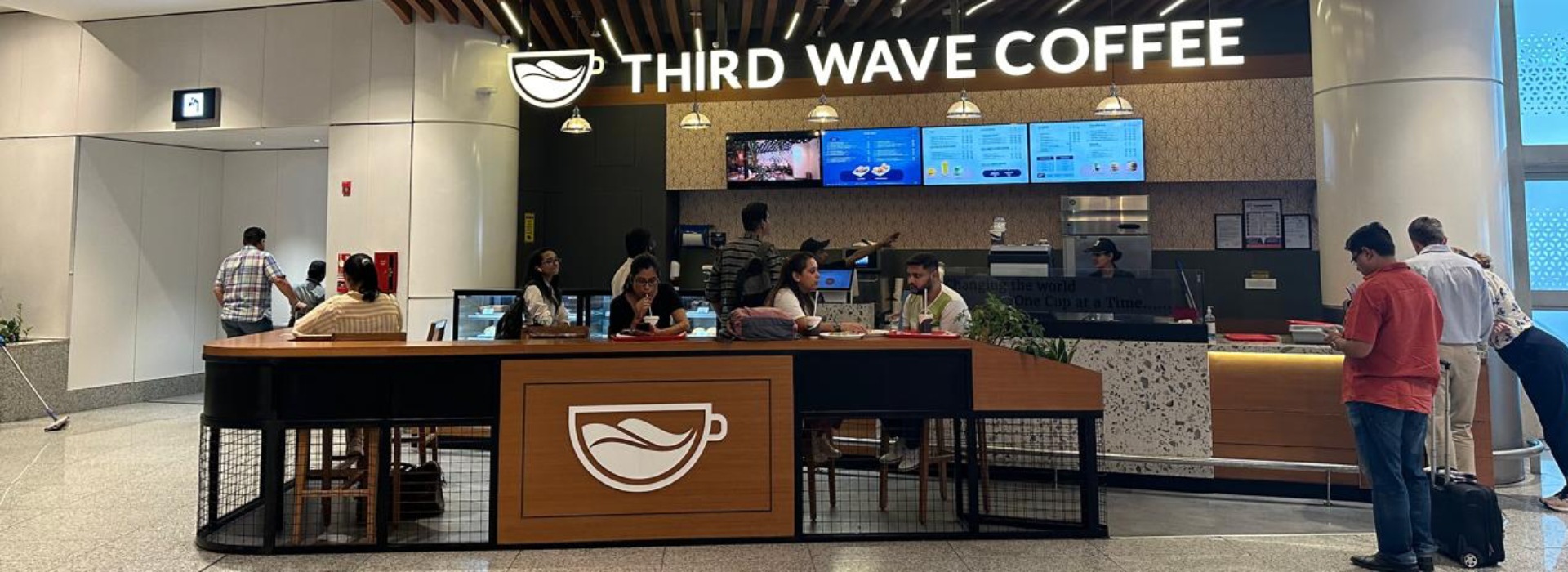
As of March 31, 2026, the company manages 518 Travel QSR outlets and 39 lounges across India, Malaysia, and Hong Kong. They do not rely on a single brand or menu; instead, they act as an ecosystem aggregator. They blend international franchises like KFC, Pizza Hut, and Wagamama with in-house concepts such as Caféccino and idli.com. This allows them to maximize revenue per square meter regardless of whether a passenger wants an artisanal automated cocktail or a quick filter coffee before boarding a low-cost carrier.
The lounge division controls a commanding 45% market share in India, running on financial network integrations rather than traditional menus. Instead of selling food directly, they sell bulk lounge access to banking institutions and credit card networks looking to reward premium cardholders. This transforms a high-volume hospitality operation into an institutional B2B aggregation platform, heavily fortified by security clearances and multi-year master concession agreements that insulate them from street-level competition.
Does a 45% market share in a highly secure environment protect a business from typical inflation, or does it simply turn the company into a captive hostage to airport concession fee hikes?
Financials Overview
Figures are consolidated, in ₹ crore.
Quarterly Performance Trends
Metric
Latest Quarter (Mar 2026)
YoY (%)
QoQ (%)
Revenue from Operations
460.68
25.67%
1.03%
EBITDA / Operating Profit
186.30
38.31%
2.93%
Profit After Tax (PAT)
122.60
15.01%
-10.51%
Earnings Per Share (EPS)
9.17
17.26%
-9.03%
The final quarter of the fiscal year delivered a resilient top-line expansion, with revenue reaching ₹460.68 crore, driven by a 17.3% expansion in net contract gains that offset flat passenger traffic numbers. EBITDA margins scaled efficiently to 40.4%, benefiting from strategic stock planning and structural labor optimization deployed during regional airline rescheduling windows.
Profit after tax tracking stood at ₹122.60 crore, experiencing sequential moderation due to shifting quarterly tax allocations and variation in joint venture profit shares. A sustainable margin base requires continuous revenue optimization inside high-occupancy airport terminals.