Tinna Rubber FY26: The Rubber Meets the Road, the Runway, and a Couple of Geopolitical Potholes
Section 1 — At a Glance
A structural shift in financial composition and capacity footprint took center stage for Tinna Rubber & Infrastructure Limited in FY26, as the company navigated escalating geopolitical friction in its international corridors alongside intensive domestic volume expansion. Headline revenue from operations reached ₹546 crore, marking an 8% increase year-on-year, while consolidated profit after tax advanced by 9% to close at ₹53 crore. This growth trajectory was anchored by a record volume of tyres processed in India, expanding 15% to 1,55,000 metric tons, driven by robust utilization levels of approximately 90% across domestic assets.
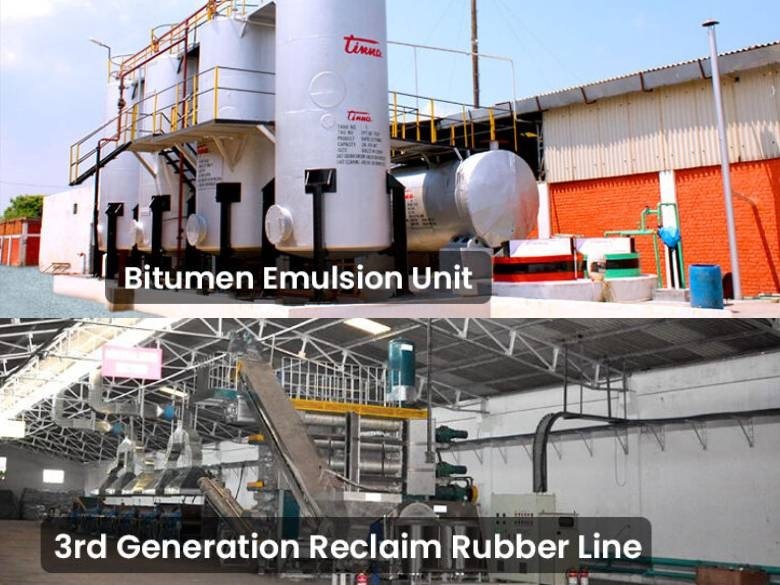
Beneath the headline volume acceleration, significant capital deployment redefined the asset base. The company finalized a capital expenditure cycle of ₹107 crore during the fiscal year, aggressively building out its high-margin Polymer Compounding & Masterbatch (PCMB) capability and entering advanced alternative tyre recycling technologies, including recovered Carbon Black (rCB) and Tyre Pyrolysis Oil (TPO). However, this aggressive expansion encountered operational drag outside domestic borders. Start-up costs, adverse foreign currency exposure, and escalating freight overheads stemming from the ongoing West Asian maritime crisis suppressed the bottom-line metrics of overseas joint ventures and subsidiaries, with operations in South Africa and Saudi Arabia generating an aggregate initial drag of ₹1.58 crore.
Strategic market repositioning directly reshaped segment performance, characterized by a deliberate contraction in thin-margin, commoditized infrastructure volumes in favor of high-value industrial and compound formulations. While balance sheet leverage visibly improved, with aggregate borrowings contracting 10% to ₹121 crore, working capital metrics faced structural elongation as debtor timelines stretched to 45 days, reflecting the stricter credit terms standard within the newly entered polymer compounding industries. Rapid structural transformation simultaneously expands a company’s market potential and vulnerabilities, requiring close observation of asset stabilization timelines. Investors are now tasked with evaluating whether these newly operationalized downstream verticals can successfully replicate the return profile of Tinna’s traditional tyre-crushing infrastructure.
Section 2 — Introduction
Tinna Rubber & Infrastructure Limited occupies a distinct niche within the industrial materials ecosystem, operating as a scaled processing engine that converts industrial waste into value-added polymers and infrastructure binders. Founded in 1977, the enterprise has spent over four decades transitioning from a conventional rubber footwear and basic crumbing manufacturer into one of Asia’s largest modern recyclers of end-of-life tyres (ELT).
The operational mandate of the business rests on extracting structural value from discarded heavy commercial radial tyres, breaking them down into microscopic compounds that reinforce asphalt, industrial conveyor belts, and automotive components. The current fiscal year marked a formal transition from a purely domestic crushing player to a multi-national recycling platform, punctuated by the operational commencement of a joint venture in South Africa and the formal establishment of corporate structures in Saudi Arabia. This international push is executing alongside a rapid product diversification strategy designed to decouple the firm from the cyclicality of public road contracts and align it with the recurring raw material needs of large-scale industrial tire manufacturers.
Section 3 — Business Model: WTF Do They Even Do?
At its core, Tinna Rubber takes things that commercial truck drivers leave on the side of the highway and subjects them to extreme mechanical duress until they look like premium industrial raw materials. The business model is a textbook study in circular economics: they procure End-of-Life Tyres (ELTs)—dense, steel-reinforced, heavy commercial radials—and strip them down with near-total material efficiency. Approximately 99% of the incoming tyre is recovered, leaving no room for wasted scrap.
The output from this mechanical shredding and pulverizing matches a highly diversified industrial chemistry catalog. The tyre is split into two primary components: high-grade rubber and high-tensile steel bead wires. The rubber is processed across a gradient of particle sizes, extending from standard crumb rubber modifier utilized in national highway surfaces to high-tensile ultra-fine micronized rubber powder (MRP) that tyre majors like MRF, Apollo, and CEAT blend back into brand-new passenger radials to save on virgin polymer costs.
To prevent standard road contractors from squeezing their margins during regular monsoon lulls, management has systematically sliced the revenue pie. In FY26, the traditional infrastructure division was trimmed down to 38% of revenue from a high of 45% the year before. Taking its place is the Industrial segment at 30%, followed by a Steel segment at 20% that turns tyre bead wires into industrial steel abrasives, an 8% Consumer segment dedicated to items like rubber gym tiles and sports turf infill, and a newly scaling 4% slice of Polymer Compounding & Masterbatches (PCMB).
Section 4 — Financials Overview
Figures are consolidated, in ₹ crore.
Metric
Latest Quarter (Q4FY26)
YoY (%)
QoQ (%)
Revenue
₹157.00
+21.64%
+12.95%
EBITDA / Operating Profit
₹29.00
+61.11%
+26.09%
PAT
₹17.00
+41.67%
+30.77%
EPS (Reported)
₹9.18
+34.80%
+29.11%
Concall Handling: What is Management Promising in the Coming Quarters?
Management did not hold back on forward guidance during the May 2026 conference call, explicitly targeting a revenue expansion rate of 20% to 25% for FY27. On the operational efficiency front, the executive team voiced high confidence, asserting that consolidated EBITDA margins are safely maintainable at the current ~18% threshold.
To back up this optimism, the CEO pointed to several key downstream project timelines. The newly constructed polymer compounding facility near Panipat is on track to triple its capacity from 6,000 TPA to 18,000 TPA by the close of Q1FY27, with the company budgeting a clear ₹75 crore topline contribution from the PCMB vertical alone over the next twelve months. Furthermore, the newly commissioned tyre pyrolysis plant and recovered Carbon Black (rCB) asset are projected to chip in an additional ₹50 crore to ₹55 crore of revenue once full commercialization lands in Q3FY27.
When analysts gently probed the capital risk of matching these targets with their planned ₹100 crore capex budget across FY27 and FY28, management maintained a firm stance on internal funding, stating that incremental debt additions would be strictly capped “up to about ₹20 crores… not any more than that.”