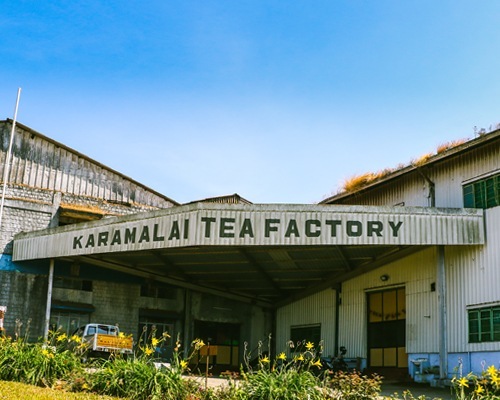
The Peria Karamalai Tea FY26: A ₹324 Crore Paper Gain Meets a ₹6.67 Crore Real Loss
Spotted a factual error — a wrong number, date, or fact? Tell us and we will check the source.
General information and entertainment, not investment advice. The author is not a SEBI-registered adviser or research analyst. No recommendation, no promised returns. Markets carry risk including loss of capital. Figures may not be current. Consult a registered adviser before acting.
1. At a Glance
Two numbers sit side by side in Peria Karamalai’s FY26 accounts, and they point in opposite directions. Net worth climbed from ₹211.98 crore to ₹449.53 crore — more than doubling in twelve months. In the same twelve months, the company posted a net loss of ₹6.67 crore.
Both are true. Reserves swelled to ₹446.43 crore, book value per share reached ₹1,452, and the market pays 0.54 times that book. Yet revenue of ₹68.3 crore, up 35% on the year, delivered an operating profit of just ₹0.74 crore — an operating margin of 1.08%. The equity grew while the business barely broke even at the operating line and lost money below it.
The gap between those two facts is the entire story of this year, and it runs through an unlisted investment, a mutual-fund markdown, and a promoter reshuffle that quietly changed who sits at the top of the ownership chart. A 113-year-old tea company had one of its most eventful balance-sheet years without selling much more tea.
How does a company more than double its net worth in a loss-making year? The answer is on the next few pages.
2. Introduction
Peria Karamalai Tea & Produce, incorporated in 1913, runs four tea gardens across roughly 6,000 acres in the Anamalai hills, generates power from wind and solar, and holds a portfolio of financial investments. Tea is the operating heart; the investment book has become the balance-sheet heart.
FY26 brought structural change on the ownership side. Following an NCLT-approved amalgamation, Placid Limited — a promoter-group entity holding 39.43% — merged into Maharaja Shree Umaid Mills Limited (MSUML), effective 25 April 2026. Post-merger, MSUML’s aggregate direct and indirect stake reached about 51.66%, making it the holding company. In exchange for its historical stake in Placid, Peria became entitled to 4,81,98,850 shares of MSUML.
The management chair also saw turnover. CFO M. Sreenivasan Muthuswamy resigned on 14 November 2025; Anup Kumar Gupta was appointed CFO effective 3 February 2026. Deputy Managing Director Shreeyash Bangur had resigned effective 31 March 2025. In May 2026 the board reappointed Alka Lakshmi Niwas Bangur as Managing Director for three years and recommended a dividend of ₹0.75 per share.
3. Business Model: WTF Do They Even Do?
Three businesses share one listing, and they are not equally weighted.
First, tea — the visible business. Peria manufactures Premium Orthodox, CTC and Green teas, and also cultivates black pepper, Arabica coffee, cinnamon and, in a detail that reads like a plantation experiment that stuck, 600 avocado trees. Two factories, four gardens, a blending unit rated at two tonnes an hour. This is the part that hires people, harvests leaves, and shows up in the revenue line.
Second, power. Wind and solar generation supplements the plantation. Wind output has been sliding — from about 2.07 million units in FY22 toward 0.77 million in a recent year — while solar has held steadier around 4 million units. A small contributor either way.
Third, and increasingly the tail that wags the dog, financial investments. Peria holds mutual funds and equity stakes, and the swings in those holdings now move the accounts more than the tea does. In a year where operating profit was ₹0.74 crore, the investment book generated fair-value movements measured in hundreds of crores. A tea company on the label; a holding company in the ledger.
The model, then, is a plantation strapped to an investment vehicle. When the markets behave, the second business flatters the first. When they don’t, the tea has to carry the weight alone — and at 1.08% operating margin, it isn’t built to.
4. Financials Overview
Figures are standalone, in ₹ crore.
Metric
Q4 FY26
YoY (Q4 FY25)
QoQ (Q3 FY26)
Revenue
12.10
9.97
17.57
Operating Profit
-8.75
-1.96
3.67
PAT
-9.81
-3.37
0.41
EPS (₹)
-31.69
-10.89
1.32
The March quarter is where the year unravelled. Revenue rose 21% year-on-year, but operating profit swung to a loss of ₹8.75 crore against a positive ₹3.67 crore the prior quarter. The company’s own results note the cause plainly: other expenses for the year