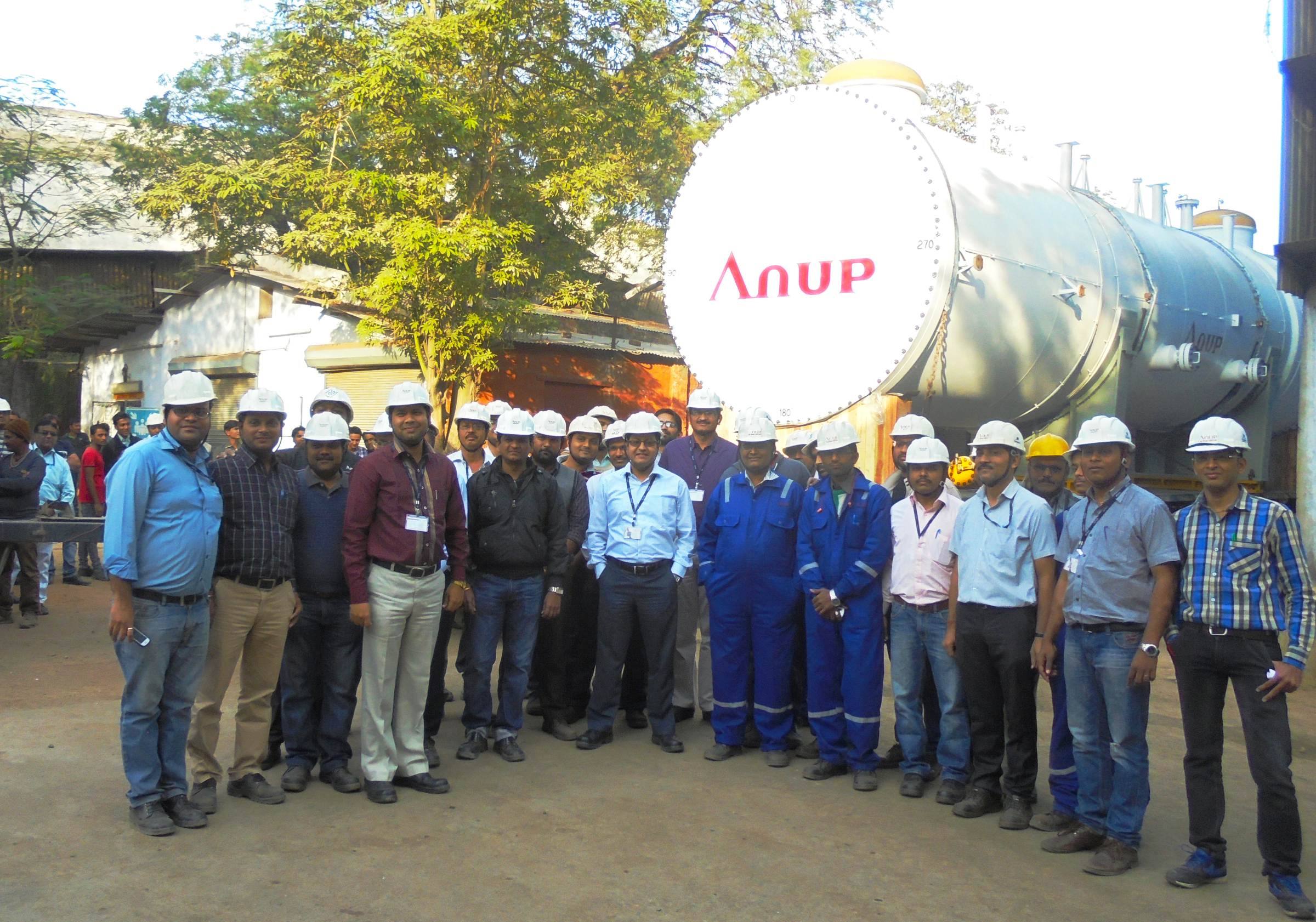
The Anup Engineering Ltd Q2FY26 – Export Heat Exchanger Warlord with a ₹883 Cr Order Book and a New Lalbhai Era Begins
Date of Publishing -
Spotted a factual error — a wrong number, date, or fact? Tell us and we will check the source.
1. At a Glance
The Anup Engineering Ltd (BSE: 542460 | NSE: ANUP) has been quietly welding its way to global domination — one heat exchanger at a time. The stock, currently chilling at ₹2,387 (down 0.34% intraday), carries a market cap of ₹4,782 crore, an EV of ₹4,925 crore, and a P/E multiple of 39.8× — not cheap, but apparently, precision steelwork comes with a premium polish.
Q2FY26 was pure industrial adrenaline: revenue jumped 20% YoY to ₹232 crore, while EBITDA clocked ₹51 crore with a 22% margin, because yes, they can bend metal better than most can bend logic. PAT stood at ₹32 crore, barely down 1.5% — a rounding error for an exporter now deriving 52% of its revenue from overseas.
Meanwhile, the company’s Rs. 883 crore order book glows red hot, with 78% from exports and SEZ markets, showing that the world’s chemical and energy bigwigs are literally outsourcing their pressure problems to Gujarat.
Oh, and plot twist — after steering this post-Arvind demerger ship for years, Sanjay Lalbhai has stepped down as Chairman, handing the torch (and the torch welding) to Punit Lalbhai, with Kulin Lalbhai joining as Director. Corporate musical chairs, Lalbhai-edition.
2. Introduction
When a company that was once a side-project of Arvind Limited decides to go solo, you expect some mild “family business with steel ambitions” story. Instead, The Anup Engineering Ltd (AEL) demerged in 2018 and immediately started behaving like the IIT topper who left the family textile business to design rocket parts.
From heat exchangers and reactors to centrifuges that sound like something ISRO might borrow, the company has quietly become a backbone of process industries worldwide.
While its cousins at Arvind are battling fabric discounts, Anup is shipping multi-tonne engineering marvels to oil & gas, petrochemical, and LNG majors across continents. The same Gujarat that gives us garba, gives the world pressure vessels rated to handle hydrogen.
In FY24, the company doubled its revenue in just two years, driven by export demand that grew a blistering 700%. If most manufacturing companies were cricket teams, The Anup Engineering would be Ravindra Jadeja — all-rounder, consistent, and annoyingly good under pressure.
And the story gets steamier — literally — as it commissions Kheda Phase-2A in October 2025. That plant alone can add ₹150-200 crore in potential revenue capacity. Yes, this is an Indian smallcap that doesn’t sell dreams; it sells steel, precision, and promises that weigh in metric tonnes.
3. Business Model – WTF Do They Even Do?
So, what does Anup Engineering actually do? Simple: it makes industrial-grade equipment that handle heat, pressure, and fluids at terrifying scales — things you’d never want in your kitchen, but the chemical and energy sectors can’t survive without.
The product lineup sounds like a sci-fi arsenal:
Heat Exchangers (72% of revenue in H1 FY25): giant metallic organs that regulate industrial temperature tantrums.
Reactors (14%): where the chemical magic (and mild explosions) happen.
Vessels (10%): glorified containers that make sure your ammonia doesn’t escape.
Centrifuges and Others (4%): the supporting cast spinning profits quietly.
The company doesn’t just manufacture — it engineers. Every design is custom-built for marquee clients like Reliance Industries, IOCL, GAIL, Toyo Engineering, and Nayara Energy.
And here’s the catch: they’re not competing on cost like most Indian manufacturers. They’re competing on engineering complexity and export capability, where quality certifications, safety standards, and tonnage capacities actually matter more than slogans.
Exports — which were just 10% in FY22 — now form 52% in H1FY25. It’s like an Ahmedabad firm suddenly realized there’s more margin in sending stuff to Houston than to Hazira.
In short, The Anup Engineering doesn’t sell paint or biscuits — it sells reliability under pressure. And that’s a pretty lucrative business if your steel doesn’t crack before your client’s deadline does.