Tata Motors Passenger Vehicles FY26: A ₹82,390 Crore Profit That the Business Didn’t Actually Earn
Spotted a factual error — a wrong number, date, or fact? Tell us and we will check the source.
General information and entertainment, not investment advice. The author is not a SEBI-registered adviser or research analyst. No recommendation, no promised returns. Markets carry risk including loss of capital. Figures may not be current. Consult a registered adviser before acting.
1. At a Glance
Here is a number that should stop you: FY26 net profit of ₹82,390 crore, up from ₹27,830 crore, an EPS of ₹223.74, and a stock the market prices at roughly 1.5 times those earnings against an industry multiple near 30x. On paper, one of the cheapest large caps in India. On paper.
Now the other numbers. Revenue fell 8.3% to ₹335,582 crore. Operating Profit collapsed from ₹47,993 crore to ₹18,719 crore — the operating margin halving from 13% to 5.58%. Cash from operations shrank from ₹63,102 crore to ₹13,041 crore. And the profit before tax from continuing operations was a loss of ₹1,623 crore.
Both sets of numbers are true and they belong to the same year. The bridge between them is a single line: other income of ₹86,291 crore, of which the overwhelming majority is a one-time accounting gain from carving the commercial-vehicle business out of the company. The ₹82,390 crore is real in the ledger and almost entirely absent from the factory floor.
This was also the year Tata Motors Limited became Tata Motors Passenger Vehicles Limited — the cars-and-JLR half of a company that split itself in two. A record domestic year, a cyber-crippled JLR year, and a demerger that rewrote the P&L, all stacked into twelve months.
Does a ₹82,390 crore headline profit tell you anything about how this business ran? Read on.
2. Introduction
For most of its listed life, “Tata Motors” meant trucks, cars, and Jaguar Land Rover bolted together. That ended in FY26. Under a Composite Scheme of Arrangement approved by the NCLT on August 25, 2025 (appointed date July 1, 2025, effective October 1, 2025), the commercial-vehicle business was demerged into a separate listed entity, and the passenger-vehicle company was renamed Tata Motors Passenger Vehicles Limited on October 13, 2025. What trades under this name now is the PV portfolio, the electric-mobility business, and JLR.
JLR remains the mass of the enterprise — roughly 81% of FY26 group revenue versus 86% in FY25, per the company’s own segment disclosure. The domestic Tata-brand PV business is about 17%, the rest IT services and insurance broking.
FY26 was, in the CFO’s words, “a tale of two halves.” The domestic side had its strongest-ever year. JLR spent the second half absorbing a September 2025 cyber incident that shut production across plants, layered on top of US tariffs, a China luxury tax, and adverse commodities. The demerger accounting then landed on top of both, producing a profit figure that has almost nothing to do with either.
The management chairs also got rearranged: Shailesh Chandra confirmed as MD & CEO, Dhiman Gupta appointed CFO effective November 17, 2025, and a wave of senior appointments in November 2025.
3. Business Model: WTF Do They Even Do?
Two businesses wearing one ticker.
The larger one is Jaguar Land Rover — British luxury SUVs and sedans, acquired in 2008 for $2.3 billion, run out of the UK with plants in Slovakia, China (a JV), India and Brazil. In FY26 the Land Rover brands did the heavy lifting: Range Rover 175,800 wholesale units, Defender 104,300, Discovery 21,300. Jaguar, meanwhile, sold 6,500 units against 26,900 the year before — a brand being deliberately switched off and rebuilt as all-electric, with the outgoing models wound down ahead of the Type 01. Geographically JLR leans on North America (28% of wholesales), the UK (22%) and Europe (19%).
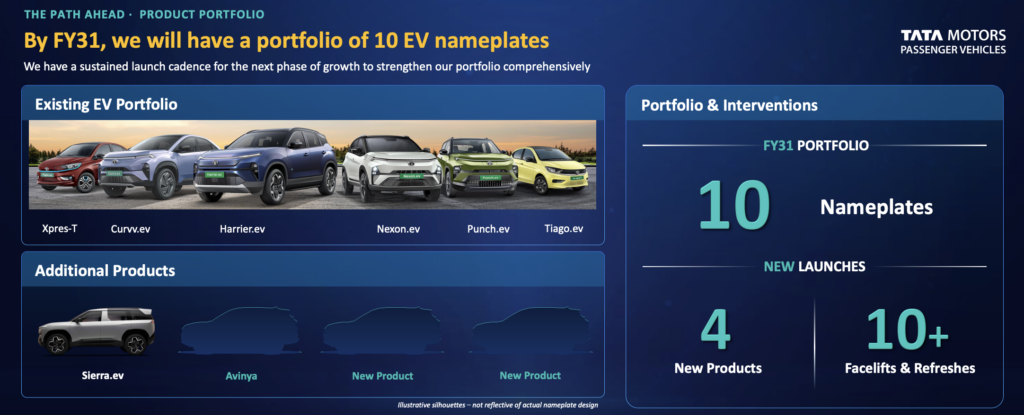
The smaller, faster one is Tata’s domestic PV arm: hatches, sedans, SUVs and India’s leading EV line-up, holding 13.6% of the domestic PV market and 40.2% EV market share in FY26, sold through 1,500-plus outlets. It sold 641,587 vehicles domestically in FY26, including 92,120 EVs.
So the model is: earn luxury margins in the West through JLR, earn volume and EV leadership in India through Tata, and hope the two cycles don’t trough at once. In FY26 they troughed at once — JLR from a cyber shutdown, the group revenue from JLR’s volume loss — while the domestic half quietly had its best year ever. A hedge that didn’t hedge this time.
4. Financials Overview
Figures are consolidated, in ₹ crore.
Metric
FY26
FY25
YoY
Revenue
335,582
366,094
-8.3%
Operating Profit
18,719
47,993
-61%
PAT (owners)
82,390
27,830
+196%
EPS (₹)
223.74
75.60
+196%
The table contains its own contradiction, and it is the whole story of the year. Revenue down, Operating Profit down 61%, and PAT up nearly threefold. Operating Profit and PAT are pointing in opposite directions because PAT this year is not an operating outcome — it carries the ₹82,616 crore exceptional gain booked on the demerger disposal, an accounting entry the company explicitly excludes from its own EPS-relevant profit and from net worth.
What management said: the CFO attributed the full-year weakness to headwinds at JLR — the cyber incident, tariffs, China luxury tax, VME pressures and adverse commodities. The consolidated PBT before exceptional items was ₹2,519 crore; after the exceptional items, continuing-operations PBT was a loss of ₹1,623 crore.
The quarter told the recovery story. Q4 FY26 revenue was