01 — At a Glance
The Tata Group’s Slow Boil That’s Starting to Pop
Tata Consumer Products hit ₹5,112 crore in quarterly revenue for the first time in its history (+15% YoY) — a “landmark quarter” by management’s own words. EBITDA expanded to ₹728 crore with margins at 14.2% (+120 bps YoY). Cash on hand: ₹1,272 crore. Nine-month revenue crossed ₹15,000 crore with all business units delivering double-digit growth. The stock has returned +16.1% over one year, massively outperformed its ROCE of 9.16% (industry peers average 12–15%), and yet trades at 76× P/E — a valuation floor that looks like it was set by someone’s great-grandfather and never revisited. Second-largest tea company globally. Largest salt brand in India. No debt to speak of. And somehow, the math doesn’t feel like a compliment anymore.
Quarterly Reality Check: ₹5,112 cr revenue. ₹728 cr EBITDA. ₹385 cr PAT. The quarterly EPS works out to approximately ₹3.89 (divide PAT by ~99 crore shares), which annualised is ₹15.56 — but P/E 76× values the stock like a 40% compounder in perpetuity. Spoiler: CAGR for last 3 years is 9% on earnings. Valuation and reality have filed for divorce.
02 — Introduction
When a Boring Blue-Chip Suddenly Looks Exciting—and Still Doesn’t Feel Cheap
Tata Consumer Products is what happens when you inherit 150+ years of brand equity (Tata Tea since 1868), add legendary operational discipline, sprinkle in three high-impact acquisitions in three years (Capital Foods, Organic India), and then sit back and watch management execute like they’re running the Swiss Railways instead of an Indian FMCG company.
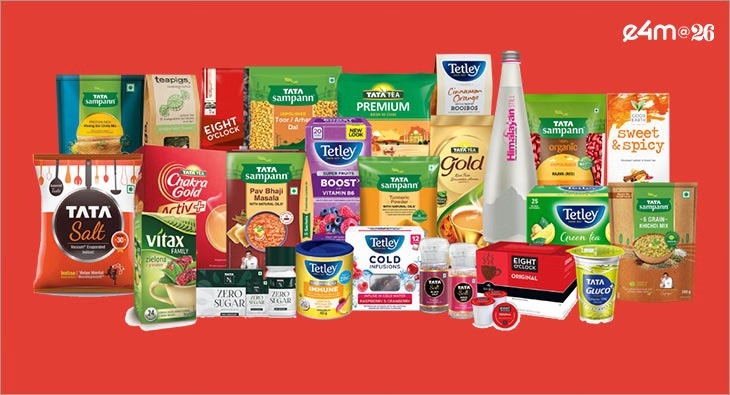
The Q3 results paint a picture of transformation in slow motion. Growth businesses (Sampann, RTD, acquired brands, Starbucks) hit ₹1,000+ crore quarterly revenue for the first time and now account for 30% of the India business — up from 18% just two years ago. The company’s go-to-market redesign, which was piloted in select geographies, is now rolling out nationally (82% complete by February 2026). Distribution network sits at 3.8 million total outlets. And the management team is methodically moving the needle on mix, premiumisation, and margin expansion without breaking a sweat in earnings calls.
Yet the stock sits at 76× P/E. Not 20×. Not 30×. 76×. That’s roughly 4x the Nifty 50 multiple and higher than Nvidia. For a company earning ₹14.8 per share (TTM) and growing earnings at mid-single digits. Something doesn’t compute.
Concall Highlight (Jan 2026): “Growth businesses hitting ~30% of India revenue, growing at ~30%. This is a structural mix shift away from being a Salt and Tea company into a multi-category food and beverage company.” — CEO. Translation: they’re trying to be Mondelez, but with better margins and worse stock price economics.
03 — Business Model: Tea, Salt, and Then Everything Else
From Legacy Categories to Growth Bets. Execution so Far: A+. Timing: 2005.
EduInvesting runs entirely on reader support — ₹360 a year keeps the lights on.