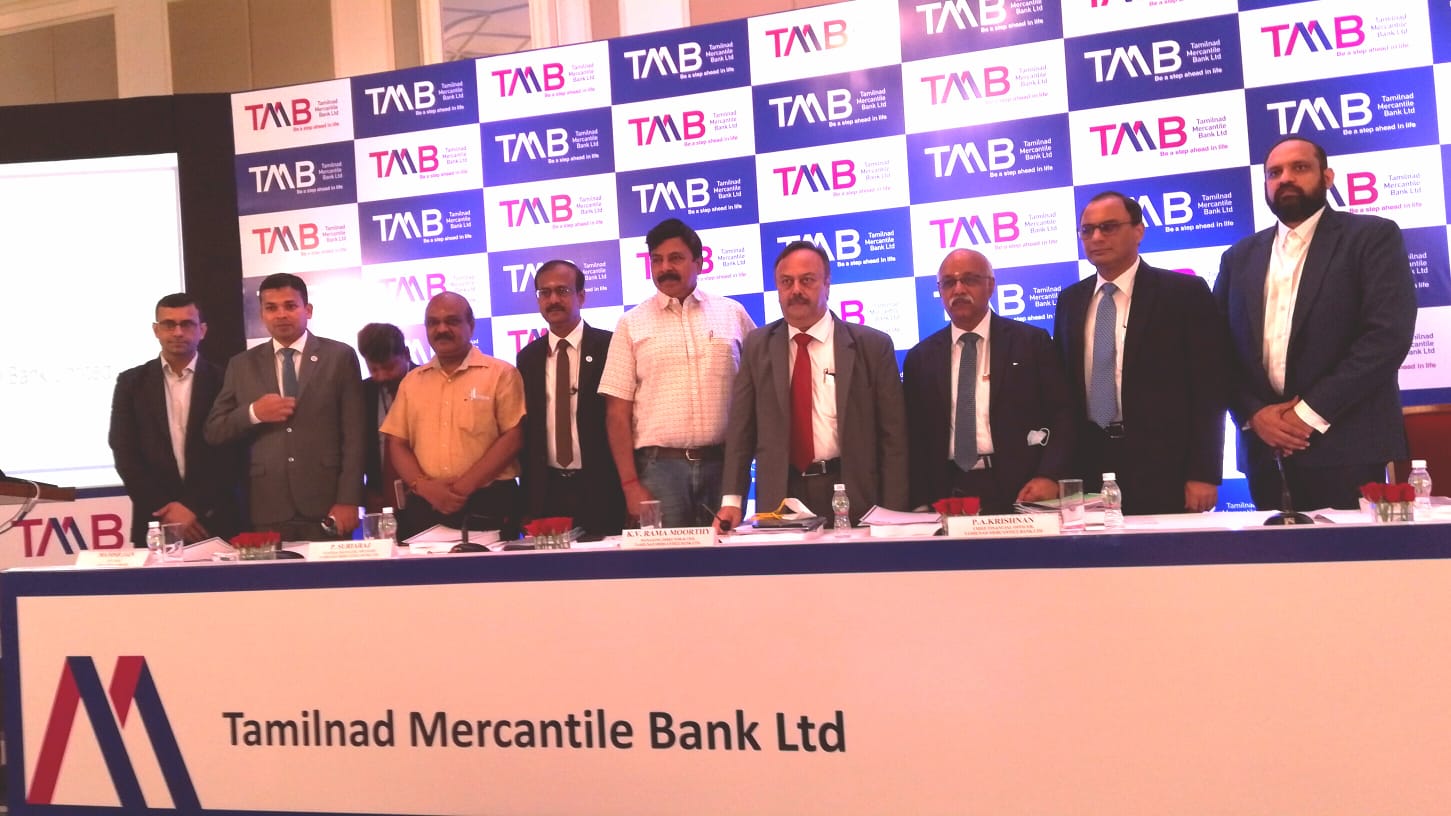
When a century-old bank grows at 15% with NPAs lower than your neighbour’s credit score, it deserves a standing ovation… or at least a meme on ‘How to stay disciplined in chaos’.
1. At a Glance
Tamilnad Mercantile Bank (TMB), the grand old man of India’s private banking sector, has just dropped its Q2FY26 results — and oh boy, the numbers are tighter than a South Indian accountant’s monthly Excel sheet.
At ₹457 a share and a market cap of ₹7,228 crore, the bank trades at a modest P/E of 5.95x and Price-to-Book of just 0.77x — cheaper than filter coffee at Saravana Bhavan if you adjust for inflation. The EPS clocks in at ₹76.7, with an ROE of 14% and ROA at 1.85%, proving that old institutions don’t need to be flashy to be efficient.
The Q2FY26 Net Profit stood at ₹318 crore, up 4.7% YoY, while Revenue touched ₹1,413 crore, up 5.68% YoY. GNPA at 1.22% and NNPA at 0.33% show TMB runs tighter controls than your dad’s loan approval process.
Despite being 103 years old, this bank still opens more branches than most fintechs close. In Q2FY26 alone, it announced new branches in Tenali, Mangalagiri, and Vizhinjam, proving expansion isn’t just for startups with venture capital and hoodies.
But behind this vintage charm lies a spicy mix of courtroom drama, fintech flings, and Tamil Nadu loyalty that could put even a soap opera to shame. Buckle up.
2. Introduction – 103 Years of Banking and Still Not Bored
If Indian banks were people, Tamilnad Mercantile Bank would be that disciplined grandfather who still wakes up at 5 AM, reads The Hindu, and balances the family accounts on paper.
Born in 1921, this institution has outlived empires, license raj, demonetization, and the RBI’s mood swings. From lending to small farmers to tying up with fintechs like Paytm and Fisdom, TMB has quietly evolved from Madras Presidency-era banking to UPI QR code chic.
The irony? While new-age fintechs burn cash faster than popcorn, TMB’s net profit margins hover around 22% — a silent reminder that old-school discipline still beats flashy user interfaces.
Yet, behind this well-oiled machine, lies a century-long drama worthy of a Netflix series: shareholder battles, Essar Group’s ghostly past, frozen stakes, and regulatory tug-of-war that could make even Arnab Goswami speechless.
Still, customers love it. Why? Because when you walk into a TMB branch, you won’t find NFT brochures or robo-advisors — you’ll find actual humans who know your father’s cousin’s credit history. That’s not CRM. That’s DNA.
So how does this southern giant manage to remain both traditional and profitable? Let’s pop open the balance sheet like a spicy sambhar dosa.
3. Business Model – WTF Do They Even Do?
Tamilnad Mercantile Bank’s model is simple — take deposits, lend small, stay humble, repeat for a century.
With 45,000+ crore advances and ₹53,800 crore deposits, TMB is the financial lifeline for thousands of MSMEs, farmers, and small traders — the people who form India’s real GDP, not the flashy unicorns on CNBC.
Its advances mix screams “grassroots banker”:
- MSME loans: 29.8%
- Agriculture: 39.9%
- Retail: 23.6%
- Others: 6.7%