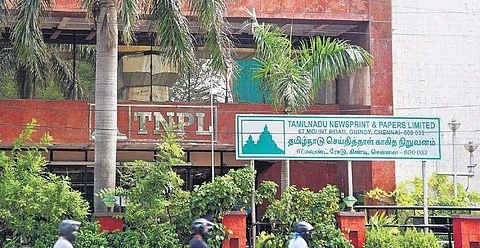
1. At a Glance – This Paper Mill Looks Cheaper Than Scrap. That Itself Is Suspicious.
A state-backed paper company trading at 3.9 times earnings, 0.42x book, throwing 2.1% dividend yield, sitting on ₹4,645 crore revenue, and yet valued at barely ₹975 crore market cap.
Either the market has gone blind.
Or it knows something.
And that is where this gets delicious.
Because Tamil Nadu Newsprint & Papers (TNPL) looks like one of those old-school industrials the market forgot at a railway station. Ugly, cyclical, debt-heavy, boring… and suddenly printing ₹248 crore FY26 PAT vs ₹4 crore FY25, while quarterly PAT explodes 986% YoY.
986%.
That number looks less like earnings growth and more like a typographical emergency.
But before anyone screams “multi-bagger”, calm down.
This is also a company where:
- Interest coverage is barely 1.26
- Debt sits at ₹1,613 crore
- ROCE has collapsed from 21% (FY23) to 6%
- Cheap imports from China, Vietnam and Indonesia have been punching margins
- Sales growth over 3 years is negative
- Debtor days have worsened
- Exchange-listed compliance fines showed up
- Capex is back, funded partly by debt
This is not a clean fairytale.
This is a detective story.
And I like detective stories.
Because sometimes “cheap” is cheap for a reason.
And sometimes the market prices a cyclical business at bankruptcy multiples just before mean reversion.
Which one is this?
That’s the puzzle.
Even more fascinating:
- Largest single-location paper plant in India
- Integrated pulp + power model
- Bagasse advantage
- Packaging board growth optionality
- Tissue plant entering
- Power revamp underway
- Rating reaffirmed at A+ Stable despite pressures
Question for readers:
Is TNPL a cigar butt with one puff left… or a neglected compounder hiding inside a paper mill?
Let’s turn the pages.
2. Introduction – A Government Paper Mill Doing Capitalism
TNPL has always been the strange beast of Indian markets.
Half PSU discipline.
Half commodity madness.
Half environmental mascot.
(Yes, that is three halves. Accounting creativity starts early.)
It makes writing paper, packaging board, notebooks, even cement. Generates power. Uses bagasse. Plants trees.
Basically a paper mill trying to behave like an ESG influencer.
But markets do not pay for virtue.
Markets pay for cash flows.
And cash flows have been moody.
FY24 revenue down.
H1 FY25 weak.
Margins crushed by imported dumping.
Wood costs nasty.
Coal painful.
Then FY26 shows profit resurrection.
Classic cyclical rebound behavior.
And these are dangerous.
Because investors often confuse cyclical rebounds with structural turnarounds.
They are cousins, not twins.
Big difference.
Yet there is intrigue:
- Packaging demand secular.
- Tissue can add growth layer.
- Power efficiency revamp may help margins.
- Wood prices showing some easing per ICRA.
This may not be dying paper.
This may be transitioning paper.
And transitions make money… if bought before the crowd