1. At a Glance
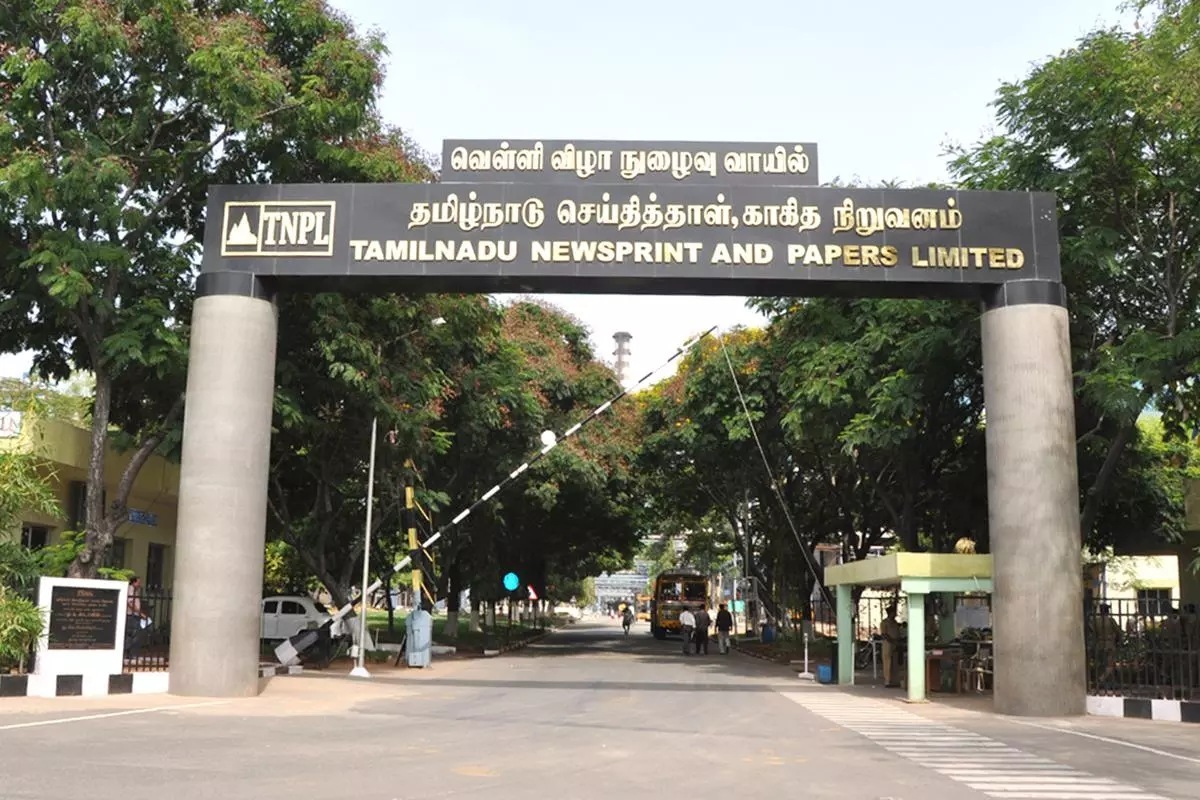
Tamil Nadu Newsprint & Papers Ltd (TNPL) — the pride of Karur, the headache of investors — is India’s most patriotic paper mill that keeps reinventing itself every few years (mostly after debt scares). Trading at ₹154 a share, this ₹1,068 crore smallcap has managed to stay debt-heavy and profit-light.
As of Q2 FY26, quarterly revenue stood at ₹1,110 crore, up 21.5 % YoY, but PAT was a modest ₹8.1 crore, because what’s life without an interest burden of ₹1,800 crore? The Operating Margin sits at 11.1 %, the ROCE limps at 5.5 %, and ROE has turned negative at -0.14 %.
Book value? A hefty ₹299. But the stock trades at just 0.52× P/B — the market clearly values it as an emotional support PSU rather than a profitable enterprise.
2. Introduction
Picture a detective walking into a printing press — papers flying, machines roaring, accountants hiding. That’s TNPL. Born in 1979 with the Tamil Nadu government as its godfather, it was supposed to revolutionize eco-friendly paper using bagasse (sugarcane residue). Fast forward to 2025, it’s still wrestling with pulp prices, bagasse supply, and the occasional coal bill from hell.
The company has 3 units with 4.4 lakh MTPA of paper capacity and 2 lakh MTPA of packaging board, making it India’s largest single-location paper plant. It also dabbles in cement and power generation, because why not mix everything that burns cash?
Over the last two years, revenue fell 9.4 % in FY24 and another 8.4 % in H1 FY25, mostly thanks to cheap imports from China, Vietnam, and Indonesia. In other words — global pulp fiction meets Indian cost inflation.
3. Business Model – WTF Do They Even Do?
TNPL basically takes sugarcane waste (bagasse), wood, and water, then converts them into paper, boards, and sometimes debt.
Segments:
- Printing & Writing Paper (67 % revenue) – the main business; school notebooks, office paper, and “important government documents nobody reads.”
- Packaging Boards (26 %) – eco-friendly coated/uncoated boards for FMCG and e-commerce packaging.
- Cement (2 %) – made from waste lime sludge (because someone read “waste not, want not”).
- Others (5 %) – notebooks, by-products, and a few megawatts of self-generated power.
Customers: FMCG, food, pharma, textiles — basically anyone who needs boxes or excuses for higher packaging costs.
The company is