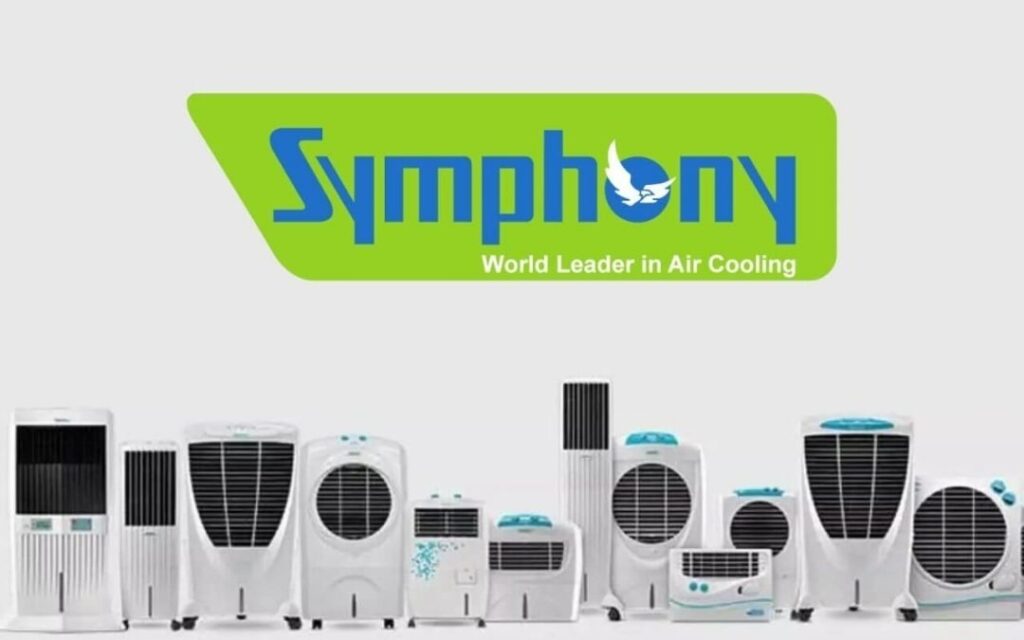
Symphony invented a way to sell air disguised as innovation and patents. With 27.5 million coolers sold globally, a 50% share in India’s organised air cooler market, and a 36.8% ROCE that makes FMCG peers jealous, you’d think investors would be chilling. Instead, the stock has crashed 37% in one year, proving even the world’s largest air cooler maker can’t cool down shareholders’ tempers.
2. Introduction
Founded in 1988 in Ahmedabad, Symphony started as the “Maruti 800 of cooling”—cheap, reliable, middle-class approved. Over decades, it scaled into the largest air cooler manufacturer worldwide, with products in 60+ countries and subsidiaries from Mexico to Australia.
97% of its revenue still comes from selling air coolers. If that sounds boring, they jazz it up with patents (55+), copyrights (20+), and more trademarks than a Bollywood lawyer’s desk (417+). They also launched Double Decker Coolers (no, it’s not a bus), kitchen fans, and even water heaters. So now they sell both “cool” and “hot”—the full shaadi tent package.
Financially, Symphony has always been the neat freak of the consumer durables sector: ROE 32%, dividend payout 44%, debt tiny at ₹142 Cr, and a business model that spits free cash like panipuri water. But in FY25, things got sweaty: exports collapsed from 34% to 8%, quarterly profit fell 57% YoY, and stock price halved.
So here we are: the company that sells air is now gasping for air in the market.
Question: Is Symphony a global champion unfairly punished for short-term hiccups, or just an old cooler in a split-AC world?
3. Business Model – WTF Do They Even Do?
Symphony makes residential, commercial, and industrial air coolers. Think:
Residential: personal, tower, traditional coolers.
Commercial: warehouses, banquet halls, factories.
Industrial (LSV): cooling systems for spaces bigger than your ego.
Key trick: asset-light outsourcing model. Manufacturing largely outsourced, Symphony focuses on design, branding, distribution. This means high ROCE, minimal debt, but also seasonal dependence.
Distribution: 30,000 dealers, 1,000 distributors, 5,000 towns. Basically, if there’s electricity, Symphony has a dealer nearby.
Side hustles: Acquisitions abroad (IMPCO in Mexico, GSK in China, Climate Tech in Australia). Some worked, some backfired (China subsidiary bled losses). They’re now exploring divestments in Australia & Mexico to cut dead weight.
So yes, business is simple: sell coolers, slap eco-friendly branding, pay dividends, repeat. Yet somehow, stock trades like a distressed NBFC.
4. Financials Overview
Quarterly Financials (₹ crore)
Metric
Q1 FY26 (Jun 25)
Q1 FY25 (Jun 24)
Q4 FY25 (Mar 25)
YoY %
QoQ %
Revenue
251
393
381
-36.1%
-34.1%
EBITDA
26
87
99
-70%
-74%
PAT
42
88
79
-52.3%
-46.8%
EPS (₹)
6.1
12.8
11.5
-52.3%
-46.9%
Annualised EPS ~₹24 → PE ~39x (premium).
Commentary: Summer was bad, exports worse. But even at half profits, Symphony is still a cash-printing machine.
5. Valuation Discussion – Fair Value Range
a) P/E Method
EPS FY25 = ₹24.2
PE range: 25x–35x (sector premium, leadership)
Fair Value = ₹605–₹847/share.
b) EV/EBITDA Method
EV = ₹6,591 Cr
EBITDA FY25 = ₹277 Cr
EV/EBITDA = 23.8x
Sector average ~15–20x
Fair Value EV = ₹4,150–₹5,500 Cr → equity value ₹600–₹800/share.
c) DCF (optimistic)
Assume 8% CAGR, WACC 12%, terminal 3%
Fair Value = ₹700–₹900/share.
👉 Combined Fair Value Range = ₹600 – ₹900/share. CMP ₹941 slightly above band.
⚠️ Disclaimer: This fair value range is for educational purposes only and not investment advice.
6. What’s Cooking – News, Triggers, Drama
Subsidiary clean-up: Exploring sale of Australian & Mexican subsidiaries (Apr 2025). Translation: “Foreign adventures didn’t work, let’s sell and come back to India.”
Buyback: August 2024 buyback of shares worth ₹71 Cr at premium—management signalling confidence (or desperate