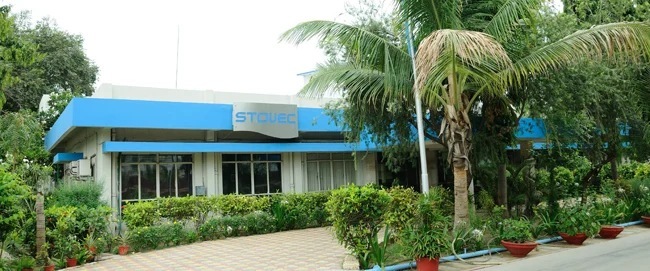
Stovec Industries Limited (SIL) just dropped its results for the quarter ended March 31, 2026. If you were expecting a celebration, you might want to put the champagne back in the cellar. While the company remains a debt-free subsidiary of the Dutch giant SPGPrints B.V., the latest numbers suggest a machine that is starting to creak under the weight of rising costs and stagnant demand.
With a market cap of just ₹382 Crore, this smallcap player is often ignored by the big institutional money, but for those watching the textile machinery space, the latest data reveals a story of shrinking margins and a heavy reliance on “Other Income” to keep the lights on. The stock is currently trading at a P/E of 64, which is more than double the industry median. Is the market seeing something we aren’t, or is this a classic case of overvaluation in a slow-growth sector?
1. At a Glance
The numbers at Stovec are doing a strange dance. On one hand, you have a debt-free balance sheet that would make any auditor smile. On the other, you have a Net Profit that has crashed 45% on a TTM (Trailing Twelve Months) basis. The company reported a revenue of ₹196 Crore for the last year, but the operating profit margin (OPM) has shriveled to a mere 4.44%. For a company that once boasted margins in the 20% range back in 2018, this is a massive red flag.
Investors are paying a premium—nearly 3 times book value—for a business that has delivered a pathetic sales growth of 5.58% over the last five years. Even more alarming is the 3-year sales growth, which is actually negative at -5.65%. This isn’t just a temporary hiccup; it looks like a structural slowdown in their core textile consumables and machinery segment.
The latest Q1 FY27 (March 2026) results show revenue from operations at ₹466.90 million, down from ₹490.56 million in the same quarter last year. While the management has managed to keep the company afloat without borrowing a single rupee, the return on equity (ROE) has plummeted to 5.60%. When your ROE is lower than a fixed deposit rate, you have to ask: what exactly is the management doing with the shareholders’ capital?
Adding salt to the wound is the high dependency on Other Income, which stood at ₹4.61 Crore last year. Without this cushion, the bottom line would look even more skeletal. The company is currently seeing high inventory days (182 days), suggesting that their products are sitting in warehouses rather than moving to factory floors. With the textile industry facing global headwinds, Stovec’s high-tech rotary screens might be finding fewer takers than before.
2. Introduction
Stovec Industries Limited is not a newcomer. Established in 1973, it has spent over five decades carving a niche in the textile printing industry. As a subsidiary of SPGPrints B.V., Netherlands, it carries the DNA of European precision and technology. They aren’t just selling machines; they sell the “consumables”—the perforated nickel screens and inks that keep the printing presses running.
The business is split into two primary segments: Textile Machinery & Consumables and Graphics Consumables. The textile side is the undisputed heavyweight, accounting for nearly 79% of the revenue. This makes the company’s fate inextricably linked to the health of the Indian textile sector, which has been riding a roller coaster of fluctuating cotton prices and shifting global demand.
Geographically, the company is firmly rooted in the domestic market, which contributes 78% of its turnover. While they do export to regions like Europe, the US, and Bangladesh, the “China + 1” strategy hasn’t yet resulted in a massive export surge for Stovec. In fact, export share has seen volatility, moving from 36% in recent peaks to lower levels currently.
The stock performance reflects this stagnation. Over the last five years, the stock has given a 0% CAGR. That is not a typo. If you held this stock for half a decade, your capital appreciation is effectively zero, excluding dividends. It is a classic “value trap” candidate—looks safe on the balance sheet