General information and entertainment, not investment advice. The author is not a SEBI-registered adviser or research analyst. No recommendation, no promised returns. Markets carry risk including loss of capital. Figures may not be current. Consult a registered adviser before acting.
1. At a Glance
Stanley Lifestyles delivered FY26 with the financials of a company mid-pivot. Revenue flat at ₹419 Cr against ₹432 Cr prior year; net profit halved to ₹12.1 Cr from ₹30.1 Cr. The gap between market cap and cash pile is telling: ₹810 Cr valuation on ₹162.5 Cr cash, implying equity holders sit on ₹647.5 Cr of business value—at a multiple every investor notices when a growth story gets expensive.
The numbers carry flags and footnotes. Operating profit margin compressed from 20% to 18%; depreciation and lease accounting surges to ₹51.7 Cr (+17% YoY). The Hyderabad flagship delayed; West Asia logistics crushed B2B exports; new store gestation drags near-term profitability. Yet management entered FY27 with order book at ₹62 Cr, the highest ever.
The stock sits at 56x P/E off an annualised EPS of ₹2.12. Three years ago it paid 7x on EPS ₹5.83. The multiple expansion happened as earnings compressed—a wedge worth watching.
2. Introduction
Stanley Lifestyles Ltd, a Bangalore furniture maker since 2007, trades in a framing most luxury businesses know: the gap between volume and margin.
The company operates two factories—Electronic City (seating, beds, kitchens, mattresses; 163,200 sets capacity) and Jigani (dedicated seating, 144,000 sets). Vertical integration runs deep: design to retail, leather sourcing, contract manufacturing for OEM clients, then retail under Stanley Boutique, Level Next, and Sofas & More. The retail network spans 73 stores as of Sep 2025 (50 COCO, 23 FOFO, per management June 2026 concall).
FY25 saw ₹426 Cr revenue. FY26 printed ₹419 Cr, a 1.6% decline. The three-year CAGR from FY24–FY26 sat at 0%; five-year CAGR (FY21–FY26) clocked 16%. The company is not contracting long-term; it is lurching.
Management characterizes FY26 as “strategic corrections, investments and operational enhancements” with a forwarding-looking thesis: the luxury housing market in six key cities (Bangalore, Chennai, Hyderabad, Pune, Mumbai, Delhi) represents ~80% of India’s luxury housing demand; project handovers peak in FY28–FY29; Stanley positions itself to capture the furnishing cycle post-handover. It is placing a decade-long bet on an inflection.
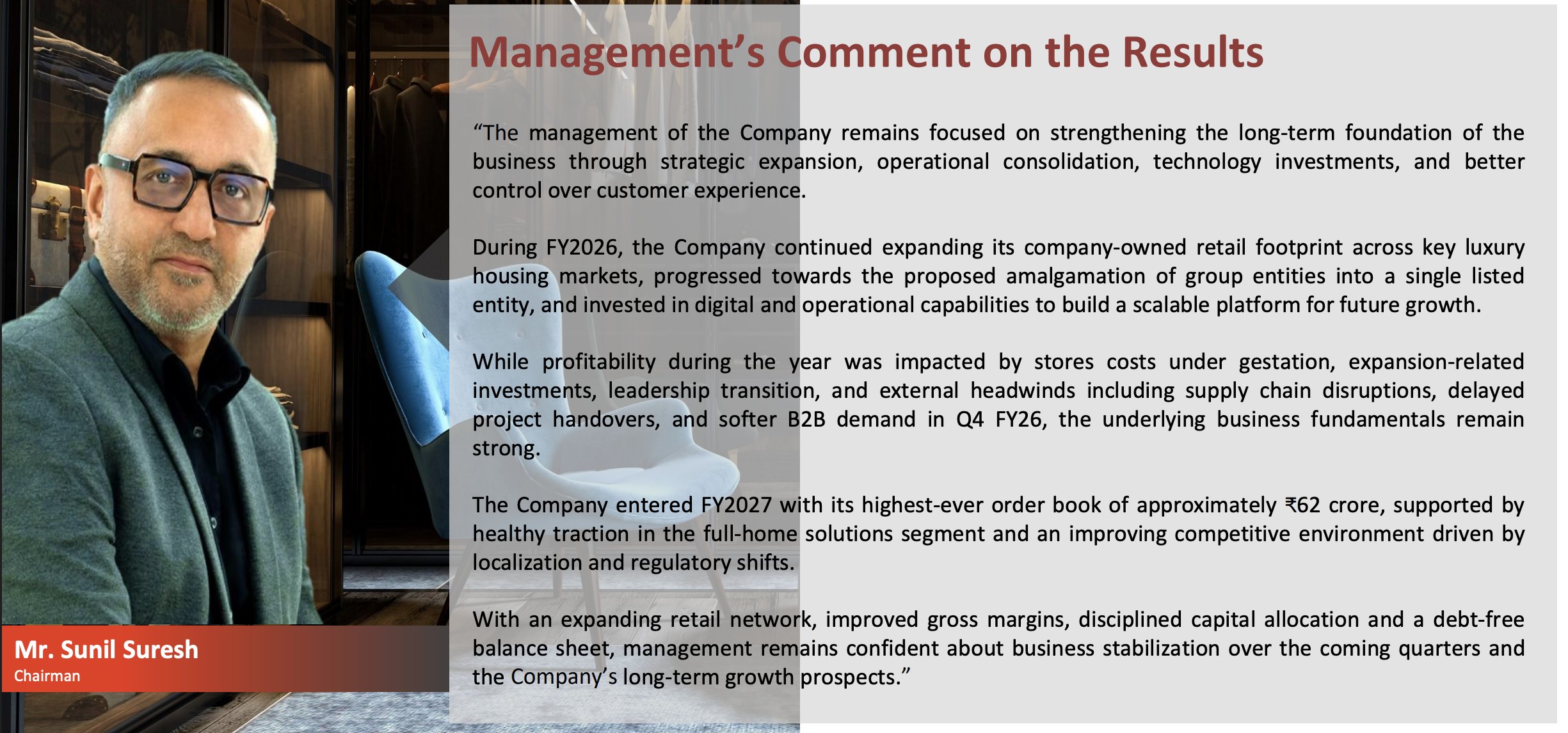
Recent moves: board-approved merger of five subsidiaries into the listed entity (announced May 2026); 11 new stores opened in the last 12 months against 3 closures; Hyderabad flagship delayed due to regulatory approvals. June 2026 concall disclosed promoter Sunil Suresh bought 1,01,000 shares (3 June 2026), holding rising to 28.47%; no dilution message sent.
3. Business Model: WTF Do They Even Do?
Stanley peddles aspiration furniture to India’s top 0.5%. The margins live in the gap between what a London showroom charges for a sofa and what a Bangalore factory can build it for, plus the margin on the spread between design and retail.
Seating leads the portfolio at 59% of FY25 revenue. Case goods (dining tables, side tables, consoles) add 16%; leather products 11%; beds & mattresses 5%; kitchens & cabinetry 4%; automotive interiors (OEM supply) 6%. The segmentation obscures a deeper tension: the company sells furniture on the order-book model. Management disclosed on the June 2026 concall that ~75% of B2C revenues flow from “confirmed customer orders”—not inventory turns. The model works when handovers accelerate; it breaks when projects stall.
Geographically, the company scattered itself across 24 cities by FY25, but concentration matters: Karnataka (24 stores), Tamil Nadu (10), Maharashtra (8), Telangana (6), Delhi NCR (3), others (22). The store model evolved. COCO (company-owned, company-operated) now accounts for 61% of FY25 revenue; FOFO (franchisee) 13%; B2B (contract manufacturing + automotive OEM) 26%. Management sees FOFO as misaligned—it bred discounting and customer experience dilution. The five-year shift was toward control.
Formats tier the price pyramid. Stanley Level Next (ultra-luxury) occupies 11 stores at ~11,121 sq ft each; Stanley Boutique (luxury) spreads across 16 stores; Sofas & More (super-premium) fills 40 stores. The data on store economics came from management: ROI payback clocks ~3 years (15–36 months depending on catchment), tracked as payback rather than per-sqft revenue due to the made-to-order model. The company expects “over half” of stores to sit in gestation (underperforming early-stage ramp). New stores lag; mature stores (>3 years) grew just 4% in FY26.
The ask: does a luxury furniture brand at ₹810 Cr market cap scale on retail expansion alone, or does the handover cycle amplify the play?
4. Financials Overview
Figures are consolidated, in ₹ crore.
Metric
FY24
FY25
FY26
FY26 QoQ
Revenue
432.5
426.2
419.3
-1.6%
Operating Profit
89.0
85.4
75.2
-12%
Operating Margin
20.6%
20.0%
17.9%
-210 bps
Net Profit
30.1
29.1
12.1
-58%
Net Margin
6.9%
6.8%
2.9%
-390 bps
EPS (Annual)
5.83
5.10
2.12
-58%
Q4 FY26 (Mar 2026) Detail:
Metric
Q4 Mar 2026
Q3 Dec 2025
QoQ Change
Sales
101.4
103.8
-2.4 Cr
Operating Profit
15.1
13.0
+2.1 Cr
Net Profit
-0.8
-0.6
-0.2 Cr
EPS
-0.14
-0.11
-0.03
The headline: net profit collapsed into negative territory in Q3 and Q4. The operating profit stayed positive, meaning the company still generated cash from day-to-day operations; but below-the-line costs (depreciation, interest, tax reversals) ate the margin.
Headwinds Called Out (June 2026 Concall):
Management cited: (i) new stores not yet mature; (ii) pre-operating and expansion expenses; (iii) temporary KMP compensation overlap; (iv) Ind AS lease accounting front-loading (₹14.7 Cr depreciation impact in early leases); (v) FX headwinds on imports (USD/EUR appreciation raising input costs); (vi) supply-chain delays tied to Middle East conflict; (vii) B2B pull-down (~₹15 Cr) from West Asia logistics disruption affecting a major OEM furniture customer.
The exceptional item: ₹3.3 Cr booked for new Labor Code impact (assessment completed, one-off).
Positive Note on Gross Margin:
Despite disruptions, gross margin expanded 151 basis points to 57.5% (FY26) from 56.3% (FY25). Management attributed this to cost optimization and emerging sourcing structure—”best-cost country strategic sourcing” plus increased localization. Leather raw material localization hit 50%; finished furniture imports dropped from ~30% (3–4 years prior) to 10–15% now, with Stanley claiming 85–90% made in-house. The delivery clock compresses to 6–8 weeks against importers’ 4–5 months—a structural advantage if housing demand materializes.
5. Valuation Discussion: Fair Value Range (Educational Only)
What follows is a walkthrough of how three valuation methods work, using this company’s numbers as the example — not a target, not a forecast, not advice.
Method 1 (P/E Multiple Approach): Annualised EPS is ₹2.12 (FY26 base). The peer