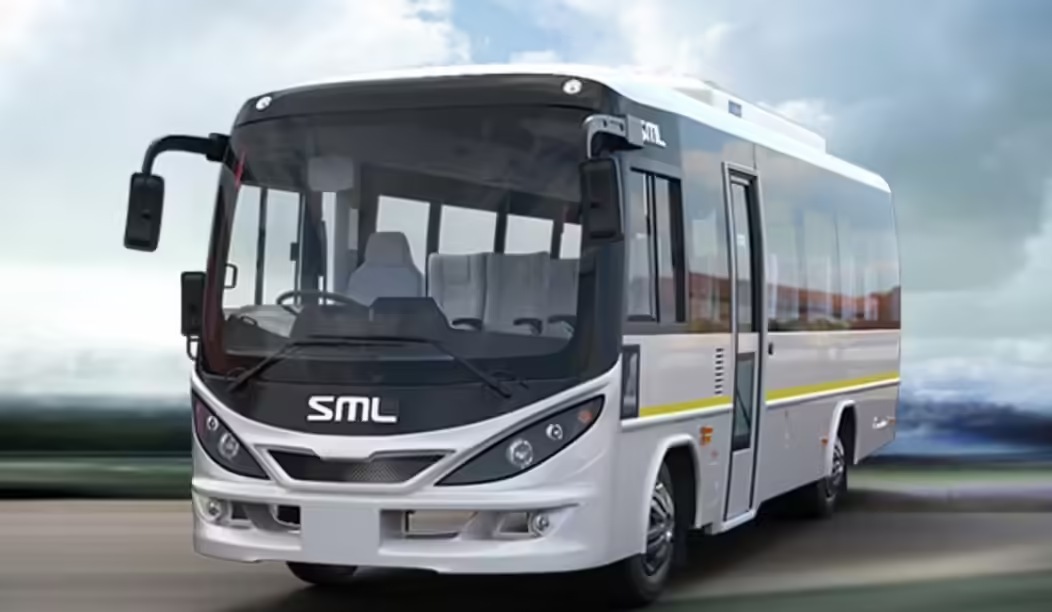
1. At a Glance
There are two kinds of small commercial vehicle companies in India.
First, the companies that keep launching new trucks every six months, talk endlessly about EVs, and somehow still cannot make money.
Then there is SML Mahindra.
For years, this company quietly sold school buses, staff buses, and a few cargo trucks while the market ignored it. Suddenly, Mahindra arrived, bought 58.96% stake, renamed the company, changed the management, upgraded the credit rating, and turned what looked like a sleepy bus maker into one of the most closely watched commercial vehicle stories in the market.
The company ended FY26 with revenue of ₹2,838 crore and PAT of ₹160 crore. That is not tiny. Revenue grew 18% while profit grew 31%. Return on equity stood at 35.4% and ROCE at 30.9%. These are not “good for an auto company” numbers. These are the kind of numbers that make larger companies wonder why they are carrying so much dead weight.
The interesting part is that SML Mahindra is still not a full-fledged truck giant. Around 67% of its business still comes from buses, while trucks contribute just 26%. That is unusual in a commercial vehicle market where most competitors survive on heavy trucks and cargo movement.
This company is basically the school bus king pretending to be a truck company.
Mahindra clearly saw something attractive here.
A strong brand in buses. A decent manufacturing base in Punjab. A 24,000-unit capacity plant. A growing cargo segment. Healthy margins. Low debt. And perhaps most importantly, a niche where Tata Motors and Ashok Leyland are large, but not unbeatable.
The Mahindra takeover changes the entire story.
Earlier, SML looked like a decent niche player with limited ambition. Now it suddenly has access to Mahindra’s network, sourcing power, distribution muscle, technology stack, connected vehicle tools, and manufacturing synergies.
This is no longer a company fighting alone.
The market has already noticed. The stock has delivered around 130% return over one year. Naturally, this has also pushed the valuation into slightly uncomfortable territory. The stock trades at a P/E of 36.7 times and at 11.2 times book value.
That is no longer cheap.
So the big question is simple.
Is SML Mahindra becoming the next serious challenger in India’s intermediate commercial vehicle market?
Or is the market already pricing in too much optimism because Mahindra entered the chat?
That is where things get interesting.
2. Introduction
SML Mahindra was originally Swaraj Vehicles. Then it became SML Isuzu. Now it has become SML Mahindra.
The company’s history is basically one long corporate relay race.
It started with Punjab Tractors, got technical help from Mazda, later shifted to Isuzu, and now Mahindra has taken over control.
The latest chapter is by far the biggest.
Mahindra acquired 58.96% stake in August 2025 after buying out Sumitomo and Isuzu stakes. After that, the company renamed itself, changed key management positions, brought in new leadership, and immediately started integration projects.
Mahindra is not hiding its ambition here.
The combined Mahindra Truck & Bus business plus SML aims to become a top-3 player in India’s intermediate light commercial vehicle truck and bus market.
That is a big statement.
Especially because SML’s business is still highly concentrated around buses.
School buses alone account for the majority of the company’s passenger vehicle volumes. Executive coaches and staff buses are also important. This makes SML less cyclical than some truck-heavy peers because school and passenger transport demand tends to be more stable than freight demand.
At the same time, it also limits the size of the market opportunity.
A company cannot become a giant only by selling buses to schools forever.
That is why Mahindra’s role becomes critical.
The integration plan already includes:
- Common sourcing
- Shared technology
- Connected vehicle solutions
- Service network integration
- Distribution expansion
- Manufacturing footprint optimisation
- Brand positioning with a two-brand strategy
In simple language, Mahindra wants SML to stop behaving like a niche regional company and start acting like a national commercial vehicle platform.
The company’s credit rating was upgraded from AA- to AA+ after Mahindra acquired control. That matters because lower borrowing costs can directly improve profitability in a business where inventory and working capital are important.
There are also operational benefits.
SML reduced its working capital debt from around ₹350 crore to ₹225 crore during FY25. Borrowings have already fallen to ₹289 crore by FY26 from ₹327 crore in FY25.
This is not the balance sheet of a stressed auto company.
But investors should not forget one thing.
Commercial vehicles remain cyclical.
When the economy is strong, companies suddenly want more buses, trucks, school fleets, and staff transport vehicles.
When the economy slows, people postpone purchases, fleet owners become cautious, and commercial vehicle demand can disappear faster than a free lunch in a brokerage office.
So even though SML Mahindra looks stronger today, this is still an auto company. Cycles matter.
3. Business Model – WTF Do They Even Do?
SML Mahindra sells commercial vehicles.
Mostly buses.
A little bit of trucks.
And some spare parts on the side.
Around 94% of revenue comes from vehicle sales while 6% comes from spare parts.
The company’s product mix is tilted heavily toward passenger vehicles.
- Passenger vehicles or buses: 67%
- Cargo vehicles or trucks: 26%
- Remaining from spares and other business
This is what makes SML unusual.
While companies like Tata Motors and Ashok Leyland dominate freight transport, SML built its reputation in school buses, staff