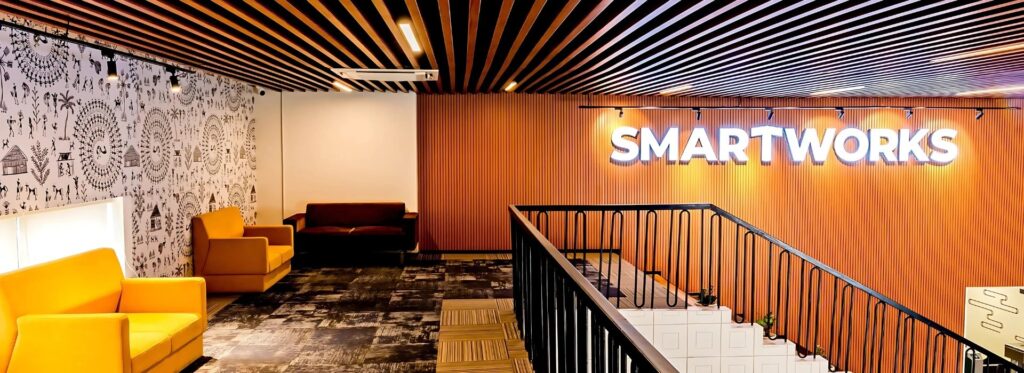
Smartworks just went public in July 2025, raised ₹582.5 Cr, and promptly reminded investors that loss-making IPOs aren’t just for tech bros anymore. With ₹1,374 Cr FY25 revenue, ₹65 Cr loss, debt at ₹3,737 Cr, and ROE at -82%, this company is basically WeWork’s Indian cousin — only with more chai points and fewer tequila-fueled founder meltdowns.
2. Introduction
Remember when offices were supposed to die after COVID? Well, Smartworks decided to double down by leasing entire tech parks, stuffing them with ergonomic chairs, gyms, crèches, cafeterias, and then marketing it as “enterprise-focused managed campuses.” Translation: “Bhai, rent ka dukaan with a treadmill.”
Founded in 2015, Smartworks claims to be India’s largest managed office campus operator with 8 million sq. ft., 182k seats, and 603 clients. Big names like Google IT, L&T Tech, Bridgestone, and Groww sit in their properties — probably wondering if they should have just bought their own building instead.
IPO hype? Oh yes. 13.45x oversubscribed, QIB 24.4x. But the company still posted a Q1 FY26 loss of ₹42 Cr. Investors clearly have short memories — or too much liquidity.
3. Business Model – WTF Do They Even Do?
Smartworks is essentially a property sub-leaser with interior design swag.
Step 1: Lease large, bare-shell campuses from landlords.
Step 2: Spend ~₹60,000 per seat on fit-outs (cheaper than industry’s ₹80k–₹2.1L).
Step 3: Brand it as a “Smartworks campus” and rent it to enterprises.
Step 4: Add extra toppings — cafeterias, gyms, visitor management apps, creches — and call it an “office experience platform.”
They also sell FaaS (Fit-out-as-a-Service) — basically design & build for companies that want their own office but don’t want to hire an architect who will ghost them mid-project.
Finally, they make money from ancillary services like Nutritap vending, CloudKitchens, and Park+ tie-ups. A co-working startup turning into a mini-mall? Very on brand.
4. Financials Overview
Q1 FY26 vs Q1 FY25 vs Q4 FY25
Metric
Latest Qtr (Q1 FY26)
YoY Qtr (Q1 FY25)
Prev Qtr (Q4 FY25)
YoY %
QoQ %
Revenue
379
313
358
21.0%
5.9%
EBITDA
241
192
232
25.5%
3.9%
PAT
-4.2
-23.0
-8.3
81.8%
49.4%
EPS (₹)
-0.41
-2.78
-0.80
NA
NA
Commentary: Revenue growing nicely, EBITDA margins absurdly fat (62%), but bottom-line still in the red. It’s like eating 5-star buffet and still going home hungry.
5. Valuation Discussion – Fair Value Range Only
P/E Method: EPS is negative. P/E = Not Meaningful. Investors are basically pricing vibes, not earnings.
EV/EBITDA Method: EV = ₹9,550 Cr; EBITDA ~₹857 Cr. EV/EBITDA = 11.1x. Peers trade at ~20–25x.
Fair range: ₹450 – ₹650.
DCF Method: Assume 25% revenue CAGR (aggressive), break-even in 2–3 years, discount rate 12%.
Fair range: ₹400 – ₹550.
👉 Consolidated Fair Value Range = ₹400 – ₹650.
Disclaimer: This is educational analysis only and not investment advice.
6. What’s Cooking – News, Triggers, Drama
IPO oversubscription (13.45x) made Smartworks look like the next Infosys. Reality: It’s still bleeding cash.
Supreme Court dismissed NGO appeal against IPO. Investors sighed relief, but litigation hangover is still there.
Client list includes Google, Groww, Philips, Persistent. Respectable, but retention still hovers around 88%.
Singapore centers (35,000 sq. ft.) — because nothing says “ambition” like burning dollars in one of the world’s most expensive cities.
Capex discipline: ₹60,000 per seat fit-out vs competitors’ ₹80k–₹2.1L. Smart… until debt piles up.