Singer India Q4 FY26: Revenue Flies, Margins Dither
Spotted a factual error — a wrong number, date, or fact? Tell us and we will check the source.
General information and entertainment, not investment advice. The author is not a SEBI-registered adviser or research analyst. No recommendation, no promised returns. Markets carry risk including loss of capital. Figures may not be current. Consult a registered adviser before acting.
1. At a Glance
Singer India posted ₹166 crore in Q4 revenue, up 36.7% year-on-year—the strongest reported quarter in the trailing data. Annualised sales hit ₹557 crore (+29%), marking the first time in three years the company has expanded faster than 6%.
Operating margins are positive but fragile. Q4 operating profit landed at ₹6.92 crore against revenue of ₹166 crore—a 4.2% operating margin. The full year delivered 2.7% margin, below the 3% levels the company had maintained through 2017-2019.
Net profit for FY26 was ₹12.76 crore, before a ₹0.73 crore hit from new labour code implementation. Adjusted PAT climbed 79.9%. Earnings per share (full-year, not annualised) hit ₹2.07 as of March 31, 2026.
At ₹71.70 (prices referenced are not live), the market pays 33.7x trailing earnings. The peer set (consumer durables homes & appliances) trades at a 48.8x median P/E. Singer sits below the peer band but above its own 10-year history.
A balance sheet holding ₹83 crore in cash. No net debt. Two questions linger: Can margins expand sustainably, or is the growth coming on price? And does ₹450-crore scale move the profitability needle?
2. Introduction
Singer India arrived in 1977. Global sewing machines and home appliances—the company assembles and trades across two segments: Sewing Products (81% of FY26 revenue) and Home Appliances (19%).
The parent entity is Retail Holdings (India) B.V., a Dutch entity controlled by SVP Worldwide, which owns the Singer and Merritt brands globally. SVP granted Singer India a manufacturing licence for these brands in India. In November 2025, the company acquired ₹11.6 crore of intangible manufacturing rights from SVP, to be amortised over 24+ years.
The shareholding sits at 30.5% promoter (RHBV), 20% institutions, and 47% public. The company is widely held. NSE listing was approved in March 2026.
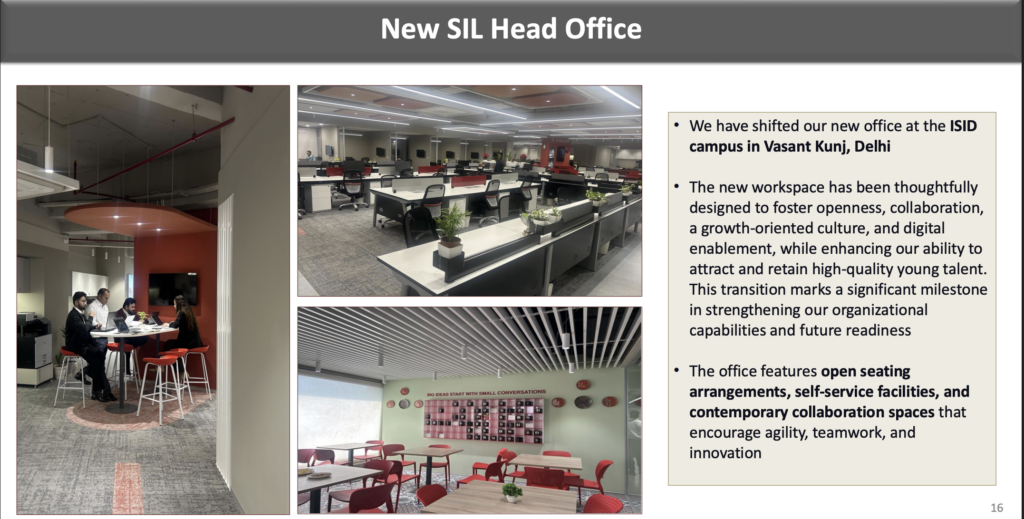
Recent moves: A new headquarters relocated to ISID campus, Vasant Kunj, Delhi (effective January 2026). A fire at the old registered office on July 13, 2025, caused no operational disruption; cloud-hosted systems enabled continuity. The company obtained the PM Vishwakarma government contract—a large, fixed-price order for sewing machines—and has executed 60% of it by Q4. The remainder is expected within two more quarters.
The company also leased a manufacturing facility in Bhiwadi, Rajasthan, expected to produce (initially assembled, components outsourced) from H2 FY27. Capex could reach ₹90 crore over three years.
3. Business Model: WTF Do They Even Do?
Singer India trades and assembles under licences. It does not own the brands or the designs—SVP Worldwide does. The company operates on a variable-cost, drop-ship, and local assembly model to avoid fixed asset intensity.
Sewing Machines (81% of FY26): The core. Three sub-categories:
Cast-iron straight-stitch household machines—called “classic black,” globally considered obsolete, but dominant in rural India at ₹2,000–3,000 price points. The company reports >50% growth in this category in FY26. Management notes these are cheaper than alternatives and serve price-sensitive markets.
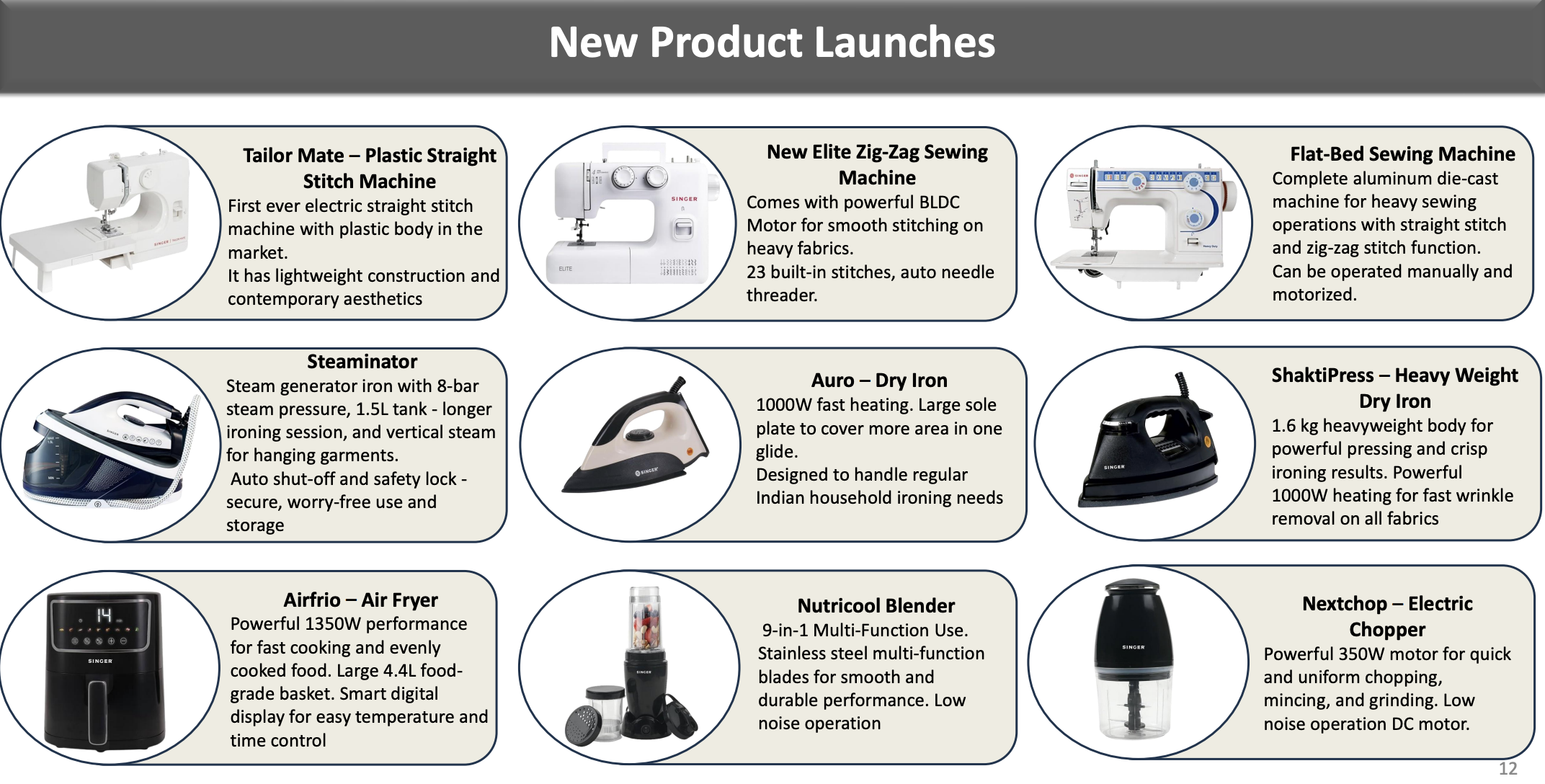
Zigzag household machines (DSBB, SLBB, new models)—modern, electric, 20–30% growth, positioned as the “future of household sewing.” Priced at ₹7,000–12,000. The company launched an India-made aluminium-body heavy-duty zigzag in FY26, manufactured at Jammu.
Industrial sewing machines—sold to garment factories, tailors, NGOs. >20% growth reported. Management views this as a “large opportunity area.”
Accessories, spare parts.
Home Appliances (19% of FY26): A distant second but expanding.
Fans—a newly expanded portfolio (BLDC, induction, TPW, exhaust). Q4 fan growth hit 49%. This is the segment’s primary growth vector now.
Irons (dry, steam), cookers, cooktops, water heaters, chopper, blender.
The appliances segment ran a loss in FY26 (₹-1.05 crore segment result) due to EPR (Extended Producer Responsibility) compliance costs and investment in the fan category. The company is “cautiously” reducing reliance on high-cost modern trade channels and pivoting to e-commerce.
Distribution is wide: 10,000+ retail points, 6,400+ dealers and distributors, 21 exclusive Singer stores, 445 service centres. E-commerce grew 30% in FY26 (sewing) and >200% in appliances (from a small base).
The business is asset-light. Capex runs low. The company relies on contract manufacturers and vendor warranties. But fixed-price government orders (PMY) expose it to commodity inflation with no pass-through.
4. Financials Overview
Figures are consolidated, in ₹ crore.
Metric
Latest (FY26)
YoY Change
Prior Year (FY25)
Revenue
557.3
+29.1%
431.7
EBITDA
21.5
+70.0%
12.6
PAT
12.8
+72.7%
7.4
EPS (Full Year)
2.07
—
1.20
Q4 FY26 specifics:
Revenue ₹166.3 crore (+36.7% YoY). Operating profit ₹6.92 crore (+48.8% in absolute EBITDA). PAT ₹5.9 crore (+45.7%).
The growth was driven by sewing machines (>45% growth) across all channels—retail up 15%, e-commerce up 50%. Appliances grew 9% in Q4 but dragged the full year due to weak cooling/heating product demand in H2 and the EPR impact.
Concall observations (Jun 2026): Management attributed the sustained growth to “execution across commercial levers,” not just demand tailwinds: product innovation (new Zigzag, Tailor Mate motorised straight-stitch), dealer engagement schemes, “value selling rather than price-led selling,” capability building, service turnaround improvements (e.g., “Live Assist” remote support).
Macro headwinds were cited: geopolitical commodity inflation, labour shortages, supply disruption. Appliances segment faced “unfavourable weather conditions, blocked inventory in trade, muted demand.” On PMY orders: “They are fixed-price orders, and we cannot change the price… We have to absorb it.” This is a direct squeeze on the margin for government supplies.
5. Market Expectations & Historical Multiples
This section describes how the market is currently pricing the company and how that compares with its own history and peer group. It is descriptive, not predictive.
Metric
Current
Historical Average (10Y)
Peer Median (23 co.)
P/E
33.7
19.5
48.8
EV/EBITDA
16.6
—
—
ROE
7.89%
6.8%
—
ROCE
10.8%
15.0%
11.1%
The market currently pays 33.7x earnings here versus a peer median of 48.8x—at a discount to the wider consumer durable set.
The multiple sits above its own 10-year average (19.5x), reflecting the recent profit acceleration and expectation of margin recovery. However, the discount to peers suggests the market is pricing in residual uncertainty on sustained margin performance.
ROCE sits at 10.8% for the latest year, up from 4% in FY24 and FY25. The 10-year average ROCE was 15%, indicating the company’s capital productivity has deteriorated over the medium term but recovered sharply in the latest year.
ROE at 7.89% (FY26) remains below the peer band and below the company’s own longer-term average of 9%, signalling that return generation on shareholder capital is still subdued relative to history.
The market appears to be pricing in a recovery narrative—sewing growth as a market-share story, fans as a new growth driver, margin normalisation as operational leverage kicks in, and the Bhiwadi capex as a path to better returns. Whether this materialises depends on execution and external conditions.
6. What’s Cooking
PM Vishwakarma (PMY) order execution — The company is delivering black sewing machines to the government under the skill development scheme. 60% complete by Q4; balance expected within ~two quarters. This is a large order but fixed-price, meaning inflation hits gross margins directly. Management expects H1 FY27 to carry