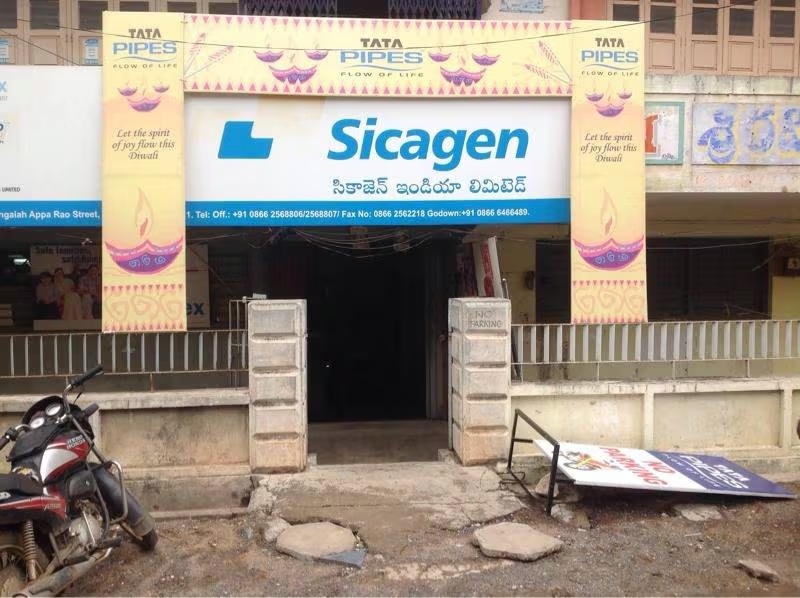
Sicagen India Ltd Q2FY26 – The ₹893-Crore Mini-Conglomerate That Sells Pipes, Drums & Dreams (But ROE Still Can’t Cross 4%)
1. At a Glance
Ah, Sicagen India Ltd — the AM International Group’s silent soldier in the world of steel pipes, water treatment chemicals, and industrial drums. Market Cap ₹261 crore, trading at ₹66 a pop, half its book value (₹131) because, well, the market has trust issues. ROE? 3.41%. That’s the financial equivalent of ordering cold coffee and getting warm water.
The latest Q2FY26 results show quarterly sales of ₹227 crore and PAT of ₹4.14 crore. Revenue up 14.7% YoY, profit… flat. The operating margin sits around 4%, so even one wrong truck of steel could tilt the balance sheet. Yet, this ₹893-crore annual revenue warrior survives with a decent dividend yield of 1.5%, no pledges, and a debt-to-equity ratio of 0.32.
But here’s the twist: while other trading companies are crying about margins, Sicagen’s profits grew 114% CAGR over five years — largely because starting from near-zero helps any percentage look great.
Still, this isn’t a dying old trader. It’s an industrial packager, power systems mechanic, and chemical peddler rolled into one corporate thali. Let’s dig in.
2. Introduction
Sicagen India is that friend in your group who does a bit of everything — trades steel, builds boats, makes water treatment chemicals, and still finds time to maintain ISO certification.
It’s part of Singapore-based AM International Group, a $2+ billion family office that loves collecting mid-sized Indian industrial assets the way some people collect mutual fund SIPs.
Founded in 2004, Sicagen started as a Chennai-based building materials trader and over time added multiple business lines: Power & Control Systems, Industrial Packaging, and even boat building (because why not?).
Financially, it’s the definition of “stable but not sexy.” Revenue barely grows at 5% CAGR, but profits somehow ballooned 138% in three years, like a sleepy student suddenly topping a surprise test. Maybe it’s operational discipline, or maybe accounting yoga — we’ll let the balance sheet tell us.
So, if you’ve ever wondered what happens when a company sells both steel tubes and MS drums while dabbling in chemicals and boats — this is your answer.
3. Business Model – WTF Do They Even Do?
Let’s be honest — Sicagen’s business is as scattered as a power cut in Chennai during monsoon. But once you map it out, it starts making sense… kind of.
Five main verticals, each with its own vibe:
Building Materials: The bread and butter. They sell pipes, tubes, steel, roofing, electricals, and construction chemicals. Basically, if it holds concrete together or conducts electricity, Sicagen probably trades it. Clients? Tata Steel, Jindal, Apollo Tubes, Finolex — the who’s who of metal and wire India.
Power & Control Systems: This is their “engineering” arm. They service mechanical governors and actuators — think of them as mechanics for industrial engines. They even convert old mechanical systems to electronic ones.
Industrial Packaging: The art of putting things in barrels. They make MS drums and cable reel drums, selling to industrial clients who prefer their goods neatly wrapped in shiny metal.
Specialty Chemicals: They make and sell water treatment and industrial chemicals. This part adds science to an otherwise brawny business.
Boat Building: Yes, you read that right. Sicagen builds self-propelled vessels and accommodation-cum-work boats. Imagine a pipe trader moonlighting as a shipbuilder.
Subsidiaries add spice:
Wilson Cables (Singapore): Manufactures premium cables for industrial applications — their international face.
Danish Steel Cluster (India): Precision engineering firm, now merged into the parent in FY24 after NCLT approval.
It’s a B2B buffet where every product touches infrastructure, manufacturing, or logistics — but with wafer-thin margins and complex coordination.
Now tell me, would you trust a company that sells both barrels and boats to deliver consistent margins?
4. Financials Overview
Source table
Metric
Q2FY26 (Latest)
Q2FY25 (YoY)
Q1FY26 (QoQ)
YoY %
QoQ %
Revenue
₹226.76 Cr
₹197.71 Cr
₹204.54 Cr
+14.7%
+10.9%
EBITDA
₹9.06 Cr
₹8.27 Cr
₹9.74 Cr
+9.5%
-7.0%
PAT
₹4.14 Cr
₹4.14 Cr
₹4.54 Cr
0.0%
-8.8%
EPS (₹)
1.05
1.05
1.15
0.0%
-8.7%
Commentary: Flat profit, growing revenue — classic sign of an inflation-spiked cost base. At ₹4.26 TTM EPS, the annualized figure lands around ₹4.2–₹4.4, implying a P/E of ~17x. Not outrageous, but not dirt-cheap either given the ROE.
When a trader’s margin is 4%, the CEO probably prays more to Excel than any god.
5. Valuation Discussion – Fair Value Range (Educational Only)
Let’s keep it simple and fun — three valuation lenses, one headache.
(a) P/E Method:
EPS (Annualized): ₹4.26
Industry average P/E: 42x
Sicagen’s historical range: 12–20x
Fair Value Range (P/E) = ₹4.26 × (12–20) = ₹51–₹85