Shree Tirupati Balajee FY26: Revenue Held the Line, Margins Did Not
Spotted a factual error — a wrong number, date, or fact? Tell us and we will check the source.
General information and entertainment, not investment advice. The author is not a SEBI-registered adviser or research analyst. No recommendation, no promised returns. Markets carry risk including loss of capital. Figures may not be current. Consult a registered adviser before acting.
1 — At a Glance
For most of FY26 this FIBC-bag maker did the hard part right: it kept the top line still. Consolidated revenue landed at ₹574 crore against ₹579 crore the year before — a rounding error of a decline after years of climbing. The problem was everything below revenue. Operating profit fell to ₹38 crore from ₹58 crore, dragging the operating margin to roughly 7% from 10%. PAT followed the margin down, landing at ₹11 crore against ₹25 crore in FY25.
The numbers that draw attention: a market cap of ₹235 crore sitting below book value, at 0.77x. The numbers that raise worry: ROCE of 6.89% and ROE of 3.68%, both single-digit; borrowings of ₹232 crore against net worth of ₹305 crore; and inventory that eats the balance sheet — 315 inventory days, a warehouse that turns over less than a third of a lakh’s worth of times a year.
A packaging company that packages capital and leaves it there. The year’s real story isn’t the revenue that held — it’s the margin that walked out.
Can a company hold its sales flat and still see profit fall by more than half? This one just did.
2 — Introduction
Shree Tirupati Balajee Agro Trading was incorporated in 2001 by Binod Kumar Agarwal to make woven sacks and FIBC bags — the big square jumbo bags that move chemicals, food grain, minerals and cement in bulk. Two decades later it operates out of Pithampur, near Indore, with an installed capacity of 28,000 metric tonnes per annum and a spread of subsidiaries — Shree Tirupati Balajee FIBC, Jagannath Plastics, and Honourable Packaging — that Infomerics consolidates as one operational unit under common management.
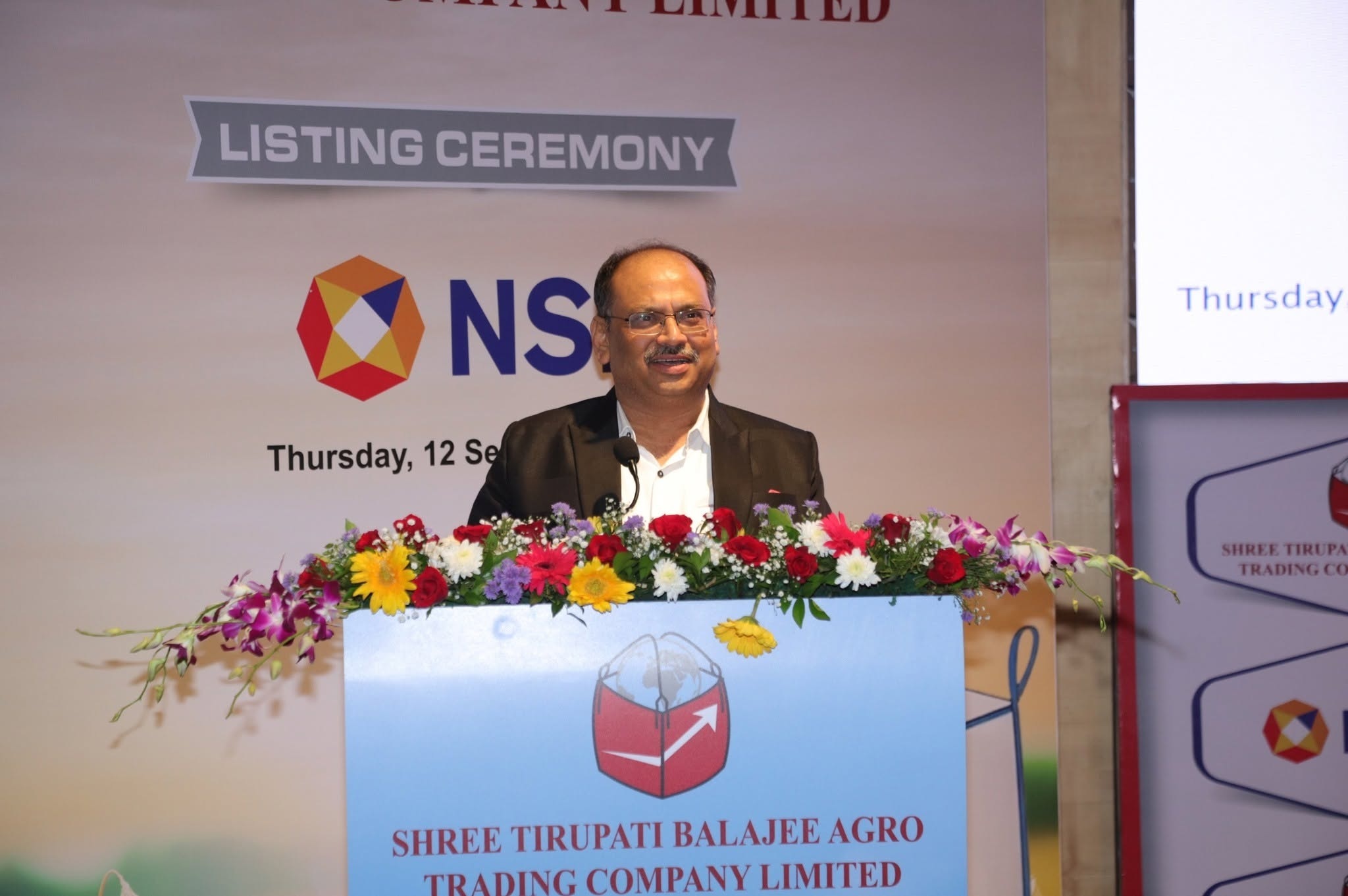
The company listed on the NSE and BSE on 12 September 2024, raising about ₹170 crore, with the fresh-issue portion earmarked for repaying borrowings, funding subsidiaries, and topping up working capital. Per the results filing, the ₹122.4-crore fresh issue was fully deployed against those heads by year-end — borrowings prepaid, subsidiaries funded, working capital fed.
Then FY26 arrived and tested the thesis. The recent moves on the record are less about expansion and more about maintenance: a credit-rating downgrade, an income-tax penalty order, and a routine board approval of audited results. Each is examined below in its own place. What holds the year together is a single tension — stable demand, unstable profitability.
3 — Business Model: WTF Do They Even Do?
They make bags. Not the tote kind — the industrial kind that can hold a tonne of fertiliser and not complain. FIBCs, or Flexible Intermediate Bulk Containers, are the load-bearing workhorses of global bulk shipping, and this company makes a genuinely dizzying catalogue of them: UN-certified bulk bags, Type C and Type D bags, thermal insulation bags, fire retardant bags, rodent repellent bags, and a patented Aero-polymesh design built on a mesh-weaving process meant to add strength without adding grams.
Rodent repellent bags. Somewhere in this catalogue is a bag whose entire selling point is that mice find it disagreeable, and that bag is doing more product differentiation than most listed companies manage in a decade.
Per the IPO documents, the revenue mix leans on FIBC at about 51%, with woven fabrics and narrow fabric at 21%, and the rest spread across woven sacks, tape and others. Roughly half the revenue is export, half domestic, with the USA a key destination and shipments reaching 38 countries. The company runs its research in-house, led by the promoter, and holds pending patents on the mesh process.
The model, stripped down: buy polypropylene granules, extrude them into tape, weave the tape into fabric, sew the fabric into bags, ship the bags abroad. Every step is a spread over the price of a petrochemical derivative. Which means the entire business is a bet that polypropylene stays cheap and customers stay patient — and FY26 disproved both halves at once.
4 — Financials Overview
Figures are consolidated, in ₹ crore.
Metric
Q4 FY26
YoY (Q4 FY25)
QoQ (Q3 FY26)
Revenue
129.56
139.04
171.80
Operating Profit
10.13
10.17
6.88
PAT
3.70
6.96
0.55
EPS (₹)
0.45
0.69
0.01
The quarter tells a two-sided story. Sequentially, operating profit nearly doubled off a battered Q3, where profit before tax had collapsed to ₹1.07 crore. Year-on-year, PAT is down about 47%, on revenue that’s about 7% lower.