1. At a Glance
Indore-basedShree Tirupati Balajee Agro Trading Co. Ltd (STBATC)– a freshly listed packaging manufacturer that once had the market buzzing post its ₹170 crore IPO – is now learning the hard truth: even jumbo bags can leak air. The stock, which listed at ₹83 in 2024, now sits at a deflated₹41, a43% collapsefrom its peak. Market cap has shrunk to ₹335 crore — barely enough to buy a few IPL teams’ cheerleading squads.
InQ2 FY26, revenue stood at₹142.65 crore, down8.3% QoQ, and profit crashed70.5% QoQto₹1.70 crore, courtesy of a vicious squeeze in margins. TheOPMnosedived to4.33%, whileROCEcooled to13.2%andROEto10.9%. For a company that makes bags for nearly every global industry — from agrochemicals to mining — its own numbers are starting to look like a bag full of holes.
Debt sits at a chunky₹217 crore, keeping itsDebt-to-Equityratio at0.72. Despite a top line of₹548 crore (TTM), the company still doesn’t pay dividends. Clearly, the only thing it packs tightly is working capital — now stretching159 days, up from111 dayslast year.
So, what happened to the so-called “Bag King of Indore”? Let’s unzip this financial sack of drama.
2. Introduction
Picture this: a company boasting exports to38 countries, with over3.8 million jumbo bagsshipped annually, five factories buzzing across21,000 sq. meters, and a management team that once had Dalal Street drooling. Now picture its Q2 numbers — profits cut by70%, and investors left holding the bag (literally).
Shree Tirupati Balajee Agro Trading Co. Ltd, despite its fancy product catalogue — fromType C conductive bagstorodent-repellent sacks— has fallen prey to the classic small-cap disease: overambitious expansion, overdependence on working capital, and overconfidence post-IPO.
Let’s not forget the glittering IPO ofSeptember 2024, where it raised₹170 crore(₹122.5 crore fresh issue). Funds were meant for debt repayment, subsidiary investments, and working capital. The idea? Become a one-stop FIBC powerhouse. The reality? NSE slapped a fine this November for late annual report submission, and profits shrank faster than polyester under a heat gun.
But hey, this is India — where packaging companies are now global exporters and retail investors love a “plastics-to-riches” story. The real question: can Tirupati Balajee bounce back, or will it be recycled into yet another packaging stock footnote?
3. Business Model – WTF Do They Even Do?
At its core,STBATCis a maker of industrial and consumer packaging products — those massiveFlexible Intermediate Bulk Containers (FIBCs), better known asjumbo bags. Think of them as the sturdy cousins of the rice bag you saw at Big Bazaar — only 10 times stronger and UN-certified.
The company’s product universe is huge — fromAero-Polymesh bagsandfire-retardant sackstocontainer liner bagsandType D conductive bags. Basically, if it can hold something in bulk — chemicals, grains, fertilizer, cement, or waste — Tirupati Balajee probably makes a bag for it.
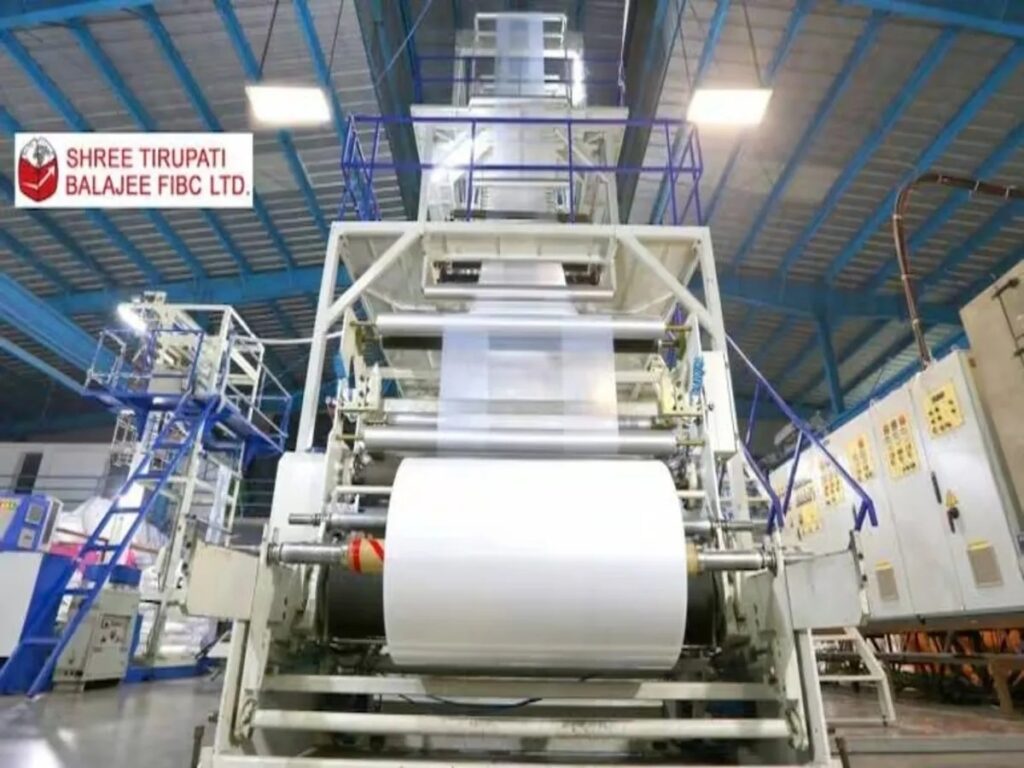
Theirfive factoriesinIndore, Madhya Pradesh, are strategically located near Mumbai and major ports, giving them decent logistics leverage. Installed extrusion capacity?~2,300 MT/month, with utilization of~2,200 MT/month— almost full throttle.
Export is a major leg — the company ships to38 countries, including theUSA, Germany, the UK, and Australia. In FY23,exports contributed 49.04%of revenue, while domestic sales stood at64.13%— yes, the total crosses 100% because multiple product streams and inter-subsidiary trading overlap.
Through subsidiaries likeHonourable Packaging Pvt Ltd (97.73%),Shree Tirupati Balajee FIBC Ltd (52.14%), andJagannath Plastics Pvt Ltd (99.85%), it controls the entire chain — from granules to finished bags. It’s a packaging mafia, but with
better margins.
4. Financials Overview
Quarterly Results Locked: Q2 FY26 (Sep 2025)
| Metric | Latest Qtr (Sep 25) | YoY Qtr (Sep 24) | Prev Qtr (Jun 25) | YoY % | QoQ % |
|---|---|---|---|---|---|
| Revenue (₹ Cr) | 142.65 | 155.57 | 125.41 | -8.3% | +13.7% |
| EBITDA (₹ Cr) | 6.17 | 16.76 | 10.49 | -63.2% | -41.2% |
| PAT (₹ Cr) | 1.70 | 9.07 | 6.36 | -81.3% | -73.3% |
| EPS (₹) | 0.26 | 0.87 | 0.63 | -70.1% | -58.7% |
Commentary:That’s not a correction — that’s a crash. PAT fell by more than80% YoY, while operating margins slid from10.77%to4.33%. The company blamed “input cost volatility and export headwinds” (classic). Translation: polypropylene prices spiked, demand softened, and forex losses hurt.
Annualised EPS based on Q2: ₹0.26 × 4 = ₹1.04 → giving aP/E of ~39x— not exactly cheap for a packaging stock gasping for oxygen.
5. Valuation Discussion – Fair Value Range Only
Let’s deconstruct this bag of numbers.
A. P/E Approach:TTM EPS = ₹2.33Industry P/E = 21.7Company P/E = 17.6→Fair Value Range:₹2.33 × (15–22) =₹35–₹51
B. EV/EBITDA Approach:EV = ₹547 CrEBITDA (TTM) = ₹62 Cr → EV/EBITDA = 8.8×Peer range: 7×–10× →Fair EV Fair Price Range:₹38–₹54
C. Simplified DCF (Educational Approximation):If free cash flows normalize to ₹25 Cr (assuming recovery post working capital correction), discounting at 12% gives a rough fair equity range of₹36–₹55.
📜Disclaimer:This fair value range is for educational purposes only and isnotinvestment advice. Please consult your financial advisor — preferably one who knows the difference between woven and non-woven.
6. What’s Cooking – News, Triggers, Drama
November 2025 has been spicy:
- NSE finedthe company ₹2,360 for a1-day delayin filing the FY25 annual report. Classic rookie mistake post-IPO.
- Monitoring agency reportconfirmed thatIPO proceeds of ₹122.42 croreare fully utilized — good news, but 26% went to “general corporate purposes,” slightly above the 25% cap. Board brushed it off, saying it’s “immaterial.” Investors weren’t amused.
- Subsidiary acquisitions:It has quietly upped its stake inShree Tirupati Balajee FIBC Ltd, acquiring an additional 73,000 shares in