Shivam Autotech FY26: A ₹410 Cr Business, a ₹41 Cr Hole Where the Net Worth Used to Be
Spotted a factual error — a wrong number, date, or fact? Tell us and we will check the source.
General information and entertainment, not investment advice. The author is not a SEBI-registered adviser or research analyst. No recommendation, no promised returns. Markets carry risk including loss of capital. Figures may not be current. Consult a registered adviser before acting.
1 — At a Glance
Shivam Autotech closed FY26 with revenue of ₹409.58 crore, down from ₹453.98 crore the year before, and a net loss of ₹81.33 crore — the deepest in the ten years on record. Reserves, which stood at ₹172 crore back in FY17, have now gone negative: the balance sheet carries reserves of minus ₹66.98 crore, and net worth has crossed below zero to roughly minus ₹40.68 crore. The auditors flagged it plainly, noting current liabilities exceeded current assets by ₹50.60 crore and net worth was negative, before signing off on a going-concern basis.
The company makes transmission gears and shafts, largely for two-wheelers, and about 43% of FY25 revenue came from a single customer, Hero MotoCorp. Borrowings sit at ₹403 crore. Interest for the year was ₹67.92 crore — more than double the ₹32 crore of operating profit the business generated.
Two things sit in tension here: a factory that still ships ₹410 crore of parts a year, and a capital structure that has been kept upright by successive rounds of refinancing. A ₹120 crore preferential debenture issue landed in February 2026, and a ₹120 crore rights issue was approved on 1 July 2026. The market caps the whole thing at ₹222 crore.
2 — Introduction
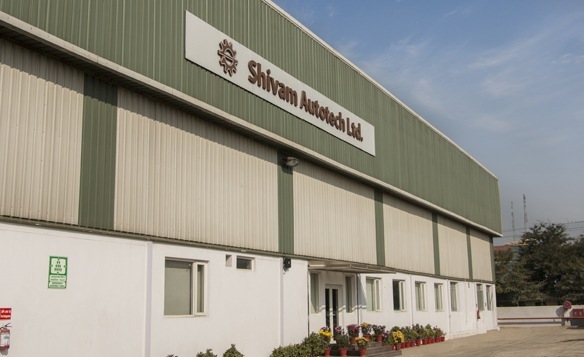
Shivam Autotech was carved out of the Munjal universe in 2005, when the forging and machinery divisions were hived off into a focused entity. It belongs to the Satyanand Munjal group, and the founding logic was simple: make gears and shafts for Hero MotoCorp, whose plants sit conveniently close to Shivam’s four units in Gurgaon, Haridwar, Bengaluru and Rohtak.
That proximity has always cut both ways. It gives Shivam a logistics advantage and a steady captive buyer; it also concentrates the fortunes of a ₹410 crore company on the order patterns of one client and one vehicle category.
The recent moves are almost entirely financial rather than industrial. February 2026 brought a ₹120 crore issue of optionally convertible debentures, split across two tranches, subscribed by Alpha Alternatives. The proceeds were earmarked to repay earlier debentures. In June 2026 the Company Secretary resigned, and on 1 July 2026 the board appointed a new one and approved a rights issue of up to ₹12,000 lakh — ₹120 crore. Consolidated figures throughout; the pattern is a business raising money to refinance the money it raised last time.
3 — Business Model: WTF Do They Even Do?
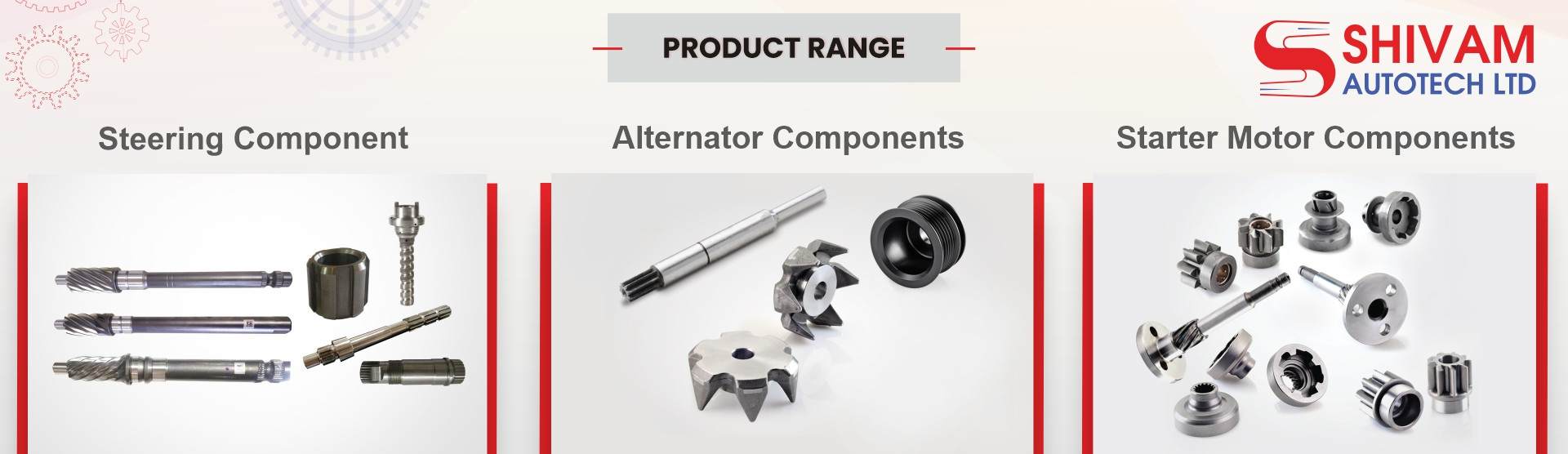
Shivam forges metal into shapes that spin. Transmission gears, transmission shafts, starter-motor components, alternator components, magneto and steering components — made using cold, warm and hot forging with near-net-shape technology, which is the industry’s term for forging a part so close to its final form that very little machining is left to do. Less waste, less scrap, tighter tolerances. The engineering is genuinely respectable.
The customer list reads well too: Hero MotoCorp, Munjal Showa, Bosch, Hilti, Mando, Indian Nippon Electricals. The problem is the weighting. Hero MotoCorp alone accounted for around 43% of FY25 revenue, and the credit assessment notes that gears and shafts make up roughly 65–70% of Hero’s own requirement for those parts. It is a deep two-way dependency dressed up as a partnership.
The other structural fact is the raw material. Steel is the principal input and, per the rating report, runs at about 37% of operating income. Shivam passes price revisions through to OEMs, but on a quarterly reset with a lag — so when steel moves, margins wear the gap in between.
Roughly 97% of revenue comes from the automotive segment, with the remaining 3% from non-automotive work. The company has talked about diversifying into three-wheelers, four-wheelers, commercial vehicles and non-auto uses like aerospace and power tools. For now, the model is still: forge parts, mostly for two-wheelers, mostly for one buyer. A well-run forge attached to someone else’s demand curve is a fine business right up until the demand curve flinches.
Does a 97% automotive mix read as focus, or as a single point of failure with a good ISO certificate?
4 — Financials Overview
Figures are consolidated, in ₹ crore.
Metric
FY26
FY25
YoY
Revenue
409.58
453.98
−9.8%
Operating Profit
32
44
−27.3%
PAT
−81.33
−48.04
loss widened
EPS (₹)
−6.19
−3.65
loss widened
Revenue fell about 10% while operating profit fell harder, roughly 27%, so operating margin compressed to about 8% from 10%. The gap between operating profit and the bottom line is the whole story: ₹67.92 crore of interest and ₹35.97 crore of depreciation turned ₹32 crore of operating profit into a ₹72.53 crore pre-tax loss, before an ₹8.81 crore tax charge dragged the