1. At a Glance – Blink and You’ll Miss the Business
₹9.29 crore market cap. CMP around ₹155. Zero quarterly sales. Quarterly loss of ₹0.05 crore. Stock P/E of ~155×. ROCE showing a suspiciously confident ~20%. Book value sitting at negative ₹10.4 like it owes money to accounting standards. Promoters hold ~49%, debt is officially zero (as of the latest quarter), and the company claims to be in wholesale trading of fruits and vegetables—despite the fruit basket being visibly empty this quarter.
In the last three months, the stock is up ~37.6%, which is impressive for a company that sold exactly nothing in the latest quarter. Over one year, the stock is down ~30.9%, reminding us that gravity still exists. High debtor days (~223) suggest money is out there somewhere, just not at home. The company reduced borrowings to zero by Sep 2025, which is admirable, but also easier when business volume is near zero.
This is not your typical FMCG story. This is more like a corporate reincarnation arc—previously biscuits, then securities, now fruits & vegetables, and currently… silence. Curious yet? You should be.
2. Introduction – From Biscuits to Bananas to Balance Sheet Yoga
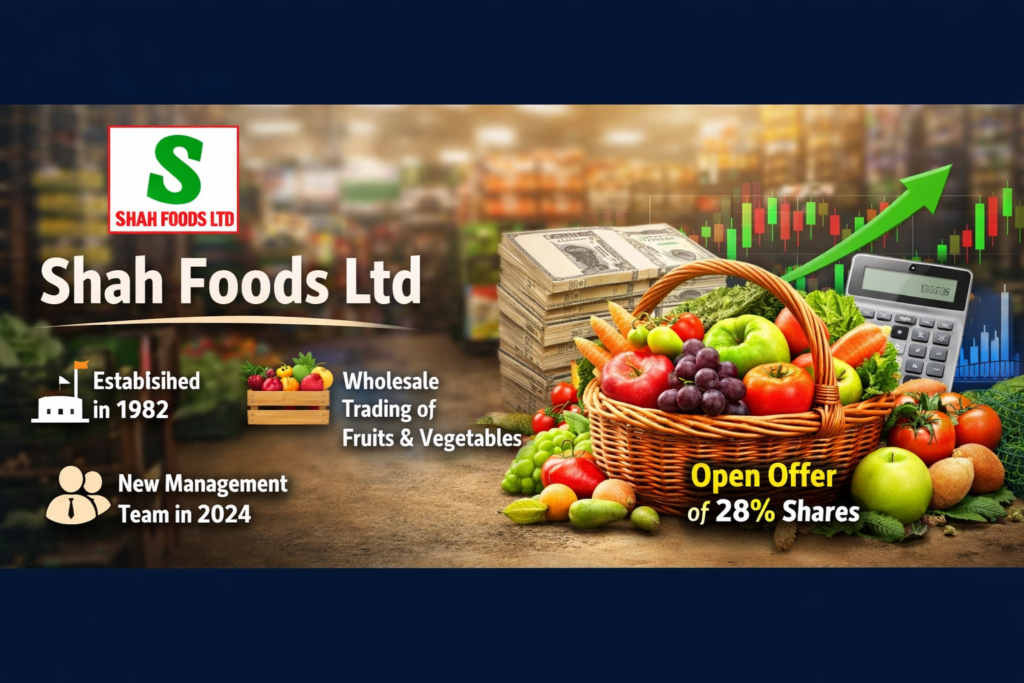
Shah Foods Ltd was incorporated in 1982, which means it has survived more Indian economic cycles than most Twitter finfluencers have seen bear markets. Historically, it dabbled in trading shares, manufacturing biscuits, and even did job work for Britannia Industries Ltd before calling it quits in June 2019 and deciding to dispose of the manufacturing undertaking.
Post-factory shutdown, the company reinvented itself as a wholesale trader of fruits and vegetables. Conceptually simple. Operationally? Well, the numbers suggest this is more of a PowerPoint business model than a cash register one—at least in recent quarters.
Add to this a dramatic reshuffling of the top deck: Managing Director and CFO resignations in March–May 2024, followed by new appointments. There was also an open offer in August 2023 to acquire 26% of the company at ₹100 per share, valuing the entire operation at a level that felt… optimistic.
So what exactly are investors paying 155× earnings for today? Legacy? Optionality? Faith? Or just vibes?
3. Business Model – WTF Do They Even Do?
Officially, Shah Foods is into wholesale trading of fruits and vegetables. No brands. No processing. No cold-chain moat mentioned. Just trading.
Earlier avatars included:
Trading in shares and securities
Biscuit manufacturing (job work for Britannia, pre-2019)
That chapter is closed. Factory shut. Assets disposed. Now we’re left with a lean balance sheet and a business that depends entirely on trading margins.
Trading businesses live and die by volume + working capital discipline. Here’s the catch:
Latest quarter sales: ₹0.00 crore
Debtor days: ~223
So either:
Business is extremely seasonal, or
Customers are very relaxed about paying, or
Activity is minimal and accounting is just keeping the lights on
If you’re explaining this business to a smart but lazy investor, you’d say:
“They buy fruits and vegetables from somewhere, sell them to someone else, and hope the margin survives inflation, logistics, and spoilage.”
Now ask yourself—where’s the scale?
4. Financials Overview – Numbers That Need Therapy
Quarterly Comparison Table (₹ in Crores)
Metric
Latest Qtr (Dec 25)
YoY Qtr (Dec 24)
Prev Qtr (Sep 25)
YoY %
QoQ %
Revenue
0.00
0.52
0.00
-100%
0%
EBITDA
-0.05
-0.02
-0.01
NA
NA
PAT
-0.05
-0.02
-0.01
-150%
NA
EPS (₹)
-0.84
-0.33
-0.17
-154%
NA
Witty Commentary: When revenue hits zero, growth rates stop making sense. EBITDA margins become philosophical questions. EPS turns into a warning label.
EPS Annualisation (Rule Applied Carefully)
Latest quarterly EPS = -0.84 Annualised EPS (Q3 average rule technically exists, but given losses and volatility, annualisation here is academically possible but economically meaningless). Still, mechanically:
Average of Q1, Q2, Q3 FY26 EPS ≈ negative
Annualised EPS ≈ negative
And yet… the stock trades at triple-digit P/E. Respect.
5. Valuation Discussion – Because Numbers Deserve Comedy Too