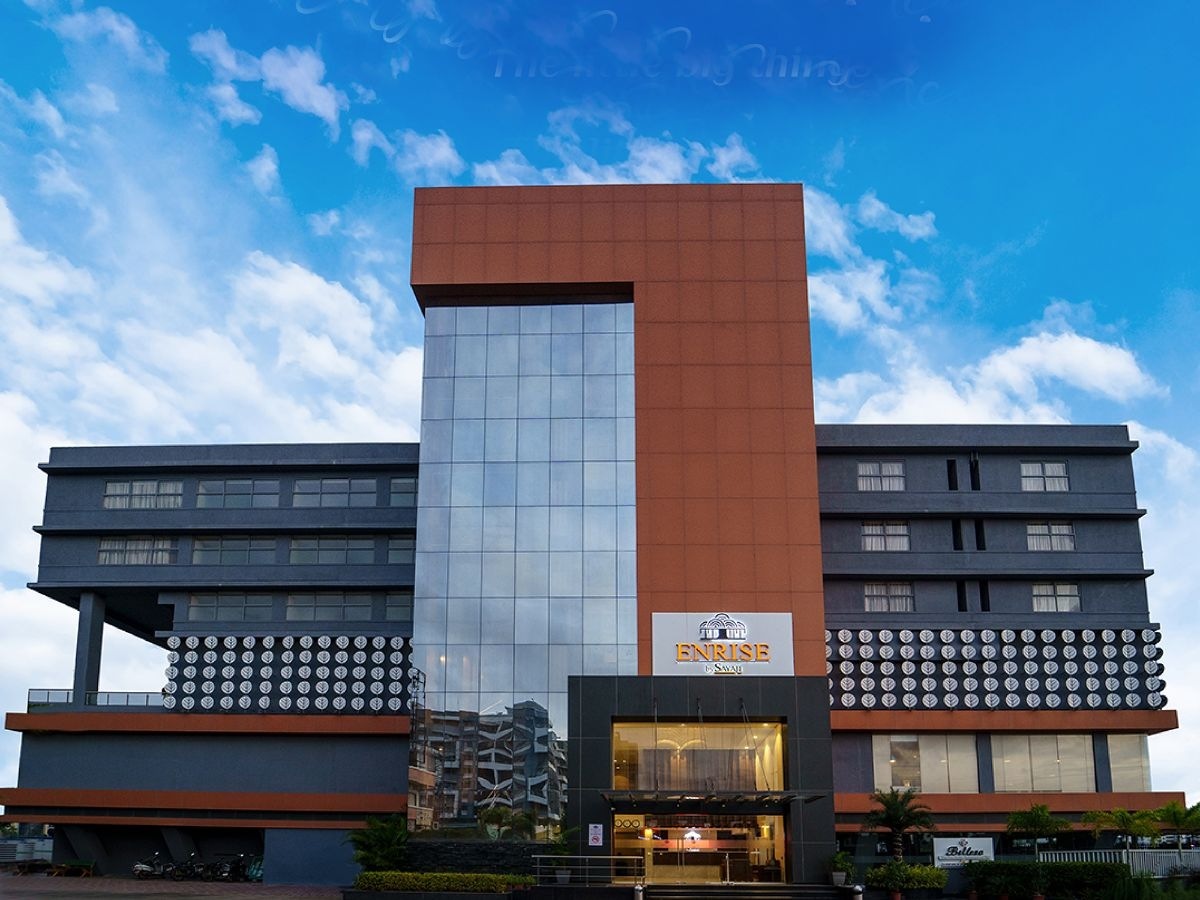
Sayaji Hotels (Pune) FY26: A Debt-Free Hotel Earning 28% ROCE That the Market Prices at a Third of Its Peers
Spotted a factual error — a wrong number, date, or fact? Tell us and we will check the source.
General information and entertainment, not investment advice. The author is not a SEBI-registered adviser or research analyst. No recommendation, no promised returns. Markets carry risk including loss of capital. Figures may not be current. Consult a registered adviser before acting.
1 — At a Glance
One hotel. One city. One operating segment the auditor politely calls “Hoteliering.” And yet Sayaji Hotels (Pune) closed FY26 with ₹81 crore of revenue, ₹19.4 crore of net profit, and a ROCE of 28.4% — a return on capital most of its far larger peers would frame and hang in the lobby. Borrowings sit at ₹0.28 crore against a net worth north of ₹101 crore, which makes the debt line less a liability and more a rounding error.
The market pays 12.7x earnings for all this, against a peer median of 30x. That single gap is the entire tension of this entry: a business that reads clean on almost every operating line, priced as though something is missing. What’s missing isn’t in the profit statement — it’s the story of a single-asset company, no dividend despite years of profit, and working capital that has quietly ballooned.
A hotel that earns like a franchise but trades like a doubt. The record follows.
2 — Introduction
Sayaji Hotels (Pune) was incorporated in 2018 and arrived on the BSE the hard way — through a demerger. On 1st August 2023, the NCLT Chennai approved the scheme splitting it out from Sayaji Hotels Ltd; shares were allotted in September 2023, and listing followed on 29th January 2024. So FY26 is only the company’s second full year as its own listed entity.
The corporate housekeeping has been busy. In FY24 the registered office moved from Chennai to Vadodara, authorised capital was lifted from ₹10 lakh to ₹9.10 crore, and the foreign investment ceiling was raised toward 24%. In December 2023 the company acquired Super Civiltech Private Limited — the subsidiary that turns the standalone accounts into consolidated ones.
The management chairs have rotated more than most. Two CFO resignations across FY25, a Company Secretary exit in early FY24, and — most recently — Suchitra Dhanani stepping down as Non-Executive Non-Independent Director effective 25 June 2026, citing other occupations. The board approved the FY26 audited results on 28 May 2026 with an unmodified audit opinion from K.L. Vyas & Company.
3 — Business Model: WTF Do They Even Do?
They run a hotel. Specifically, a hotel — the Sayaji-branded property in Pune, stocked with the full amenity thesaurus: Grand rooms, Suites, Super suites, Premium Super suites, a restaurant, a fitness centre, a poolside lounge/bar, a concierge, and — the line that earns its own applause — BBQ Grills.
The revenue mix is refreshingly legible. Per the FY24 disclosure, Rooms brought in roughly 61%, Food & Beverages about 33%, and rental/banquet income the remaining ~6%. This is a business you can draw on a napkin: fill rooms, feed guests, rent the ballroom.
What makes the model interesting is what it isn’t. There’s no sprawling estate to depreciate into oblivion, no management-contract fee engine, no asset-light franchising layer. It is one building doing one thing, and the operating margin — 34.5% for the year — suggests it does that thing efficiently. A single hotel throwing off 28% ROCE is the kind of number that makes analysts double-check the segment note. There’s only one, and it says “Hoteliering.” Sometimes the napkin is the whole strategy.
Does a single-asset hotel deserve a re-look, or is concentration exactly the risk the multiple is flagging? Hold that thought.
4 — Financials Overview
Figures are consolidated, in ₹ crore.
Metric
Mar 2026 (Q4)
YoY
QoQ
Revenue
21.52
+7.6%
-2.1%
Operating Profit
6.22
-1.1%
-29.2%
PAT
3.63
-0.5%
-38.1%
EPS (₹)
11.91
-0.7%
-38.1%
The Q4 quarter tells a softer story than the year. Operating profit fell from ₹8.78 crore in the December quarter to ₹6.22 crore, and PAT slid from ₹5.86 crore to ₹3.63 crore. Q4 OPM landed at 28.9%, the lowest in eight quarters, against 39.95% the quarter