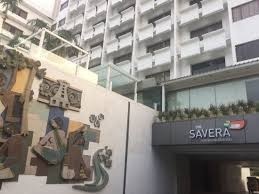
Savera Industries FY26: Revenue Cracks ₹100 Cr for the First Time, and Q4 Profit Falls 82% in the Same Breath
Spotted a factual error — a wrong number, date, or fact? Tell us and we will check the source.
General information and entertainment, not investment advice. The author is not a SEBI-registered adviser or research analyst. No recommendation, no promised returns. Markets carry risk including loss of capital. Figures may not be current. Consult a registered adviser before acting.
1. At a Glance
For the first time in its history, Savera Industries booked more than ₹100 crore of revenue in a single year — ₹102.32 crore in FY26, up 28% on FY25’s ₹79.66 crore. A 57-year-old four-star hotel in Chennai, one property, 230 rooms, finally crossed the three-figure line.
Then the March quarter arrived and reported ₹0.70 crore of net profit against ₹3.81 crore a year earlier — a fall of 81.6%. Full-year profit after tax came in at ₹12.82 crore, slightly below FY25’s ₹13.24 crore, even as the top line grew by more than a quarter. The revenue accelerated; the profit did not follow.
Two numbers explain most of the gap: depreciation rose from ₹2.73 crore to ₹6.73 crore, and other income of ₹6.15 crore now sits next to that ₹12.82 crore profit. A hotel that added a water plant, several restaurants, and a habit of selling land closed the year larger, busier, and no more profitable than before.
A company that grew its sales 28% and its profit not at all in the same year is worth reading closely. That’s the tension this entry records.
2. Introduction
Savera has been in one business, in one city, for a very long time. Incorporated in 1969, it runs Hotel Savera in Chennai — a four-star property that Crisil notes has grown from 20 rooms in 1968 to 230 today, expanded over decades by buying up the land around it. Alongside the hotel sit seven health centres under the O2 Health brand.
FY26 is the year the single-property story stopped being single. In December 2024 the company entered packaged drinking water manufacturing, on land and building leased from a related party, M/s. Shyam Hotels & Restaurants, and launched the water under the brand Savera Aqua. It also added restaurants — Amaravathi at ECR Road Chennai, Amaravathi Highway Family Restaurant at Gudur in Andhra Pradesh, and Delhi Dhaba and Kaarikudi outlets — and in May 2025 acquired three restaurants for ₹3.5 crore.
Running underneath all of it: land. The board approved the sale of roughly 9.008 acres in Kancheepuram district in March 2025, and land parcels were sold through the year, contributing an exceptional gain of ₹2.19 crore to FY26. A hotel company, quietly, has become a hotel-plus-water-plus-restaurants-plus-real-estate company.
3. Business Model: WTF Do They Even Do?
Strip away the new limbs and the core is one building in Chennai that rents rooms and sells food. Per the FY25 revenue split, rooms and ancillary services were about 41% of the take and food and beverages another 41% — meaning four out of every five rupees came from people sleeping or eating on the premises. Gym collections chip in about 5%, wine and liquor 3%, interest income 3%, banquet halls 2%, spa 2%. It is a hotel that also runs some treadmills.
Occupancy is the number that actually moves the model, and it moved the right way — from 76.8% in FY24 to 80.5% in FY25. For a property with fixed costs baked into 230 rooms, every occupied room above the break-even line is the point of the whole exercise.
The FY26 additions bolt new economics onto that base. The water plant and restaurants bring revenue but also bring depreciation and operating cost of their own — which is precisely the story the profit line tells later. And the water plant runs on premises leased from a promoter-linked entity, so the company now pays rent to people connected to the people who run the company. That’s not a scandal; it’s a related-party arrangement, and the entry simply notes where the building came from.
Does adding a water brand and four restaurants to a single hotel diversify the business, or just give it more places to spend depreciation?
4. Financials Overview
Figures are standalone, in ₹ crore. The latest period is the year ended March 2026.
Metric
FY26
FY25
YoY
Revenue
102.32
79.66
+28%
Operating Profit
17.7
15.0
+18%
PAT
12.82
13.24
−3%
EPS (₹)
10.75
11.10
−3%
Revenue and operating profit both climbed. Profit after tax slipped. The wedge between them is depreciation, which rose to ₹6.73 crore from ₹2.73 crore on the data sheet — the new water plant and restaurant assets arriving on the books with their charges attached. Profit before tax was almost flat year on