Saregama India Q4 FY26: Music Licensing Recovers with 32% YoY Surge while Capital Allocation Pivots to Bhansali CCPS and Video Winding Down
1. At a Glance
The financial narrative of a century-old brand transforming itself into a modern intellectual property powerhouse is bound to turn heads. Saregama India Limited is generating significant traction, pulling in an operating revenue of ₹9,846 million for the full year FY26 and delivering its highest-ever quarterly Adjusted EBITDA of ₹1,327 million in Q4 FY26. Investors tracing the digital media expansion have trained their eyes on this stock, as its core music licensing engine shows accelerating performance, growing 32% year-on-year in the latest quarter to reach ₹2,267 million.
Yet, beneath the harmony of record-breaking operating profits lies a complex arrangement of sharp strategic shifts and non-cash frictional costs. The company reported a significant step-down in its top-line for the full year, dropping from ₹11,713 million in FY25 to ₹9,846 million in FY26. This 16% top-line contraction is driven by a massive 78% plunge in live events revenue, which cratered from ₹2,852 million down to ₹618 million as the blockbuster multi-city tours of the prior year failed to repeat.
Compounding the operational volatility, the bottom line was hit by a one-time exceptional non-cash impact of ₹70 million in Q3 FY26 and an additional ₹16 million in Q4 FY26, stemming from structural adjustments related to the new Labour Code. Furthermore, the company has locked up ₹325 crore of its capital into Compulsorily Convertible Preference Shares (CCPS) of Bhansali Productions, indicating a radical structural departure from traditional in-house film production.
The core investment thesis now rests on whether high-margin digital audio licensing can entirely underwrite the structural retreat from domestic film production and the inherent lumpiness of experiential ticketed events. While music net margins expanded to a spectacular 55% in Q4 FY26, the company’s overall return profile remains constrained by an unutilised Qualified Institutional Placement (QIP) cash pile of ₹387 crore, dragging return on equity down to 13.3%. Will the aggressive catalogue expansion turn into structural outperformance, or will the massive content acquisition costs dilute capital efficiency?
2. Introduction
Saregama India Limited holds a unique position within the domestic media and entertainment matrix. Established in 1902 as the Gramophone Company of India and later known universally via its consumer-facing avatar HMV, the corporate structure has transitioned from a physical music manufacturer into a pure-play content ownership vehicle. The company acts as a permanent custodian of Indian audio history, controlling an intellectual property library of over 180,000 tracks spanning 23 languages, capturing approximately 50% of all music ever recorded in the country.
The operational architecture is designed to capture the structural tailwinds of digital India. Affordable data monetization and expanding smartphone penetration have shifted the company’s dependency away from legacy physical storage devices into dynamic, recurring digital streams. Saregama scales its monetization framework across modern consumer platforms including Over-The-Top audio streaming services, video broadcast syndication, social media shorts, and synchronized film music placements.
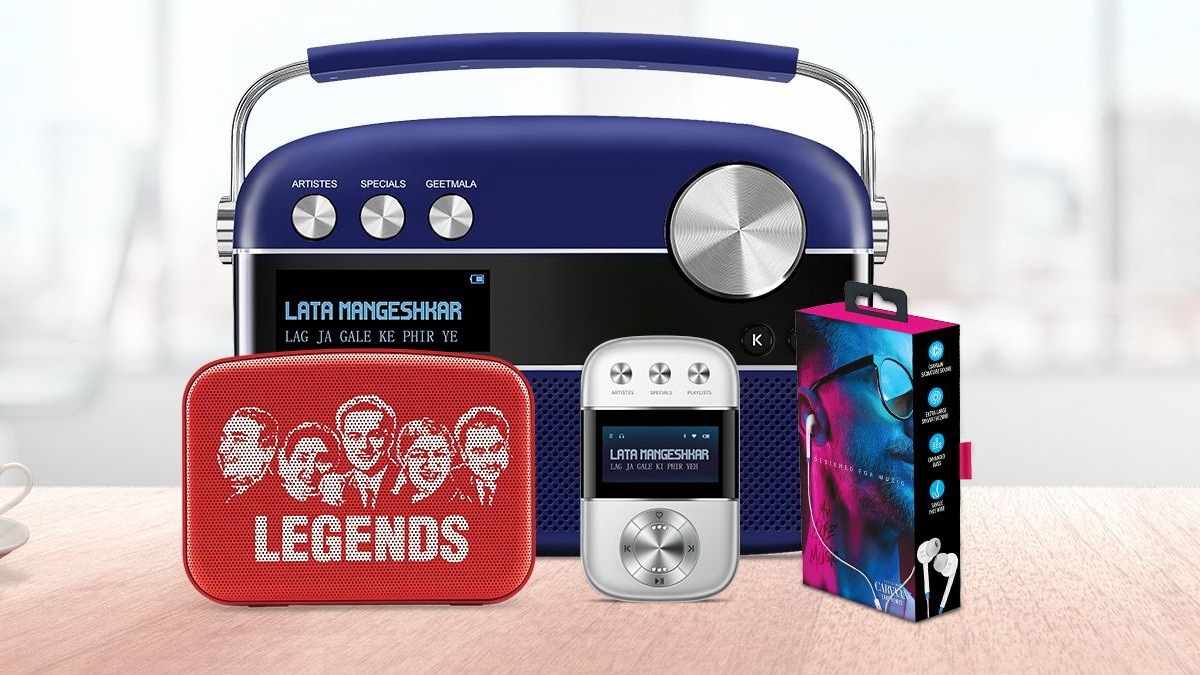
The long-term operating history of the enterprise reflects the volatile nature of media formats. In the late 20th century, the organization faced intense headwinds as long-playing records gave way to magnetic tape cassettes, which were later displaced by compact discs. In 2017, the management re-engineered its physical retail strategy by launching Saregama Carvaan, a hardware product pre-loaded with retro audio tracks targeted at an older demographic.
As the retail lifecycle of physical digital audio players matures, the management is executing another structural pivot. The company is actively moving out of capital-intensive, high-risk in-house movie production and reallocating its cash reserves into pure content ownership and digital-first youth content via its recent corporate combinations. This transition aims to build an insulated intellectual property model that extracts high-margin digital annuities while minimizing operational execution risks.
3. Business Model – WTF Do They Even Do?
Saregama operates an intellectual property tollbooth. The business model is simple: acquire or produce an audio or video track once, secure the underlying copyright for 60 to 90 years, and charge every platform that plays it. It is a classic long-tail royalty machine that extracts cash every time a user streams a song on Spotify, listens to a background track on a YouTube short, watches a syndicated television serial, or uses an iconic retro tune in a modern commercial advertisement.
 [ Content Production / Catalogue Acquisition ]
│
▼
[ Intellectual Property Pool ]
(180,000+ Audio Tracks)
│
┌────────────────┼────────────────┐
▼ ▼ ▼
[ OTT Streaming ] [ Social Media ] [ B2B Brands / Sync ]
Recurrent Royalty Micro-licensing Upfront Licensing
The primary economic contributor is the Music segment, broken down into licensing, artist management, and retail. Under licensing, the company collects recurring revenues across 30 streaming platforms, 20 broadcasting networks, and 8 social media environments. In an effort to control the downstream delivery pipeline, Saregama has built an artist management vertical that commands over 300 influencers and creators, aggregating an audience footprint of 410 million followers. This enables them to capture commissions from live events, brand endorsements, and digital content creation.
The physical retail segment revolves around ‘Carvaan’. This unit is experiencing a planned structural scale-down. Recognizing that the cost of legacy electronics distribution eats up capital, management has stripped down stock-keeping units (SKUs) and abandoned physical multi-brand retail outlets. Carvaan is now sold exclusively via digital e-commerce channels and select modern trade stores, functioning primarily as a high-margin niche product rather than a volume driver.
The second core pillar is the Video division, which generates revenues by producing content across multiple lengths—ranging from 1-minute short-form reels up to 120-minute feature films. This includes regional television production, prominently supplying over 10,000 hours of cumulative content to Southern satellite networks like Sun TV. In the digital space, short and medium-form formats are driven by its Pocket Aces (Dice TV) acquisition, which functions as a marketing machine to acquire, seed, and popularize new musical content across younger demographics.
Do you think a media company can successfully transition from physical hardware to a digital-only licensing model without losing its core identity? Let us know your thoughts in the comments below.
4. Financials Overview
A granular look at the latest performance numbers reveals a striking divergence between top-line trends and bottom-line efficiency. The company publishes official financial statements on a quarterly basis, allowing for a precise evaluation of its short-term operating trajectory against long-term historical performance.
Consolidated Financial Performance Matrix
Metric (₹ in Millions)
Q4 FY26 (Latest Quarter)
Q4 FY25 (YoY Quarter)
YoY Change (%)
Q3 FY26 (QoQ Quarter)
QoQ Change (%)
Revenue from Operations
2,874.0
2,408.0
19.35%
2,604.0
10.37%
Adjusted EBITDA
1,327.0
1,016.0
30.61%
1,210.0
9.67%
Profit Before Tax (PBT)
1,034.0
816.0
26.72%
695.0
48.78%
Profit After Tax (PAT)
741.0
599.0
23.71%
512.0
44.73%
Earnings Per Share (EPS) (₹)
3.86
3.11
24.12%
2.67
44.57%
Note: In accordance with the official financial reporting, the latest period represents an official quarterly release. The historical basic share parameters indicate a stable face value of Re.1 per share.
Annualised EPS Calculation
To track corporate valuation momentum under the standardized annualisation framework for final quarter entries, the full-year consolidated performance must be used. For the financial year ended March 31, 2026, Saregama delivered a total consolidated Net Profit of ₹2,062 million