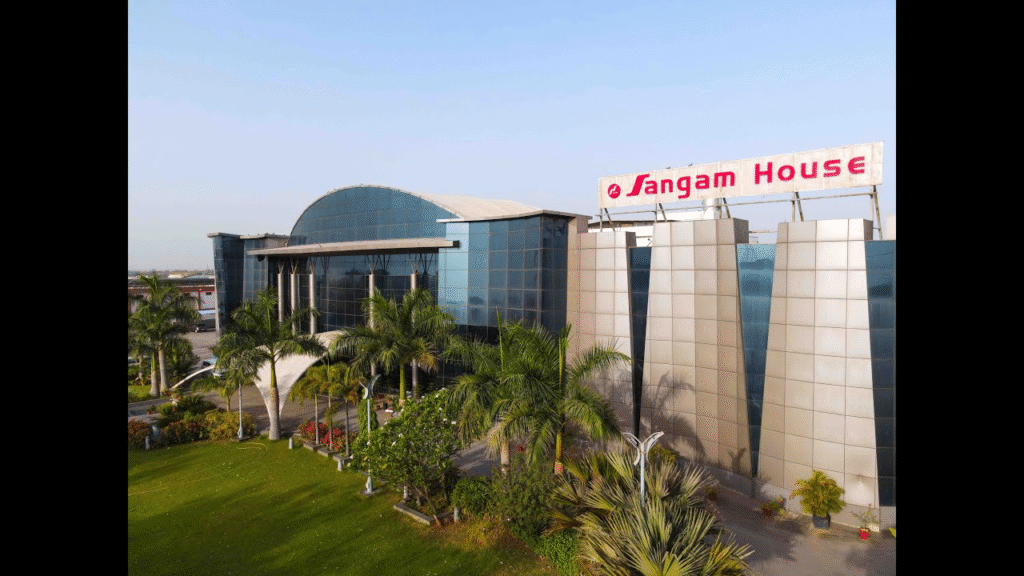
Sangam India is that desi textile giant which makes everything from yarn to denim to athleisure, while also juggling debt repayments like a Bollywood producer juggling investors. With a market cap of ₹1,872 Cr, sales of ₹2,954 Cr, and PAT of barely ₹24 Cr, the company is running a textile empire that looks impressive on a loom but feels weak in the ledger. It’s India’s PV yarn price-maker, denim exporter to 20+ countries, and the proud parent of C9 Airwear — the athleisure brand you’ve probably scrolled past on Myntra while searching for Jockey.
2. Introduction
If Reliance is the Ambani of textiles, Sangam is the neighborhood uncle who owns half the looms in Bhilwara. Founded with a big dream to dominate polyester-viscose yarn, denim, and fashion wear, it’s now one of India’s biggest PV yarn producers and denim exporters. On paper, this is a vertically integrated powerhouse: 3 lakh+ spindles, 302 weaving machines, and the capacity to churn out 60 million metres of denim per year.
But here’s the twist: despite such scale, net margins are stuck at 1–2%. It’s like running a five-star buffet but making profits equal to the pani puri stall outside. High interest, capex spending, and global demand cycles keep pulling the threads apart.
Still, Sangam has ambition. From expanding denim capacity to investing in DaMENSCH (yes, they bought into men’s innerwear startup), to building renewable energy plants, the company is trying to turn itself from a commodity yarn player into a lifestyle brand.
But will this pivot save it from its ₹1,138 Cr debt mountain? Let’s spin the yarn.
3. Business Model – WTF Do They Even Do?
Sangam’s empire is divided into four main looms:
Yarn (Cotton + PV, 48% share) Largest PV dyed yarn producer in India, exports to 34+ countries. If Grasim makes viscose, Sangam is the biggest buyer — practically their favourite wholesale customer.
Denim Fabric (29% share) 60 million metres capacity, exporting to 20+ countries. Clients include Mango, Primark, and Walmart — so your Zara jeans might secretly be born in Rajasthan.
PV Fabric & Woven Fabrics (20% share) Polyester-Viscose blends with air-jet looms, used in suiting. Basically, the raw material for half the blazers you see at Indian weddings.
Seamless Garments (3% share) C9 Airwear, their attempt at fashion. 114 machines producing athleisure, innerwear, and shapewear. Available on Amazon, Flipkart, Nykaa, etc. But contribution to revenue? Barely 3%. In short, the brand is still more TikTok than Titan.
Question: Would you buy C9 leggings over Jockey or Decathlon?
4. Financials Overview
Metric
Latest Qtr (Jun’25)
YoY Qtr (Jun’24)
Prev Qtr (Mar’25)
YoY %
QoQ %
Revenue (₹ Cr)
790
693
734
14.0%
7.6%
EBITDA (₹ Cr)
57.6
67.3
57.7
-14.4%
-0.1%
PAT (₹ Cr)
3.53
14.3
9.5
-75.3%
-62.9%
EPS (₹)
0.47
3.17
2.11
-85.2%
-77.7%
Commentary: Revenue up nicely, but PAT collapsed 77%. This is classic textile cyclicality — sales look good, profits vanish. EPS annualised = ₹1.9 → P/E = ~195x. Even Louis Vuitton jeans aren’t priced this high.
5. Valuation – Fair Value Range Only
Method 1: P/E Multiple
EPS (annualised) = ₹1.9
Reasonable industry P/E = 15–25x
Fair Value = ₹28 – ₹48
Method 2: EV/EBITDA
EV = ₹2,958 Cr
EBITDA TTM ≈ ₹235 Cr
EV/EBITDA = 12.6x vs industry 9–12x
Fair Value Range (10–12x) = ₹300 – ₹360
Method 3: DCF
Assume 8–10% growth, 11% discount rate.
Value range = ₹270 – ₹340
Overall Fair Value Range: ₹28 – ₹360 (depending on whether you see it as a yarn trader or a fashion unicorn).
Disclaimer: This is educational number-play, not a stock recommendation. Don’t mortgage your