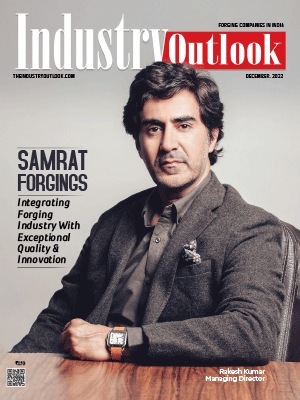
1. At a Glance – Blink and You’ll Miss the Margin
Samrat Forgings Ltd, a ₹130 crore market cap company trading around ₹259, is what happens when heavy steel meets light margins. Incorporated in 1991 and still hammering metal in Punjab, the company just delivered Q2 FY26 (Sep 2025) revenue of ₹51.8 crore with a net profit of ₹0.81 crore, down a painful 56.7% YoY, while sales grew a modest 2.6% YoY. Return-wise, the stock has been slapped by the market with a –12.4% return over 3 months and –24.8% over 1 year, despite a respectable 5-year price CAGR of ~25%. The valuation? A P/E of ~34.6, which feels optimistic for a company carrying ₹89 crore of debt, an interest coverage of 1.7x, and operating margins that wobble like a misaligned axle. And yet, promoters sit tight at ~75% holding, no pledging, no dividend, and a constant “trust us, expansion is coming” vibe. Curious already? Good. You should be.
2. Introduction – The Forging Business: Where Steel Is Stronger Than Profits
Forging companies are supposed to be boring. Hot steel, big hammers, predictable orders, steady margins. Samrat Forgings, however, likes to keep investors emotionally engaged. One quarter it flexes with double-digit OPM, next quarter it reminds you that interest costs are very real and OEMs are very demanding.
This is not a startup story. This is a 34-year-old forging veteran supplying gears, shafts, knuckles, and pins to some of India’s most recognisable OEMs—Ashok Leyland, Mahindra & Mahindra, Swaraj Tractors, Tata Hitachi, even locomotive works. On paper, that sounds like stability. In the P&L, it looks more like a constant tug of war between operating profit and finance costs.
The latest quarter tells the story clearly. Revenue is holding up. EBITDA is positive. But PAT is thin enough to make a razor jealous. And the market, being the dramatic creature it is, has responded by compressing the stock price despite long-term sales growth of ~18% over five years.
So the question becomes: Is this a cyclical hiccup in a solid forging story, or a structurally leveraged business pretending everything is fine? Let’s dig in.
3. Business Model – WTF Do They Even Do?
Samrat Forgings does exactly what its name suggests—it forges stuff. Hot, heavy, industrial stuff.
The company manufactures closed-die steel forgings and machined components, catering to both automotive and non-automotive sectors. Translation: they take steel billets, heat them, smash them into shape, machine them precisely, and ship them to OEMs who really don’t like excuses.
Their product basket is wide:
- Automotive: knuckles, gears, axle housings, flanges
- Farm equipment: crankshafts, camshafts, stub axles
- Locomotive: drive gears, shafts, hanging links
- Earth-moving & construction: trunnions, bosses, ring gears
- Oil & energy: shafts and drill-related components
They operate three units in Punjab, with:
- Forging capacity: ~8,400 MT
- Machining capacity: ~50,000 components per annum
Certifications like IATF 16949, AD-2000, and “Zero Defect Supplier” status help them stay relevant with OEM procurement teams that love paperwork almost as much as they love cost cutting.
But here’s the catch: this is a volume business with limited pricing power. Steel prices move, interest rates move, OEM orders fluctuate—and Samrat absorbs most of the stress. Does this sound like a business that should trade at 35x earnings? Hold that thought.
4. Financials Overview – Numbers That Sweat More Than the Steel
Result type locked: Quarterly Results
Latest