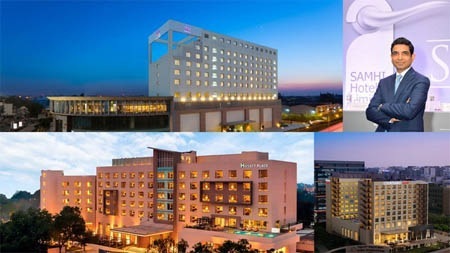
Samhi Hotels FY26: A Five-Star PAT Valuation Packaged in Late-Checkout Drama
At a Glance
Samhi Hotels Limited concluded FY26 with a financial performance that commands institutional attention, characterized by a sharp divergence between exceptional accounting entries and underlying operational realities. Headline revenue for the fiscal year reached ₹1,247.80 crore, representing a 10.43% year-on-year expansion from ₹1,130.01 crore in FY25. The company’s reported profit after tax (PAT) staged a massive accounting-led surge, jumping over 488% to settle at ₹502.99 crore compared to ₹85.50 crore in the preceding fiscal. However, this headline profit is significantly distorted by non-cash exceptional events, including a massive ₹330 crore deferred tax asset (DTA) recognition write-back in the final quarter and ₹966 million in asset impairment reversals.
Operationally, the group generated a consolidated EBITDA of ₹431.11 crore, leaving reported EBITDA margins visually flattened at 34.55%. Profitability was noticeably clipped by a mid-year Goods and Services Tax (GST) regulatory pivot to a 5% rate without input tax credits, alongside an estimated ₹44 crore to ₹52 crore top-line loss induced by sequential external macroeconomic shocks. Deleveraging progressed firmly, with gross borrowings down to ₹1,854.34 crore. While capital efficiency metrics show a surface-level return on equity (ROE) of 24.81%, the group’s true economic engine remains constrained by a single-digit return on capital employed (ROCE) of 8.92%, exposing the high capital density required to fuel its turnaround strategy.
Introduction
Samhi Hotels Limited operates as a specialized, acquisition-led hotel ownership and asset management platform in India. The company’s core business architecture focuses on identifying underperforming or distressed hospitality assets in high-density urban micro-markets and executing structural operational turnarounds. Rather than creating native brands, Samhi secures long-term co-branding and operating agreements with Tier-1 international hospitality operators—predominantly Marriott, InterContinental Hotels Group (IHG), and Hyatt.
By offloading direct distribution and reservation responsibilities to global loyalty networks, Samhi concentrates exclusively on institutional asset management and real estate optimization. The company has historically favored a leasehold and cluster-heavy operational framework across major commercial hubs. Moving deep into FY26, the company’s strategic narrative centers on an aggressive pipeline designed to structurally alter its revenue mix toward premium properties while attempting to unlock equity via institutional co-investment platforms.
Business Model: WTF Do They Even Do?
Samhi Hotels is essentially a corporate house flipper, but for commercial buildings where people sleep in structured shifts. They locate distressed or tired business-district hotels, buy them at a discount to replacement cost, clean up the capital structure, and slap an international luxury operator’s flag onto the roof.
As of late FY26, the company owns a portfolio of 38 hotels spanning 14 cities. However, calling it a singular portfolio is generous; it is a three-headed corporate hydra divided by room rates:
Upper Upscale & Upscale (~42% of revenue): The crown jewels (Hyatt Regency, Sheraton, Westin) where business travelers bill expensive dinners to their employers. Rooms here fetch an Average Room Rate (ARR) of ₹12,537.
Upper Mid-scale (~41% of revenue): The middle-management workhorses operating under Fairfield by Marriott and Four Points by Sheraton, pulling a steady ARR of ₹7,904.
Mid-scale (~17% of revenue): The no-frills Holiday Inn Express cluster, serving up affordable breakfast and tight 14-square-meter floor plans at an ARR of ₹4,385.
The operational thesis relies entirely on “distribution arbitrage.” Samhi leverages global reservation engines like Marriott Bonvoy to fill rooms, while attempting to squeeze local operational efficiencies out of clustered properties. It is an asset-heavy game disguised as institutional management, where financial success depends entirely on filling beds faster than interest costs can compound.
Financials Overview
Figures are consolidated, in ₹ crore.
The underlying operational trend lines of Samhi Hotels are best assessed through its rolling quarterly performance over the last year, which illustrates how quickly top-line momentum can be sidetracked by regulatory and external volatility.
Quarterly Financial Performance (Last 4 Quarters)
Metric
Q1 FY26 (Jun)
Q2 FY26 (Sep)
Q3 FY26 (Dec)
Q4 FY26 (Mar)
Revenue
₹272.21
₹292.97
₹337.75
₹344.86
EBITDA / Operating Profit
₹90.50
₹107.13
₹122.12
₹111.60
PAT (Reported)
₹17.28
₹92.43
₹39.61
₹353.67
EPS (Reported, ₹)
₹0.78
₹4.18
₹1.79
₹15.92
Earnings quality is rarely found in the headline columns of an audited report during a transition year. True financial health must be isolated by stripping away structural revaluations and non-cash balance sheet adjustments.
The quarterly trajectory showcases a business that grows revenues steadily but experiences severe margin leakage. Q4 FY26 revenue reached ₹344.86 crore, yet operating profit fell sequentially to ₹111.60 crore due to the dual weight of pre-opening capex and the structural impact of the GST credit withdrawal. The absolute divergence arrives at the PAT line—Q4 reported net profit sits at an astronomical ₹353.67 crore, driven entirely by a non-cash deferred tax asset credit of ₹330.18