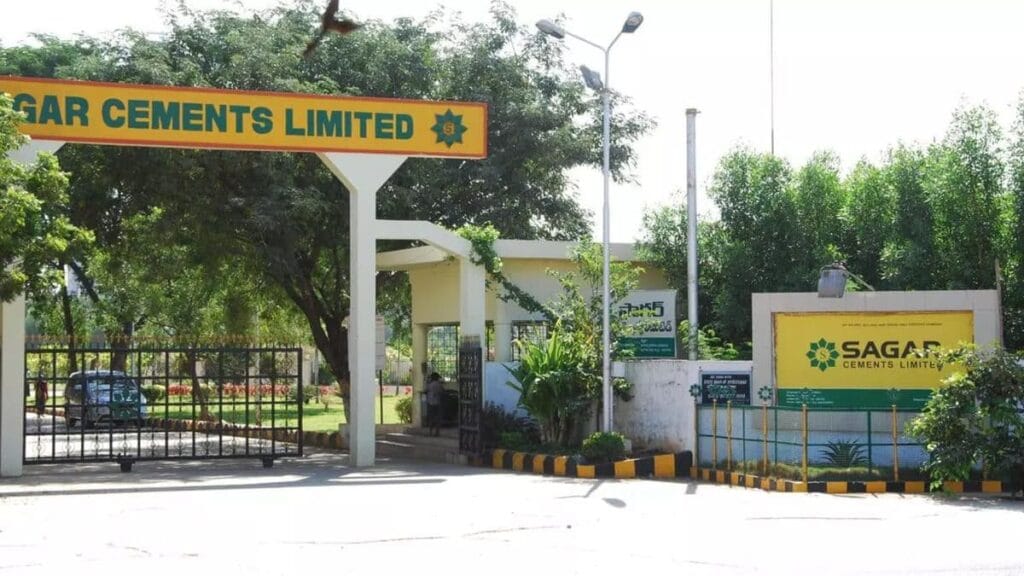
Sagar Cements (Market Cap ₹3,164 Cr, CMP ₹242) just dropped its Q2FY26 results, and the scoreboard reads: Revenue ₹602 Cr (+27% YoY), Loss ₹44 Cr (because profit is overrated). The company’s operating margin shrunk to 9%, and the preheater commissioning didn’t quite preheat the P&L. Debt stands at ₹1,640 Cr, giving a Debt-to-Equity ratio of 0.98 — the kind that makes banks smile and shareholders sweat. ROE is a cool -10.3%, ROCE sits at a heroic -2.19%, and the promoters have 27% of their holdings pledged — perhaps as collateral for optimism.
Over the last three months, the stock’s gone absolutely nowhere (0.08%), perfectly matching the cement in its name — solid, unmoving, emotionless. But under that still surface, something’s brewing — capacity expansion, solar investments, and debt refinancing. Will FY26 finally see the company cement its fortunes, or are we looking at another chapter of “When EBITDA met Interest Cost”? Keep reading, Sherlock.
2. Introduction – The Cement Family’s Problem Child
If India’s cement industry were a Bollywood family, UltraTech would be the dependable elder brother, Shree Cement the overachiever cousin, and Sagar Cements—the experimental younger sibling who keeps saying, “Bro, this time it’s different.”
Founded with noble intentions — to produce high-quality cement and contribute to India’s infrastructure — Sagar has spent the last few years contributing more to its lenders’ interest income than to investors’ returns. The company’s expansion spree across Madhya Pradesh and Odisha looked impressive on PowerPoint but translated to power loss on paper.
To be fair, the cement sector isn’t exactly a spa retreat. Freight costs bite, energy costs spike, and price discipline is as elusive as punctual trains in monsoon. Yet, even in this chaos, the best players find a way to print cash. Sagar? It finds new ways to test depreciation schedules.
Still, the optimism never dies. The company’s 8.25 MTPA cement capacity and 66.85 MW captive power setup are no small feat. But when your interest coverage ratio is 0.19, you’re not covering interest—you’re just sending it “thoughts and prayers.”
Will FY26 change the narrative? Or will we just get another episode of Cemented in Losses?
3. Business Model – WTF Do They Even Do?
Let’s decode this cement puzzle.
Sagar Cements manufactures and sells cement — that’s it. But because corporate presentations can’t just say “we make cement,” the product list looks like a chemistry lab manual: Ordinary Portland, Portland Pozzolana, Portland Slag, Composite, Sulphate Resistant — all the same grey powder with slightly different excuses for margins.
Their revenue mix screams simplicity: 89% cement, 11% power generation. The latter sounds exciting until you realize it’s captive power — they’re generating electricity just to keep the kiln warm and the losses lit.
Production-wise, the company’s empire spreads across five locations — Jeerabad (MP), Jajpur (Odisha), and older units across South India. Together, they can crank out 8.25 MTPA of cement and 4.75 MTPA of clinker. If output equaled profit, they’d be rolling in it. But alas, capacity utilization has been as inconsistent as Delhi weather.
The future plan? 10 MTPA by FY27 and a greener footprint. Translation: they’ll build more plants and power them with the sun while the bottom line prays for shade.
Question for readers: if your interest cost is higher than your operating profit, can solar really save you?
4. Financials Overview
Metric
Latest Qtr (Sep’25)
YoY Qtr (Sep’24)
Prev Qtr (Jun’25)
YoY %
QoQ %
Revenue
₹602 Cr
₹475 Cr
₹671 Cr
26.7%
-10.3%
EBITDA
₹51 Cr
₹20 Cr
₹121 Cr
155%
-57.8%
PAT
-₹44 Cr
-₹57 Cr
₹7 Cr
23.8%
-728%
EPS (₹)
-3.24
-4.25
0.09
23.8%
NM
NM = Not Meaningful (just like some of their capex returns)
Commentary: The YoY improvement looks good until you realize that “less loss” ≠ “profit.” Sequentially, margins crashed from 18% to 9% as power costs and freight ate into every bit of joy. Cement volumes rose 17% YoY, but realization slipped—because price hikes in cement last about as long as resolutions after budget day.
5. Valuation Discussion – The Fair Value Range
Method 1: P/E Approach Annualized EPS = (-3.24 × 4) = -12.96. Since it’s negative, P/E is not meaningful. Move on before your calculator files for bankruptcy.
Method 2: EV/EBITDA EV = ₹4,629 Cr, EBITDA (TTM) = ₹247 Cr → EV/EBITDA = 18.7x. Industry average for mid-tier cement = 14–18x. So fair EV = 14× to 18× EBITDA → ₹3,458 Cr to ₹4,446 Cr. Subtract net debt (~₹1,640 Cr) → Equity value range = ₹1,818–₹2,806 Cr → per share ₹140–₹220.
Method 3: DCF (Because Why Not) Assume 8% sales CAGR for 5 years, terminal growth 3%, WACC 10%. Discounting future free cash flows (yes, there are few) gives ₹180–₹230 per share.
📘 Fair Value Range: ₹140 – ₹230 (For educational purposes only. Not investment advice. If you act on it, you’re on your own adventure.)
6. What’s Cooking – News, Triggers, Drama
2025 has been anything but boring for Sagar Cements. Let’s recap the spicy bits:
Capex buffet: ₹140.5 Cr for grinding capacity expansion + 6 MW solar plant at Jeerabad. Because when profits don’t grow, capacities must.
Rating downgrade: India Ratings cut them to IND BBB+/Negative. The “plus” is for effort.
Preheater commissioning: Fancy engineering jargon for “we spent more money.”