1. At a Glance
Sadhav Shipping Ltd is commanding significant attention in the Indian SME maritime services sector. The company’s unexecuted order book has surged to approximately ₹292.4 crore, which represents a massive 3.02x multiple of its FY25 net sales. This structural jump in future revenue visibility is driven by large long-term award wins, such as the ₹100 crore R1 contract for its vessel, Saroja Blessing, to be executed over the next three years. Investors have flocked to the stock, pushing its market capitalization to ₹177 crore, drawn by the secular theme of India’s “Maritime Amrit Kaal Vision 2047” and an expanding fleet that now stands at 20 vessels.
However, beneath this waves-of-growth narrative lies a complex web of financial stress points that demands deep analytical scrutiny. While the top-line numbers show momentum, a rigorous forensic look at the numbers reveals critical operational and financial vulnerabilities:
- Severe Customer Concentration: The business is heavily reliant on a single state-backed giant. ONGC alone accounts for roughly 49% of the company’s total revenue, with the top five customers controlling over 88% of the aggregate order influx. Any contractual disruption, bidding dispute, or delayed project implementation by ONGC introduces immediate systemic risk to the company’s top-line stability.
- Credit Rating Red Flags: On January 23, 2026, Brickwork Ratings reaffirmed the long-term and short-term ratings for the bank loan facilities of ₹32.97 crore at BWR BB/Stable/A4. Crucially, the agency sustained the company under the “ISSUER NOT COOPERATING” category. According to the credit rating rationale, the management has consistently failed to provide required financial information, and the rating agency was unable to secure feedback from the lenders regarding the ongoing operational conduct of the loan accounts. Non-cooperation during a phase of aggressive fleet expansion raises major red flags regarding financial transparency.
- Deteriorating Working Capital Efficiency: The company’s balance sheet is absorbing significant friction. Debtor days have deteriorated rapidly, stretching from 51 days to 85 days. This sharp inflation in cash conversion cycles points to uncollected dues, cash tied up in receivables, and potential systemic delays in realizing milestone payments from state-owned entities.
- Aggressive Interest Capitalization: Machine-generated alerts and structural cost lines indicate that the company might be capitalizing a chunk of its interest expenses into its Fixed Assets/Capital Work-in-Progress (CWIP), masking the true impact of its ₹81.2 crore debt burden on the current year’s Profit and Loss statement.
Can Sadhav Shipping genuinely convert its massive ₹292.4 crore order book into high-margin liquid cash flows, or will it find itself structurally cap-sized by an expanding working capital cycle and building friction with its credit rating agencies? Let us dive into the financial mechanics.
2. Introduction
Sadhav Shipping Ltd was incorporated in 1996 and spent its formative decades building out a niche specialized maritime presence across Indian coastlines. Headquartered in Mumbai, the corporate entity listed on the NSE Emerge SME platform on March 1, 2024, through an Initial Public Offering (IPO) that allotted 40,18,800 equity shares. This listing provided the necessary equity injection to scale up capital expenditure.
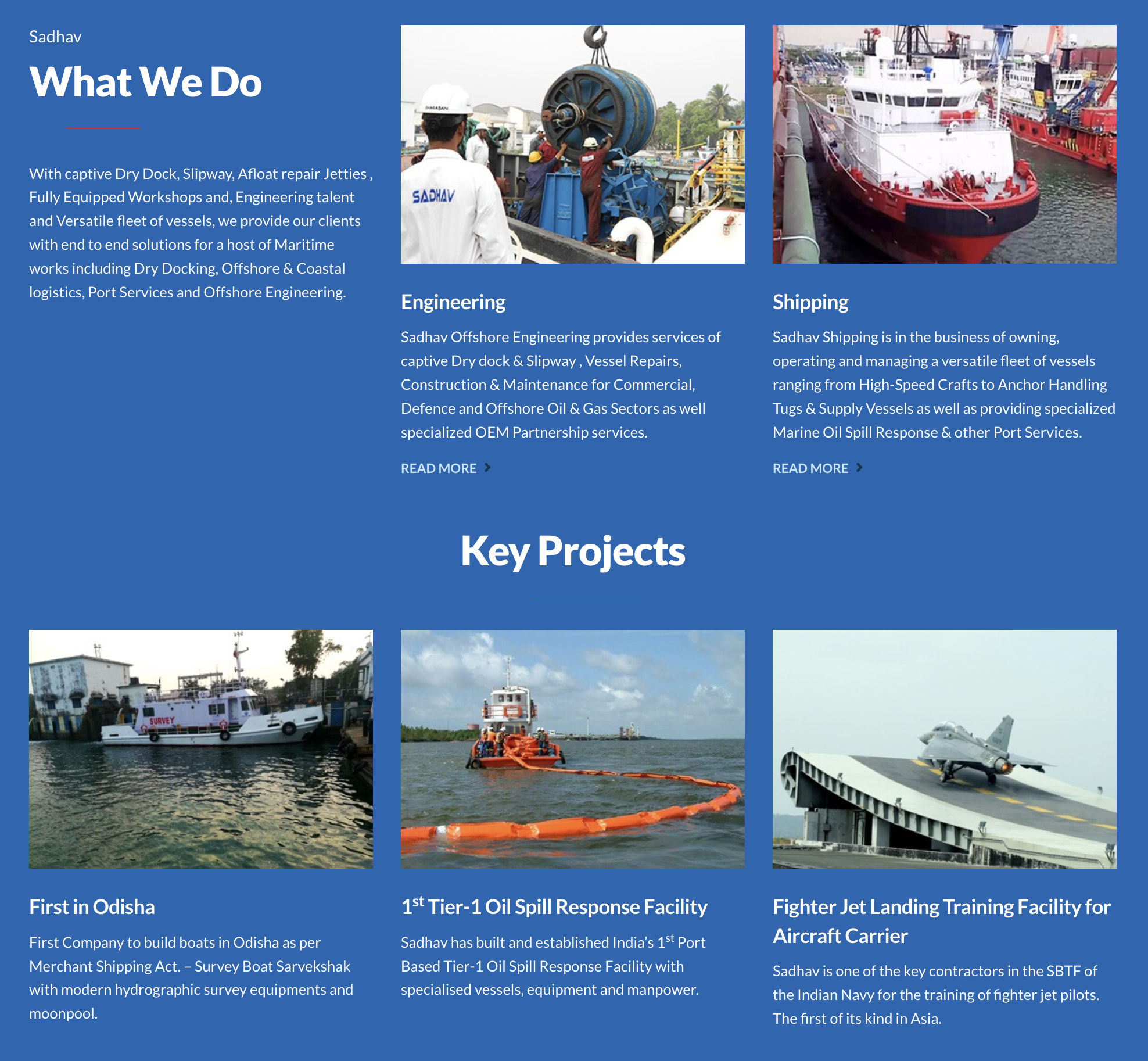
The company’s core operations are structured around owning and operating high-specification maritime assets, including tanker barges, bulk cargo barges, security boats, and anchor handling tug vessels. Over the years, the business has successfully moved from basic shipping logistics to higher-yield technical operations, such as port-based Tier-1 Oil Spill Response (OSR) solutions and dedicated security patrolling.
From an asset-ownership standpoint, Sadhav operates a combination model. Out of its aggregate 20-vessel fleet, it retains direct ownership of 17 assets, while the remaining 3 are managed on behalf of third-party clients and port authorities. The average fleet age is maintained within a 10-to-12-year window. In maritime logistics, a younger fleet profile serves as a structural entry barrier, enabling the operator to command premium charter rates from private ports, clear rigorous compliance audits for offshore energy exploration, and keep annual dry-docking and maintenance outlays low.
The corporate leadership consists of an institutional core: Capt. Kamal Kant Choudhury serves as Chairman and CEO, supported by Managing Director Abhas Ch. Choudhury, and Executive Directors Vedant K. Choudhury (Operations) and Sanijivan Choudhury (Finance).
3. Business Model – WTF Do They Even Do?
To explain it simply: Sadhav Shipping acts as the specialized maritime workforce for India’s massive ports and offshore energy installations. They do not run container ships moving generic consumer goods across oceans. Instead, they operate the heavy-duty utility vehicles of the sea.
The business model functions across three clear silos:
Offshore Supply Vessels (OSV) — 63% of FY25 Revenue
This is the primary revenue driver. The company deploys specialized vessels equipped with Dynamic Positioning (DP) systems to support upstream oil and gas exploration and production (E&P). These vessels transfer heavy machinery, fuel, fresh water, and engineering crews out to deep-water offshore platforms and rigs.
Port Services — 25% of FY25 Revenue
Ports are highly congested, complex zones. Sadhav provides pilot boats, high-bollard-pull tugs, and harbor craft to safely guide large international cargo vessels into berths. They have secured multi-year asset deployment contracts with premier institutions like the Mumbai Port Authority, Paradip Port Authority, and the Jawaharlal Nehru Port Authority (JNPA).
Oil Spill Response (OSR) — 12% of FY25 Revenue
This serves as a high-margin regulatory barrier business. Maritime regulations require ports and oil facilities to maintain rapid-response defensive setups to contain environmental accidents. Sadhav sets up dedicated port-based Tier-1 oil spill containment booms and recovery infrastructure, acting as a critical compliance partner.
[Offshore Energy E&P / Port Expansion] → [High-Spec Asset Fleet via Sadhav] → [Long-Term Fixed Charter Revenues]
To break past standard charter growth caps, the management has formed a structural Joint Venture with United Petro Group (UPG). This venture aims to establish an integrated maritime facility focusing on offshore supply bases, localized shipbuilding, and annual ship repair capabilities for 20 to 25 vessels. Furthermore, the company is attempting to pivot into the National Green Tug Transition Program (GTTP), targeting structural positioning in electric harbor crafts over a 15-year lease horizon.
But here is the catch: when 49% of your total business comes from ONGC, you aren’t just an independent maritime player; your economic survival is linked entirely to the capital expenditure budgets and bureaucratic payment processing timelines of a single public sector enterprise.
How long can an SME operator sustain highly capital-intensive operations when its primary client holds all the pricing and payment leverage?
4. Financials Overview
The company reports financial performance on a Half-Yearly basis, as confirmed by