Search for Stocks /

Rathi Steel & Power FY26: A ₹716 Crore Steelmaker Where the Courtroom File Runs Longer Than the Order Book

Spotted a factual error — a wrong number, date, or fact? Tell us and we will check the source.

General information and entertainment, not investment advice. The author is not a SEBI-registered adviser or research analyst. No recommendation, no promised returns. Markets carry risk including loss of capital. Figures may not be current. Consult a registered adviser before acting.

1. At a Glance

Rathi Steel & Power closed FY26 with revenue of ₹716.05 crore, up roughly 42% on the ₹503.15 crore it booked in FY25. Net profit came in at ₹12.86 crore against ₹13.95 crore the year before — a company growing its top line by two-fifths while its bottom line quietly slipped. The gap between those two numbers is the whole story of this steelmaker, and it is worth sitting with.

The fourth quarter carried the year. Q4 revenue of ₹244.44 crore rose about 63% year-on-year and 53% sequentially, and quarterly profit of ₹7.45 crore was nearly double the ₹3.80 crore of Q4 FY25. Management attributes the surge to the restart of the idled TMT bar mill, whose rolling volumes grew about 117% for the year.

Sitting alongside the results is a second file: a Rouse Avenue court order dated March 2026 declining to take cognizance of an Enforcement Directorate money-laundering complaint against the company and its promoters, and a scattering of GST and income-tax demands running through the year. The operating margin holds near 4%. The market pays 12.3x earnings against an industry 21.6x.

For a 55-year-old name that once ran a ₹500 crore-plus turnover before most of these troubles began, the question the year leaves open is which file grows faster.

2. Introduction

Incorporated in 1971, Rathi Steel And Power Ltd manufactures steel and steel-related products under the Rathi brand. Its plant sits on roughly 12.5 acres in Ghaziabad, in the NCR region, with a steel melting capacity of about 85,000 TPA and rolling capacity of 200,000 TPA.

The recent corporate history reads as a long convalescence. Per the investor presentation, an integrated steel unit commissioned at Sambalpur, Odisha, in 2008 became non-operative and was closed in 2012 after the state could not allocate the promised iron-ore mines, leaving bank-account NPAs and unsustainable debt at Ghaziabad. The turnaround leaned on asset sales, and on a ₹114.71 crore equity infusion through preferential allotment in February 2024. The company records reaching a zero-debt status by March 2024 — a status the FY26 balance sheet shows has since loosened.

FY26 itself was busy on the announcement wire. The steel melting shop was temporarily closed from October 2025 under a Commission for Air Quality Management order and permitted to resume in November 2025. Pawan Kumar was appointed CFO in November 2025. Mahesh Pareek was appointed Managing Director in May 2025. And in June 2026 the company ran a trial of hot charging of MS billets to make Fe 550/550D TMT rebars.

Does a 42% revenue jump mean much when the profit beneath it went the other way? Hold that thought.

3. Business Model: WTF Do They Even Do?

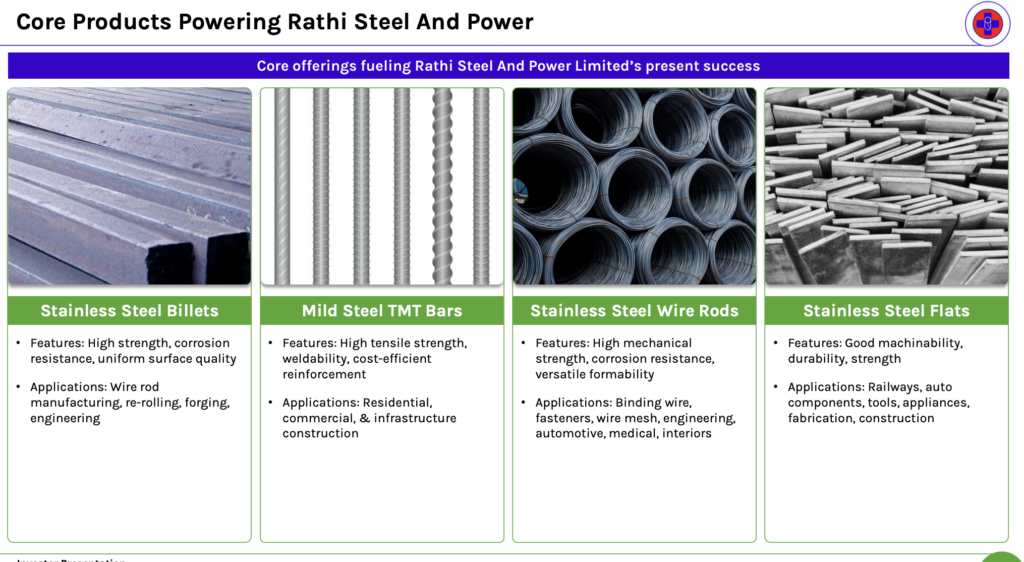
Rathi melts steel and rolls it into long products. The catalogue, per the company’s own materials, runs to stainless steel billets (feedstock for wire rods and forging), stainless steel wire rods (drawn into binding wire, fasteners, mesh, and engineering components downstream), stainless steel flats, and mild steel TMT bars for construction.

The split, per management’s concall commentary, is roughly 60% from the stainless-steel B2B business and around 40% from TMT bars. Stainless products are sold entirely through direct B2B channels; TMT bars go through a dealer network and direct sales, leaning on brand recall in NCR and North India. Management was candid that TMT bars travel poorly — freight economics keep them close to home, so the TMT business is essentially an NCR business.

The technology pitch is direct charging: hot billets moved straight from the caster to the rolling mill without reheating. Management describes the company as India’s only stainless-steel wire rod producer using this route, and in June 2026 extended a trial of it to the TMT line. Per management, the direct-charging route can save roughly ₹3,000–4,000 per tonne, or about 6–7% on the selling price of TMT bars including yield benefits — meaningful only on the tonnage actually routed that way, since rolling capacity exceeds what the melting shop can feed.

The honest description of this model: a legacy re-roller with a genuine efficiency edge on part of its volume, running two divisions each at barely half utilisation, trying to grow into a plant it already owns. There is no exotic product here. There is a lot of empty capacity and a brand that still opens doors.

4. Financials Overview

Figures are standalone, in ₹ crore.

MetricQ4 FY26YoY (Q4 FY25)QoQ (Q3 FY26)
Revenue244.44+63.4% (149.57)+52.8% (160.02)
Operating Profit9.77+23.7% (7.90)+54.1% (6.34)
PAT7.45+96.0% (3.80)+290% (1.91)
EPS (₹)0.860.450.22

Revenue and operating profit both moved up sharply. The profit line moved even harder — Q4 depreciation of ₹0.77 crore sits well below the roughly ₹2.5 crore of each preceding quarter, and that figure sits on the data sheet.
From the concall: management guided to holding a 20–25% revenue growth momentum on average, framed against an FY25 base, and flagged its cost of borrowing at 16% from a single lender, which it is looking to refinance. Raw material runs about 80% of sales, per management — a number that explains why a 4% operating margin is the ceiling this model has been hitting.

5. Market Expectations & Historical Multiples

This section describes how the market is currently pricing the company and how that compares with its own history and peer group. It is descriptive, not predictive.

MetricCurrentHistorical AveragePeer Median
P/E12.3x22.0x
P/B1.06x
EV/EBITDA6.95x
ROE9.25%9.01% (3-yr)
ROCE11.0%13.7%

The market currently pays 12.3x earnings here versus a peer median of 22x and an industry 21.6x. The book multiple sits at 1.06x — the market pays roughly book value for the equity.

What the market appears to be pricing is a business whose profit hasn’t yet followed its revenue. Sales grew about 42%, but reported PAT slipped, margins held at 4%, and ROCE at 11% trails the peer median of 13.7%. The lower multiple tracks the thinner return and the contingent liabilities of ₹58.2 crore disclosed on the record. Against that, the market has in front of it a plant running near half utilisation with management guiding to 80%.

One factual observation on market expectations: the multiple assigned here is roughly half the peer set’s, on a return profile that also sits below it.

6. What’s Cooking

Plenty, and most of it arrived from lawyers rather than customers.

In March 2026, a Rouse Avenue court declined to take cognizance of an Enforcement Directorate money-laundering complaint against the company and its promoters, tied to a Kesala North coal-block allocation; per the order, attached immovable property valued at ₹30,72,380 was directed to be released. Separately, the company disclosed a GST demand of ₹5.73 crore plus equal penalty in December 2025, with recovery stayed by the Allahabad High Court in February 2026; a further Section 74 CGST demand of ₹3.06 crore plus penalty in March 2026; and an Odisha GST demand of ₹2.58 crore dropped on appeal in January 2026. Income-tax assessment orders in January 2026 raised demands of ₹1.28 lakh, ₹14.37 lakh, and ₹23.04 lakh.

On the operating side: the steel melting shop was closed under a CAQM air-quality order in late October 2025 and resumed in November 2025, and the June 2026 hot-charging trial produced Fe 550D grade rebars. The company also received a GreenPro Type-1 Ecolabel certification from CII for its Rathi Powertech 550-grade TMT bars.

7. Balance Sheet

ItemFY24FY25FY26
Total Assets219.50265.42327.19
Net Worth112.67128.13149.89
Borrowings10.4046.6344.80
Other Liabilities96.4390.66132.50
Total Liabilities219.50265.42327.19

Assets equal liabilities in each column.

  • The zero-debt milestone of March 2024 lasted about one balance-sheet date; borrowings went from ₹10.4 crore to ₹46.63 crore in FY25 and sit at ₹44.8 crore now — the company took on working-capital debt to run its restarted mill, at a 16% cost management named.
  • Total assets grew ₹107 crore over two years while net worth grew ₹37 crore; the balance sheet expanded mostly through liabilities, with other liabilities jumping ₹42 crore in FY26 alone.
  • Receivables climbed from ₹24.77 crore to ₹56.54 crore in one year as revenue scaled — a bigger book to finance.

A wisdom line: debt-free is a snapshot, not a state; a plant that wants to run needs working capital, and working capital has a price tag of 16%.

Net position: borrowings of ₹44.8 crore against cash of ₹2.26 crore — net debt, not net cash. Debt-to-equity sits at 0.30.

8. Cash Flow: Sab Number Game Hai

YearOperatingInvestingFinancing
FY2424.15-10.17-8.70
FY25-11.06-26.6032.45
FY26-1.32-22.1524.44

Trace the money and the strain shows. Operating cash flow was positive ₹24.15 crore in FY24, then turned negative across both FY25 and FY26. Investing stayed negative throughout — this is a company spending on its plant. Financing turned positive in FY25 and FY26, funding the gap. In plain terms: the business drew cash in, spent on capex, and covered the shortfall by raising money.

A wisdom line: a P&L can report profit while the cash statement reports withdrawals; receivables and inventory are where the difference goes to live.

9. Ratios: Sexy or Stressy?

RatioValue
ROE9.25%
ROCE11.0%
P/E12.3x
PAT Margin1.8%
D/E0.30
  • ROE at 9.25% — the equity is working, but it is working a short shift.
  • ROCE at 11.0% sits above the cost of the plant’s own equity return but below the 16% it pays its lender — the capital earns less than the borrowing costs.
  • PAT margin of 1.8% on ₹716 crore of sales — with raw material at about 80% of sales per management, the business is a thin skim over a very large input bill.
  • D/E of 0.30 is modest, but it is 0.30 more than the zero the company celebrated two years ago.

10. P&L Breakdown: Show Me the Money

YearRevenueOperating ProfitOther IncomePATEPS (₹)
FY24493.192122.9323.532.77
FY25503.15227.0013.951.62
FY26716.05280.4412.861.49

The Other Income column is the tell. In FY24, other income of ₹22.93 crore was roughly the size of operating profit — the reported PAT of ₹23.53 crore that year leaned heavily on non-operating gains, including an exceptional item of ₹19.84 crore noted in the presentation. By FY26, other income has fallen to ₹0.44 crore, and PAT of ₹12.86 crore is almost entirely the real business.

So the trajectory is better than the headline PAT decline suggests: profit fell from ₹23.53 crore to ₹12.86 crore, but the earlier figure was propped by one-offs and the latter is operating. Operating profit itself rose from ₹21 crore to ₹28 crore across the three years.

EPS guard: EPS fell from ₹2.77 to ₹1.49 alongside falling PAT, so the direction matches. But note the share count also rose — from about 3.13 crore shares historically to roughly 8.64 crore after the FY24 preferential allotment — so per-share figures across the longer history are not comparing the same base.

11. Peer Comparison

CompanyRevenue (Qtr)PAT (Qtr)P/E
APL Apollo Tubes6,26935441.2x
Welspun Corp4,31337124.2x
Shyam Metalics5,24031224.8x
Godawari Power1,61028021.1x
Jindal Saw4,63312416.9x
Gallantt Ispat1,20512333.9x
Rathi Steel2447.4512.3x

Rathi is the smallest house on the street by an order of magnitude — quarterly revenue of ₹244 crore against peers running into the thousands of crores. It also carries the lowest multiple in the set at 12.3x, against a peer median of 22x. The gap is a fact: the market assigns the lowest multiple here to the smallest business, whose ROCE of 11% also trails the peer median of 13.7%.

12. Miscellaneous: Shareholding & Promoters

Holder%
Promoters41.30
Institutions (FII + DII)5.19
Government (ED Raipur)3.59
Public49.92

Promoter holding has fallen over three years from 51.47% to 41.30% — a decline the machine-generated notes flag at about -10.2%. An unusual line on the register: the Enforcement Directorate, Raipur, appears holding 3.59%, classified under Government.

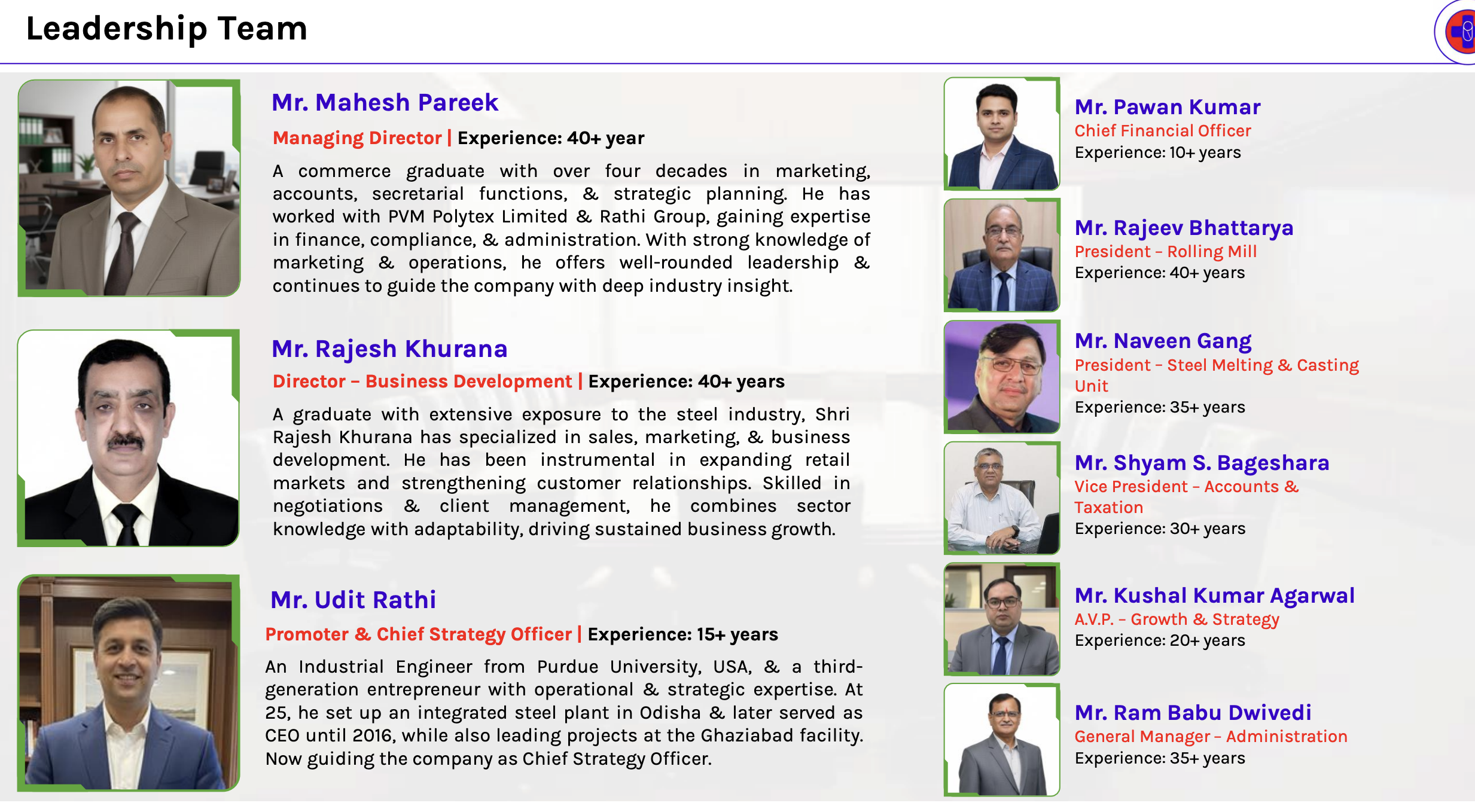
The promoter and management group runs through the Rathi family. Udit Rathi, described as Promoter and Chief Strategy Officer, is a Purdue-trained industrial engineer who set up the Odisha plant and served as its CEO until 2016. On conduct, the public record is not silent: the coal-block matter that produced the ED case also produced a 2016 conviction of the promoters under Sections 120B/420 IPC, with an appeal pending before the Delhi High Court, per the March 2026 court order.

13. Corporate Governance: Angels or Devils?

The audit is clean on its face — M. Lal & Co. issued an unmodified opinion on the FY26 standalone results. The single reported operating segment is “Steel.”

The red flags on the record are legal and fiscal rather than accounting. The promoters stand convicted in the coal-block predicate offence with an appeal pending; the ED money-laundering complaint was declined cognizance in March 2026. Multiple GST demands surfaced through the year — ₹5.73 crore (stayed), ₹3.06 crore, and ₹2.58 crore (dropped on appeal) — alongside contingent liabilities of ₹58.2 crore. The tax rate on the P&L runs at effectively 0%, aided by carried deferred-tax assets of about ₹72.9 crore visible on the balance sheet.

None of this is invented; all of it is disclosed. The governance picture is a company that discloses diligently and litigates continuously.

14. Industry Roast & Macro Context

Indian steel is a volume game where everyone is large and nobody is comfortable. India runs as the world’s second-largest crude steel producer, per the company’s IBEF-sourced slides, with per-capita consumption having crossed 100 kg against a global average nearer 230 kg — the growth-runway argument every steel deck opens with.

The sector’s live problem is imports. Management noted India has temporarily turned net importer in certain categories as competitively priced material enters Asian markets, pressuring the primary producers, whose pain flows downstream to re-rollers. Layer on fuel costs — management said prices had roughly doubled over a few months amid the Iran situation — and a business already skimming 4% margins has little cushion. Green steel is the sector’s new sales pitch, with GreenPro and similar certifications increasingly demanded by institutional buyers, per management. It is a real dynamic; it is also every steelmaker’s slide 12.

15. EduInvesting Verdict

StrengthsWeaknesses
42% revenue growth; TMT mill restart lifting volumes ~117%PAT slipped despite revenue jump; 1.8% margin
Direct-charging efficiency edge; net debt only 0.30x equityBoth divisions near 50% utilisation
OpportunitiesThreats
Guided 20–25% growth; 80% utilisation headroomPromoter conviction under appeal; ED, GST, tax overhang
Green steel / Fe 550D premium demand₹58.2 Cr contingent liabilities; 16% borrowing cost; import pressure

Rathi Steel spent FY26 doing two things at once: restarting a shuttered mill and clearing a courtroom docket. The revenue line says the first is working; the profit line says the payoff hasn’t landed yet; the annexures say the second is far from over.

A ₹716 crore business the market prices at half its peers’ multiple, with a plant half full and a legal file more than half a century in the making — the numbers are climbing while the record it carries has yet to be closed.

This entry touches on legal proceedings that are matters of public record and remain under appeal; it records what has been disclosed, and settles nothing.

Leave a Reply