Ramkrishna Forgings Ltd Q4 FY26: Massive ₹3,761 Cr Asset Base Meets Inventory Ghost-Busting and a Railway Revolution
1. At a Glance
If you are looking for a quiet, predictable auto-component story, you’ve come to the wrong neighborhood. Ramkrishna Forgings Ltd (RKFL) is currently a high-speed chase involving forensic inventory audits, massive capital expansion, and a pivot toward the Indian Railways that would make a station master dizzy. This is the second-largest forging player in India, a company that doesn’t just make “parts”—it builds the metallic backbone of commercial vehicles, wagons, and increasingly, the high-tech Vande Bharat train sets.
The numbers are loud. We are looking at a company with a Market Cap of ₹10,869 Cr, sitting on a gross block of fixed assets worth ₹3,761 Cr. But size isn’t everything when you’ve had to restate your books because someone forgot to count the inventory correctly. In a move that reads like a corporate thriller, the company recently “restated” its financials to account for a significant inventory overstatement—leading to a CRISIL rating watch that was only recently resolved.
Yet, while the auditors were busy with their magnifying glasses, the promoters were busy with their chequebooks. They’ve infused ₹204.75 Cr via convertible warrants to “compensate” for the inventory mishap. Talk about skin in the game—or perhaps just fixing the skin you lost.
The growth story is now shifting gears. The company is moving away from its heavy dependence on the North American Class 8 truck market—which has been as volatile as a crypto chart—and is betting big on the Indian Railways and Passenger Vehicles (PV). With a new ₹249 Cr horizontal casting line commissioned in March 2026 and an 8,000-ton press line adding 40,000 TPA, RKFL is armed to the teeth for the next cycle.
They aren’t just selling “forgings” anymore; they are selling “fully locked-in assemblies.” This is the transition from being a blacksmith to becoming an architect. With the Rail Wheel JV expected to start commercial production in Q2 FY27, the company is looking to dominate a space that was previously the playground of imports.
But can they manage the debt? With borrowings at ₹2,449 Cr, the balance sheet is heavier than a 20-ton axle. The management claims the “worst is behind,” but in the world of high-leverage manufacturing, the “worst” often has a way of coming back for an encore.
2. Introduction
Ramkrishna Forgings is a Kolkata-headquartered giant that has spent the last four decades perfecting the art of hammering hot metal into high-precision components. From humble beginnings, it has climbed the ladder to become the #2 forging player in India, second only to Bharat Forge.
The company operates a massive manufacturing footprint across Jamshedpur, West Bengal, and the NCR region. It isn’t just about domestic dominance; RKFL is a global predator, exporting to over 22 countries. If you see a heavy truck in North America or Europe, there is a statistically significant chance that its steering knuckle or crankshaft was born in an RKFL furnace.
However, the last couple of years have been a rollercoaster. The company faced a “double whammy”: a slowdown in the US commercial vehicle market and an internal “inventory discrepancy” that required a total restatement of accounts. Most companies would have folded under the pressure of a CRISIL “Watch Negative” status, but RKFL chose to expand its way out of trouble.
They have aggressively acquired distressed assets like JMT Auto (now Ramkrishna Casting Solutions) and ACIL Ltd, integrating them into a massive consolidated entity. This isn’t just a forging company anymore; it is a casting, machining, and assembly powerhouse.
The current narrative is all about “de-risking.” De-risking from the US market, de-risking from the cyclicality of Commercial Vehicles (CV), and moving toward the stability of Railways and the high-growth potential of Electric Vehicles (EV). They are currently supplying almost every major EV CV maker in the country.
As we dive into the Q4 FY26 data, the question remains: Can this massive industrial engine maintain its momentum, or will the weight of its ₹2,449 Cr debt cause it to stall?
3. Business Model – WTF Do They Even Do?
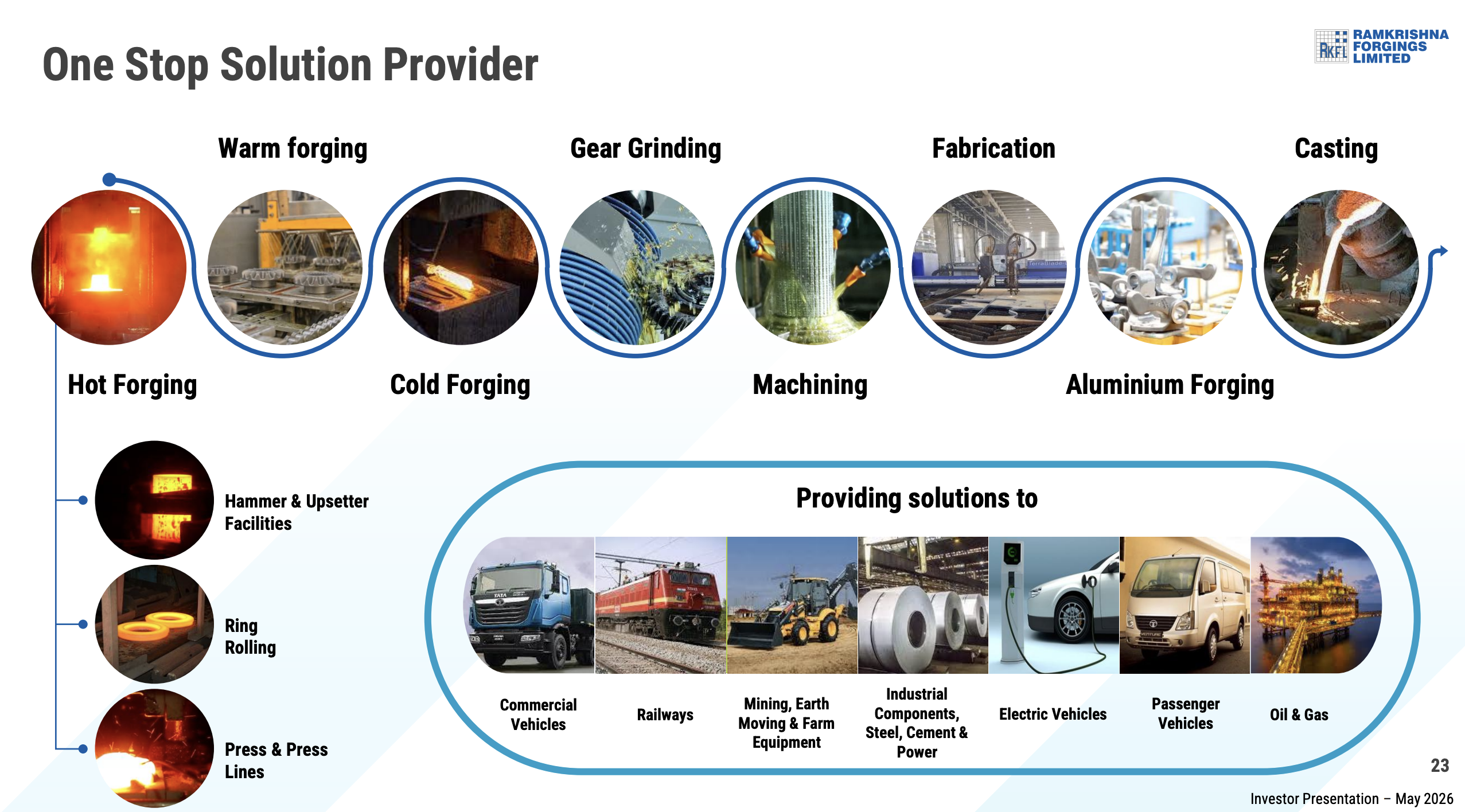
RKFL takes raw steel and subjects it to extreme heat and pressure to create components that simply cannot afford to fail. Think of things like front axle beams, crankshafts, and transmission parts. If these break, the truck stops, the train derails, or the earthmover becomes a very expensive paperweight.
The business is split into two main buckets:
Automotive (79% of revenue historically): Supplying to the big boys like Tata Motors, Volvo, Daimler, and BharatBenz.
Non-Automotive: This is the “cool” part of the portfolio including Oil & Gas, Energy, and the star of the show—Railways.
The “secret sauce” they are currently pitching is Value Addition. Instead of just selling a forged piece of metal for ₹X, they machine it, assemble it, and sell it as a “ready-to-install” unit for ₹3X. Their new bogie assemblies for the Railways are the prime example of this “highly margin accretive” strategy.
They operate on a “Cost Plus” model with most domestic clients, meaning if steel prices go up, they pass the bill to the customer. However, in the export market, it’s a bit more of a street fight. They are currently battling US tariffs and shifting their focus to Europe and Mexico to keep the furnaces burning.
To put it simply: they are the guys who make the stuff that makes the world move. And right now, they are trying to make sure they move faster than their debt collectors.
4. Financials Overview
RKFL’s financials are currently a work in progress, recovering from the “inventory ghost” of 2025. The latest Q4 FY26 results show a significant jump in sales, but the bottom line is still nursing the wounds of exceptional charges and higher interest costs.
Management “Walk the Talk” Check: In previous concalls, management promised a reduction in net debt. As of Q3/Q4, they achieved a ~₹350 Cr reduction, bringing the net debt down toward their ₹2,000 Cr target. They also promised the commissioning of the 8,000T press line by Dec ’24; it finally hit commercial production in March ’26. A bit late, but the metal is finally moving.
Quarterly Performance Comparison (Consolidated)
(Figures in ₹ Crores)
Metric
Q4 FY26 (Latest)
Q4 FY25 (YoY)
Q3 FY26 (QoQ)
Revenue
1,217
947
1,099
EBITDA
203
98
162
PAT
56
12
14
EPS (₹)
3.08
11.04*
0.75
*Note: Q4 FY25 EPS was skewed by tax adjustments and restatements.
Annualised EPS Calculation:
As this is the Q4 (March) result, we use the full-year EPS for valuation.
Full Year FY26 EPS: ₹3.95 (as per latest data).
Witty Commentary:
The revenue growth is impressive—a 28% jump YoY. It seems the “Railway” engine is finally providing some serious torque. However, the PAT (Profit After Tax) remains shy. The company is generating massive EBITDA, but the “Interest + Depreciation” duo is eating the lunch, the dinner, and most of the snacks.
5. Valuation Discussion – Fair Value Range
Let’s get clinical. RKFL is a “heavy” company—heavy assets, heavy debt, and heavy expectations.
Method 1: P/E Multiple
The stock is currently trading at a staggering P/E of 134. This is not “normal” for a forging company. It reflects the market’s belief that the FY26 earnings were “depressed” due to one-time charges (Labour codes, restatements) and that the future “Railway” profits will be massive.
Normalized EPS Estimate: If we take the Q4 PAT of ₹56 Cr and assume stability, we get an annual PAT of ~₹224 Cr.
Implied Forward PE: Based on Market Cap of ₹10,869 Cr, this gives a forward P/E of ~48x. Still premium, but more “sane” than 134.
Method 2: EV/EBITDA
Enterprise Value (EV): Market Cap (₹10,869 Cr) + Debt (₹2,449 Cr) – Cash (~₹37 Cr) = ₹13,281 Cr.
Annualized EBITDA: Q4 EBITDA of ₹203 Cr x 4 = ₹812